Where Cajun Dead et le Walkin' Stick Stands: Film and Soundtrack Progress, Fall 2026
Explore Cajun Dead and the Walkin' Stick's fall 2026 film progress, bilingual storytelling, the Raï soundtrack, and independent Acadian vision in arts

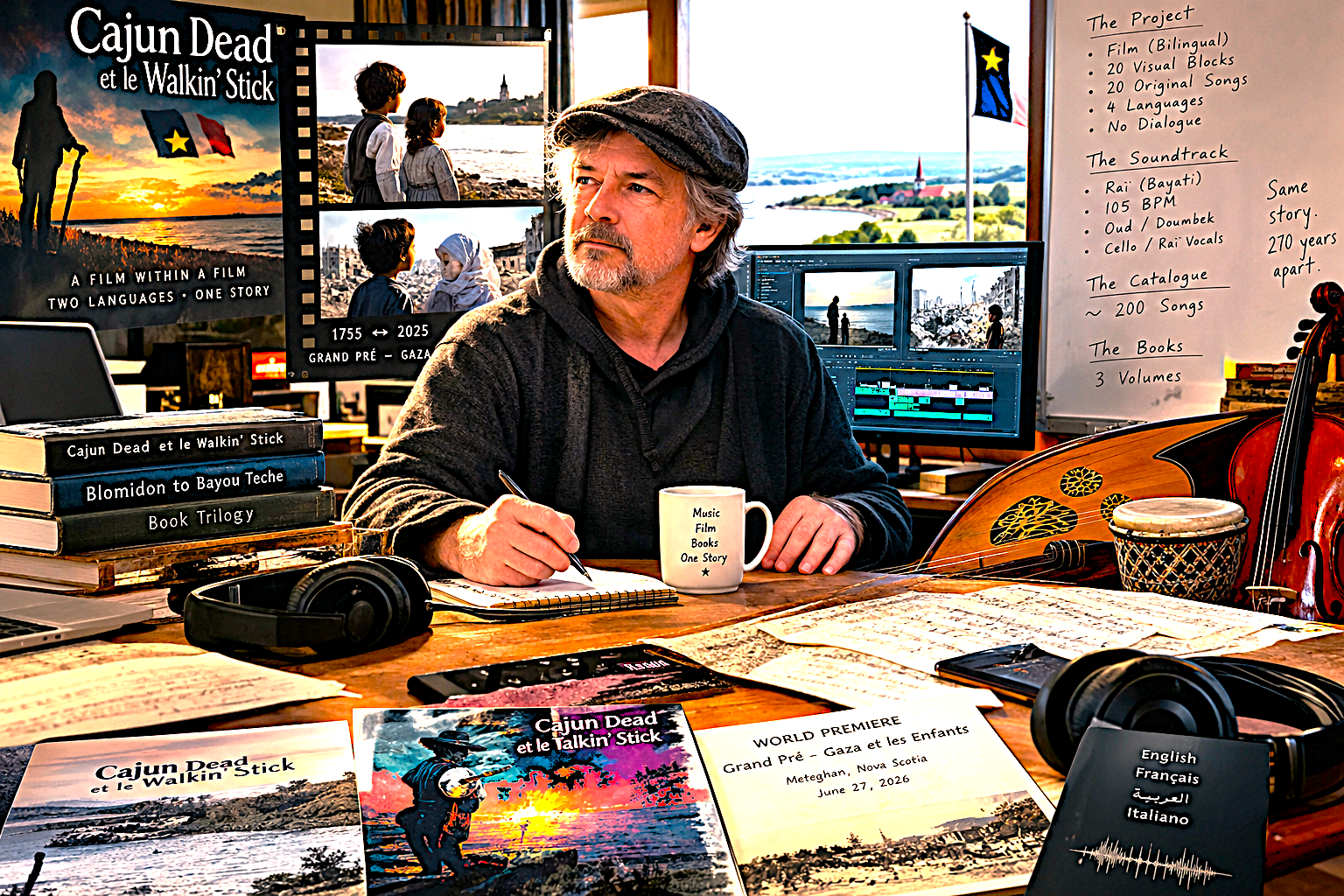
When Cajun Dead et le Walkin' Stick first surfaced as a book trilogy, it was a niche Acadian literary project. By mid-2026, its creator, Nova Scotia-based artist Claude Edwin Theriault, has pushed the project into a full "film within a film"—and the surrounding song catalogue that scores it has grown into one of the more unusual soundtrack builds in independent Canadian filmmaking. Here's where things actually stand, based on the project's own announcements and listings, since there's not yet independent festival or press coverage to check those claims against.
A quick note on sourcing
Almost everything publicly available about this project's progress comes from Theriault himself—through his own blog-style releases (via newstrail.com and moderncontemporaryartworktrends.com) and event listings he's submitted to sites like Maritime Art Info. There's no studio, label, publisher, or outside producer attached, and no mainstream arts outlet appears to have covered it independently yet. That's worth keeping in mind: what follows describes what the project says about itself, not verified third-party reporting.
The film: "film within a film," not a single cut
The project has evolved past a straightforward adaptation of the book trilogy. Theriault now describes Cajun Dead et le Walkin' Stick as structured as a film within a film—two parallel versions of Volume One, Blomidon to Bayou Teche, one in English and one in French, telling the same story from each language's own cultural vantage point rather than one being a dub of the other.
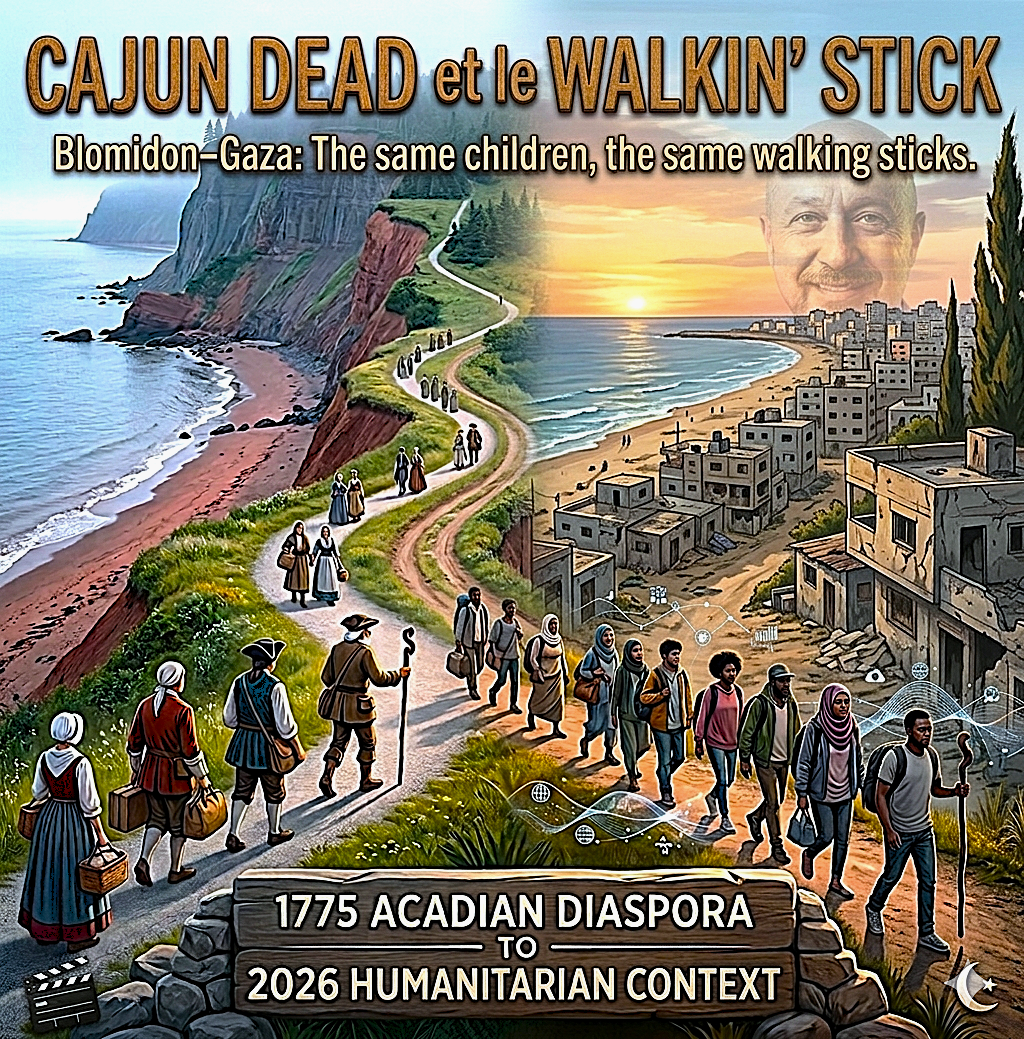
Volume One centres on Grand Pré—Gaza et le Enfants: two five-year-olds in Grand Pré, Nova Scotia, in 1755, during the Acadian Grand Dérangement, paired with two children in Gaza in 2025, all guided across the dual timeline by the immortal figure Cajun Dead. A "world premiere" listing for Volume One appeared on the Maritime Art Info events calendar in late July 2026, tied to Meteghan, Nova Scotia—though this reads as a self-submitted listing rather than confirmation from an established festival. Separately, an April 2026 release described the project pursuing submissions to festivals in London and Paris, again per Theriault's own posts, without confirmation of acceptance.
The film keeps its founding formal conceit: no spoken dialogue anywhere. The entire narrative is sung across four languages—English, French, Algerian Arabic, and Italian—built from twenty visual blocks paired with twenty original songs, and designed explicitly with autistic and Asperger's audiences in mind, on the reasoning that visual symbolism and musical emotion communicate more directly to some neurodivergent viewers than dialogue-driven narrative does.
Production itself is described as a one-person operation: Theriault, working without a distributor or institutional funding, in the same Nova Scotia studio where he also does agentic AI/SEO consulting work—with recent posts framing AI-assisted filmmaking tools as part of how a single independent artist can attempt a feature at this scope.
The soundtrack: from the "Talkin' Stick" song catalogue to a Raï-inflected score
The music side of the project—released under the name Cajun Dead et le Talkin' Stick—has been the more active front over the past year, with a steady stream of individual single releases (distributed to Apple Music and other streaming platforms) feeding a catalogue Theriault now describes as approaching 200 songs. Recent singles pulled from that catalogue span a wide stylistic range: Acadian chanson-inflected songs like "Lànge Piaf et les gamins," alt-country/rockabilly tracks like "Blood on Their Hands," and pointedly satirical entries like "Bitch bin Mississippi Acadie," aimed at what Theriault frames as the gatekeeping culture around institutionally funded Acadian heritage art.
For the film score specifically, the project has narrowed toward a distinct sound: a Raï-based soundtrack, built around the bayati maqam at 105 BPM, scored with oud, doumbek, cello, and a raï tenor vocal line. The stated intent is to use Raï—the Algerian musical tradition born from displacement and colonial-era migration across the Mediterranean, inscribed on UNESCO's Intangible Cultural Heritage list in 2022—as the connective tissue between the film's two timelines. According to the project's own description, songs on the English-language cut move through English, Arabic, and Algerian Arabic before returning to English, while the French-language cut's songs blend Algerian Arabic and Algerian French, mirroring the Acadian community's own history of a suppressed language carrying testimony the dominant culture couldn't fully police.
The book trilogy, still the spine of it all
The three-volume book series—Blomidon to Bayou Teche, being the first, published in paperback in 2024—remains, in Theriault's framing, the literary form the material was always working toward, with the film and song catalogue treated as expansions of the same underlying "complainte" (lament) tradition rather than separate projects bolted together after the fact.
The bigger picture
Whatever independent verification eventually surfaces, the throughline in Theriault's own account is consistent: an unfunded, unsigned, single-creator project trying to hold a nearly 200-song archive, a three-book trilogy, and a bilingual, wordless feature film together around one idea—that the 1755 Acadian expulsion and the 2025 Gaza displacement are, structurally, the same story told 270 years apart. Where the project goes next likely hinges on whether any of those festival submissions or premiere listings convert into actual programmed screenings with outside confirmation—which is the detail most worth watching for going forward.
Sources
- Grand Pré – Gaza et le Enfants: Film de Cajun Dead et le Walkin Stick — Maritime Art Info (event listing)
- Film Within a Film on Humanitarian Refugee Crisis—Newstrail
- Cajun Dead et le Walkin'Stick Film Trilogy Ignites War Refugee Crisis Awakening—Newstrail
- Cajun Dead's Film Within a Film—Newstrail
- Cajun Dead Expands the Book Trilogy to Film Within a Film—Newstrail
- Acadian Film Release June 27, 2026—Grand Pré Gaza et les enfants—Modern Contemporary Artwork Trends
- Cajun Dead Raï Soundtrack: 1755 and Gaza in One Film Score—Modern Contemporary Artwork Trends
- Cajun Dead et le Talkin' Stick—New Single "Lànge Piaf et les gamin"—Newstrail
- Alt-Country Cajun Dead et le Talkin'Stick—"Blood on Their Hands"—Newstrail
- Cajun Dead and Le Walkin's Stick: Blomidon to Bayou Teche—Amazon