Acadian film release June 27-2026- Grand Pré Gaza et les enfants
A sung humanitarian film in 4 languages for neurodivergent children. Two refugee children, 1755 Acadia & 2025 Gaza, 270 years apart. One road.

 Claude Theriault
Griot narratives live on in Cajun culture.
When Two Children, 270 Years Apart, Walk the Same Road: Cajun Dead et le Walking Stick and the Film the World's Refugees Have Been Waiting For
By Claude Edwin Theriault | Nova Scotia, Canada
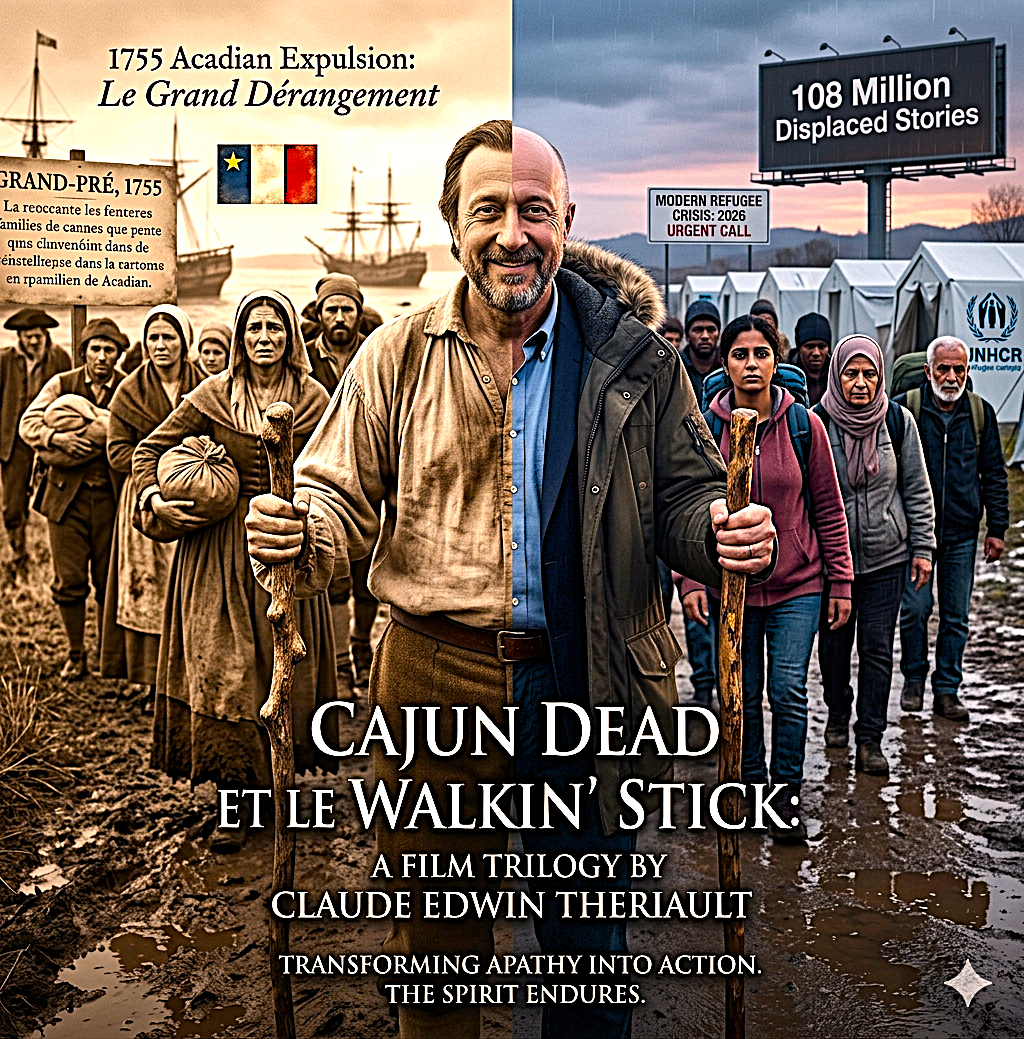
There is a door. On one side of it, a five-year-old Acadian girl stands in Grand Pré, Nova Scotia, in 1755, watching her world burn. On the other side, a five-year-old Palestinian girl stands on Salah Al-Din Road in Gaza in 2025, separated from her mother in a crowd surge. The door between them is 270 years thick. But the road they walk is the same. And the man who comes for them—the immortal humanitarian figure known as Cajun Dead, walking stick in hand, a carved mark for every child he has carried to safety—has been walking it since 1692.
This is the premise of Cajun Dead et le Walking Stick—Volume One: Blomidon to Bayou Teche, the debut feature film by Nova Scotia French-Acadian contemporary artist and creative director Claude Edwin Thériault. It is a humanitarian film unlike anything currently in the Canadian independent cinema landscape—and it arrives at a moment when the world's indifference to its 120 million displaced people has never been more visible or costly.
Inspired by the film within a film, like the Quebecois film Icendie and Cafe des Flores, format of parallel lives
A Film in Four Languages, Sung Not Spoken, Built for Neurodivergent Children
Cajun Dead and the Walking Stick run for one hour and fifteen minutes across twenty visual blocks—and contain no spoken dialogue. Every scene, every emotional beat, every act of displacement and mercy is carried entirely by the human voice, sung in four languages: English, French, Algerian Darija Arabic, and Italian. The twenty songs that form the film's complete soundtrack are drawn from the parallel Cajun Dead et le Talkin' Stick album catalogue—the same mythological universe. The same three-note chanson threads through both timelines like a pulse that cannot be extinguished.
"I built this film for the neurodivergent child who reads images and music with total fluency but finds spoken narrative overwhelming," says Theriault. "That child deserves stories told in their language. I am that child."
The film was designed specifically for autistic and Asperger's audiences—viewers who navigate the world through visual symbolism, recurring motifs, and emotional sound rather than conventional dialogue-driven narratives. Its recurring symbols—the walking stick; the red-tailed falcon Intrepid; the three circular notes of the chanson; and the volcanic rock that appears on two continents—function as a visual grammar that bypasses language entirely and speaks directly to the pattern-reading mind. Theriault is a multidisciplined contemporary artist, AI creative director, and NFT creator based in Nova Scotia, Canada, working across sacred and digital art, agentic AI systems, and long-form visual storytelling.
The Dual Timeline: Grand Pré 1755 and Gaza 2025
The film runs two parallel narratives simultaneously. In 1755, Acadian children Eva Lynn Thériault and Gabby Dev Dugas are expelled from their homes at Grand Pré, separated from their families, and carried across the Atlantic by Cajun Dead—a Vatican-Red Cross operative whose walking stick has been adding marks since the Port Royal earthquake of 1692. In 2025, Palestinian children Leila Nur and Sami Daw are displaced from Gaza, carried west by that same figure, on that same road, 270 years later. Both pairs of children cross the same ocean in opposite directions and arrive in the same falling snow.
The structural parallel is not a metaphor. It is an argument. The 1755 Acadian Grand Dérangement displaced approximately 10,000 people and killed nearly half. The 2025 Gaza crisis has displaced over two million people. As Theriault documented in his press release announcing the film, one artist with no budget built the humanitarian refugee film the globalized, indifferent world needs to see. The administrative vocabulary of both crises—the orders, the paperwork, and the institutions that mean well and cost lives by being too careful—is identical across three centuries. The children's faces are the same. The chanson is the same.

Why This Film Matters Now — 120 Million People the World Has Stopped Watching
According to current research, the forcibly displaced population worldwide has reached historic levels, with millions of refugees established in numerous places across the globe following conflict and displacement events. The UNHCR estimates that there are currently 120 million forcibly displaced people on earth—among them approximately 40 million children. These are not statistics. They are five-year-olds holding another five-year-old's hand in the dark.
"Acadian culture is the culture of the expelled," Theriault says. "That history carries an obligation. You do not get to celebrate the survival of the Acadian people and look away from the Palestinian child on the same road. The 1755 Grand Dérangement and the 2025 Gaza crisis are one continuous humanitarian cycle. This film holds them both at once."
In his Newstrail press release connecting the 1755 Acadian deportation to Gaza 2026, Theriault argued that the Cajun Dead soundtrack connects these two displacement events in a way no other Canadian film has attempted. The film's release comes at a moment when, as Theriault notes with characteristic directness, French Acadian culture is producing films about how to hang laundry on a clothesline the correct Acadian way while 120 million people have no clothesline, no laundry, and no home to hang it outside of.
AI Filmmaking as a Humanitarian Tool
Cajun Dead and The Walking Stick were produced using AI-assisted generation tools—Focal ML, Seedance 1.5 Pro, and Seedream 4.5—and assembled in CapCut desktop. It represents a new model of independent humanitarian filmmaking: one artist, no budget, a feature-length visual argument about the globalization of indifference, produced in the same Nova Scotia studio where Theriault builds agentic AI systems for forward-thinking clients. The film is the first volume of the Cajun Dead Trilogy. Volume Two is in production.
You can view Claude Edwin Theriault's full body of contemporary and sacred artwork at moderncontemporaryartworktrends.com.
Frequently Asked Questions
Q: What is Cajun Dead and the Walking Stick about? It is a feature-length humanitarian film placing the 1755 Acadian Grand Dérangement and the 2025 Gaza refugee crisis side by side in a dual-timeline narrative. Two pairs of five-year-old children—Acadian and Palestinian—are carried across the Atlantic 270 years apart by the same immortal humanitarian figure, Cajun Dead.
Q: Why does the film have no spoken dialogue? The film was designed specifically for neurodivergent and autistic children who read visual symbolism and sing emotion with total fluency. The entire narrative is sung in four languages—English, French, Algerian Arabic, and Italian—across twenty songs drawn from the Cajun Dead et le Talkin' Stick album catalogue.
Q: Who is the film for? For neurodivergent children and adults, for the Acadian and francophone diaspora, for the global humanitarian community, and for anyone who believes that a five-year-old refugee in 1755 and a five-year-old refugee in 2025 deserve the same witness.
Q: How was the film made? Using AI-assisted video generation tools, including Focal ML, Seedance 1.5 Pro, and Seedream 4.5, assembled in CapCut Desktop by Claude Edwin Theriault—one artist, no studio, and no budget—in Nova Scotia, Canada.
Q: Where can I watch it? Cajun Dead et le Walking Stick — Volume One is now streaming on YouTube. Search: Cajun Dead et le Walking Stick, Claude Edwin Theriault.
Citations
- UNHCR Global Trends — Forced Displacement: https://www.unhcr.org/global-trends
- UNICEF — Children in Conflict: https://www.unicef.org/reports/children-war
- Internal Displacement Monitoring Centre: https://www.internal-displacement.org
- Theriault Press Release — Cajun Dead Film Within a Film Is the Humanitarian Refugee Movie the World Has Been Waiting to See: https://www.newstrail.com/cajun-dead-film-within-a-film-new-refugee-movie/
- Theriault Press Release — Grand Pré 1755: A Humanitarian Refugee Film at the Heart of the Global Refugee Crisis: https://www.newstrail.com/humanitarian-refugee-film-global-refugee-crisis/
- Claude Edwin Theriault Contemporary Art: https://www.moderncontemporaryartworktrends.com/