From Grand-Pré to Gaza: Why the Cajun Dead et le Talkin' Stick Soundtrack Is a Case Study for Self-Representing Artists
No label. No studio. One artist built a bilingual film, a 200-song soundtrack, and a media platform connecting Acadian history, raï, and Gaza.


No label greenlit this project. No A&R executive signed off on a bilingual film-within-a-film scored in English, French, Arabic, and Algerian French, connecting the 1755 Acadian deportation to the displacement crisis in Gaza. Claude Edwin Theriault built it himself, under the name Cajun Dead et le Talkin' Stick, and published the reporting on it himself too. That combination—an artist who is also his own publisher, PR wire, and archivist—is the real story here, and it's one worth unpacking for any musician trying to get heard without a gatekeeper's permission.
A Film Within a Film, Built Without a Studio
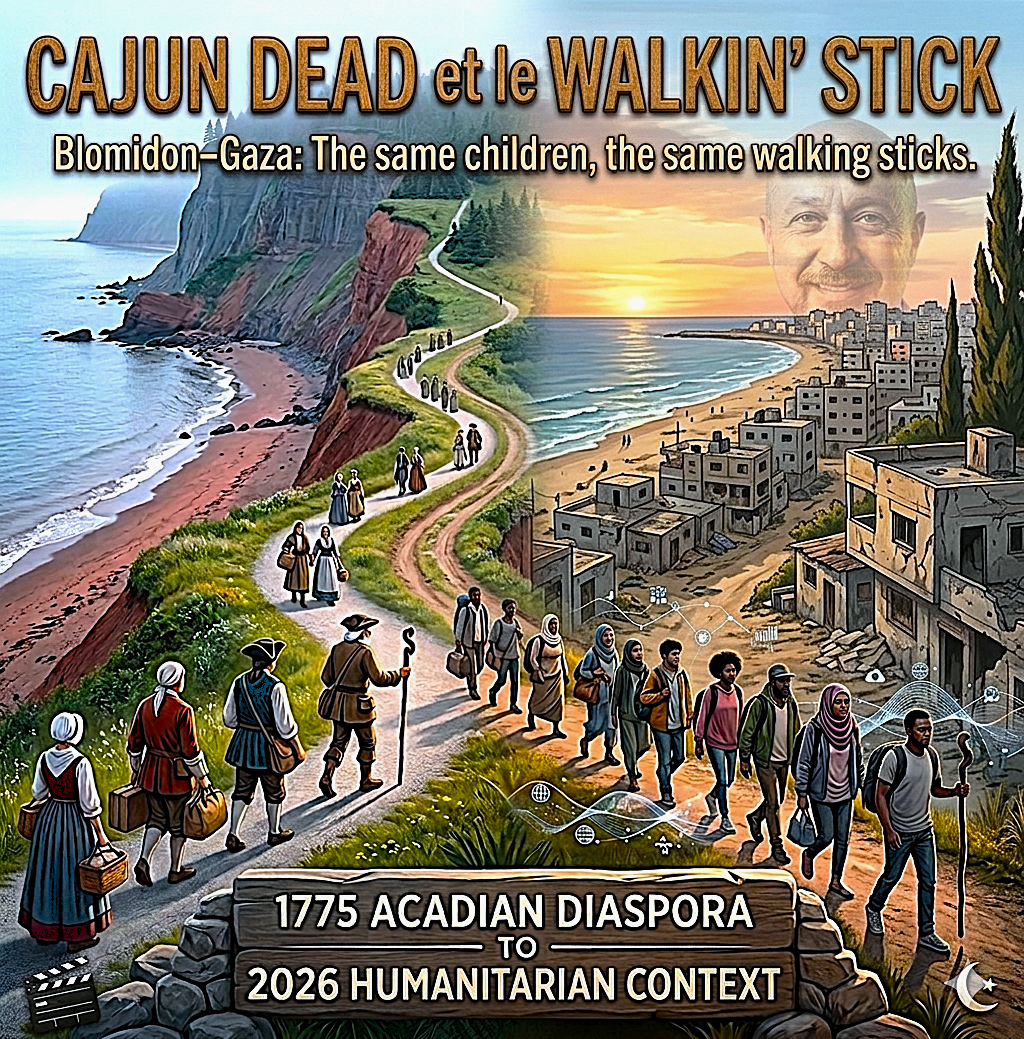
The project's centrepiece is a "film within a film": two parallel versions of the same story, one in English and one in French, each carrying its own soundtrack. The narrative follows two Acadian children expelled from the Bay of Fundy in the 1755 Grand Dérangement alongside two Arab children displaced in Gaza in 2026, a conflict the ICMC's April 2026 displacement report documents as having displaced roughly 1.9 million people. The two timelines never intersect on screen. According to the project's own account, that's deliberate—the film is built to hold both testimonies "without reducing either to an illustration of the other."
Whatever one makes of the comparison itself, the production model is the notable part: nearly 200 songs written over years, AI-assisted composition and video tools standing in for a studio budget, and a screenplay assembled retroactively from an existing catalogue rather than commissioned from scratch. That's not how film scoring has traditionally worked. It's closer to how a self-published novelist assembles a manuscript from years of notebooks.
Why Raï Is the Soundtrack's Backbone
The musical thread running through both versions of the film is raï, the Algerian folk tradition that means "opinion" in Algerian Arabic—historically the sound of communities excluded from official cultural narratives. Raï was inscribed on UNESCO's Representative List of the Intangible Cultural Heritage of Humanity in 2022, recognition that gives the genre a documented, citable pedigree rather than just an aesthetic association.
The project draws a specific musicological line: raï's modal roots trace to al-Andalous music carried out of Granada after the 1492 expulsion, which migrated to Oran on one path and, the project argues, northward through Brittany into the Acadian complainte tradition on another. Whether or not every listener accepts that lineage as tightly as the project presents it, it's a more ambitious and more researched claim than most independent releases bother making. Most DIY artists write a one-paragraph bio. This one wrote a modal-theory argument connecting two continents.
The Self-Representing Artist as Publisher, Not Just Performer
This is the part that matters most for other independent musicians. Theriault didn't just release music—he built the media infrastructure to explain it. His own outlets, including the project's complete song catalogue guide and a companion piece on the Griot and Acadian complainte oral tradition, function as a structured knowledge base: FAQs, schema markup, cross-linked articles, and consistent framing that a search engine—or increasingly, an AI answer engine—can index and cite.
That's a meaningful shift from the traditional model of waiting for a music blog or a radio programmer to decide an artist is worth covering. The original feature on the Grand-Pré-to-Gaza soundtrack reads like a magazine feature, not a press release, and it functions as both an artistic statement and a marketing asset simultaneously. For an artist without a label's publicity department, that dual function isn't a luxury—it's the only way the work gets discovered at all.
What It Means for Independent Musicians in 2026
The wider DIY music industry has been converging on this same conclusion. Guidance from outlets like CD Baby's DIY Musician now frames independent artists as needing to "show up like a small media company" rather than simply releasing tracks and hoping algorithms notice. Cajun Dead and le Talkin' Stick are that advice taken to its logical extreme: a catalogue-length archive, a self-built press network, and a flagship project ambitious enough to generate its own coverage cycle.
The lesson for other self-representing artists isn't necessarily to replicate the scale—200 songs and a bilingual film is a multi-year undertaking. It's the underlying discipline: treat your catalogue as an archive worth documenting, write the explainer content nobody else will write for you, and be willing to make a claim large enough that it's worth someone's time to read about. Whether or not every reader agrees with how directly the project links 1755 and 2026, it's impossible to say the artist played it safe—and in a streaming landscape crowded with algorithm-safe releases, that's increasingly the only thing that gets noticed.
Five FAQs
What is "raï," and why does it anchor this soundtrack? Raï is an Algerian folk tradition, inscribed by UNESCO in 2022, historically associated with communities whose experiences were excluded from official cultural narratives. The project uses it as the sonic thread connecting its two displacement storylines.
What is the "film within a film" structure? It's two parallel versions of the same narrative—one English-language, one French-language—each with its own soundtrack, telling a shared story of displacement from two different linguistic and historical vantage points.
Is this project affiliated with a record label or studio? No. It's independently produced, using AI-assisted composition and video tools, and self-published across the artist's own website network rather than through traditional music-industry channels.
Where does the 1755-to-2026 comparison come from? It's the project's own artistic framing, connecting the Acadian deportation of 1755 to present-day displacement in Gaza, which the ICMC's 2026 report says has displaced roughly 1.9 million people. It's a thematic argument made by the artist, not a claim of historical equivalence.
Why does this matter for other independent artists? It's a case study in what "self-representing" can look like at full scale: building your own catalogue, your own explainer content, and your own press infrastructure instead of waiting for traditional gatekeepers.
Sources:
- ICMC — Understanding Global Displacement in 2026
- UNESCO—Raï, Popular Folk Song of Algeria
- CD Baby DIY Musician—Music Marketing in 2026
- From Grand-Pré to Gaza: The Cajun Dead et le Talkin' Stick Soundtrack
- Cajun Dead et le Talkin' Stick—Complete Song Catalogue Guide
- What Is a Griot? The Acadian Complainte Oral Tradition