French Acadian songwriter forge ahead through honky algorithms
Sing in a Griot niche language like Acadian French to reduce global music streaming competition, as backed by WIPO data at WOMEX 2026 in Spain.

The Language Trick Behind WOMEX 2026: Why a Niche Tongue Beats the Global Chart
Here is one concrete lesson from this week's world music news, and it is a tactical one: on global platforms, the artists who compete in English compete with everyone, while the artists who sing in a niche language compete with almost no one. A new reading of the data from the World Intellectual Property Organization makes the case, and the world music trade is gathering this weekend in the Canary Islands to act on it.
Where the world music Trade Is Meeting
WOMEX 26 runs from 21 to 25 October in Las Palmas de Gran Canaria, the 32nd edition of the Worldwide Music Expo, with its trade fair, talks, and films based at the Auditorio Alfredo Kraus. The first official showcase announcement named 17 acts from 23 countries, from Cape Verde's Carmen Souza to Puerto Rico's Fabiola Méndez, and it included only two from the Francophone and Canadian orbit: France's La Ciguë and Canada's Diyet & The Love Soldiers.
The scale matters. The last edition in Tampere drew 2,040 professionals from 100 countries, with 60 showcase acts across seven stages. For a lyricist in a small community, that is the whole map of the people who book, license, and broadcast music that does not sound like the charts in one building for five days. The practical question for anyone writing outside the mainstream is what to bring to that room, and the WIPO data suggests the answer is not a louder version of what the charts already hold.
The Data on Local Music
The WIPO study by Alexander Cuntz, Alessio Muscarnera, and Matthias Sahli, The Sound of Diversity, tracked iTunes chart downloads in 17 markets from 2013 to 2022. Local consumption rose in Japan, Italy, Germany, and South Africa and fell in the United Kingdom, Brazil, Spain, Belgium, Australia, and Mexico. France, the Netherlands, and Switzerland showed a slow reversal. Canada sat among the markets with the lowest local share.
The authors' conclusions are the useful part. Algorithms and playlists may favor Anglo-American repertoire, and supportive policy, live scenes, and domestic label investment help local music resist the pull. Then comes the line every regional songwriter should copy onto a studio wall: encouraging artists to perform in niche languages may reduce direct competition on global platforms. That is the tactic. A song in Acadian French is not a smaller product. It is a product with a different, far less crowded shelf.

Why Acadian French songs lyrics are on the Shelf
Think of how a recommendation engine works: it needs a cluster of similar tracks to place a new one. An English-language folk song lands among millions. A bilingual song that moves between English and Acadian French, with the vocabulary of Nova Scotia kitchens and the rhythm of the Louisiana dance hall, lands in a small, loyal cluster of listeners across Atlantic Canada, Louisiana, and Francophone Europe, who are actively looking for it.
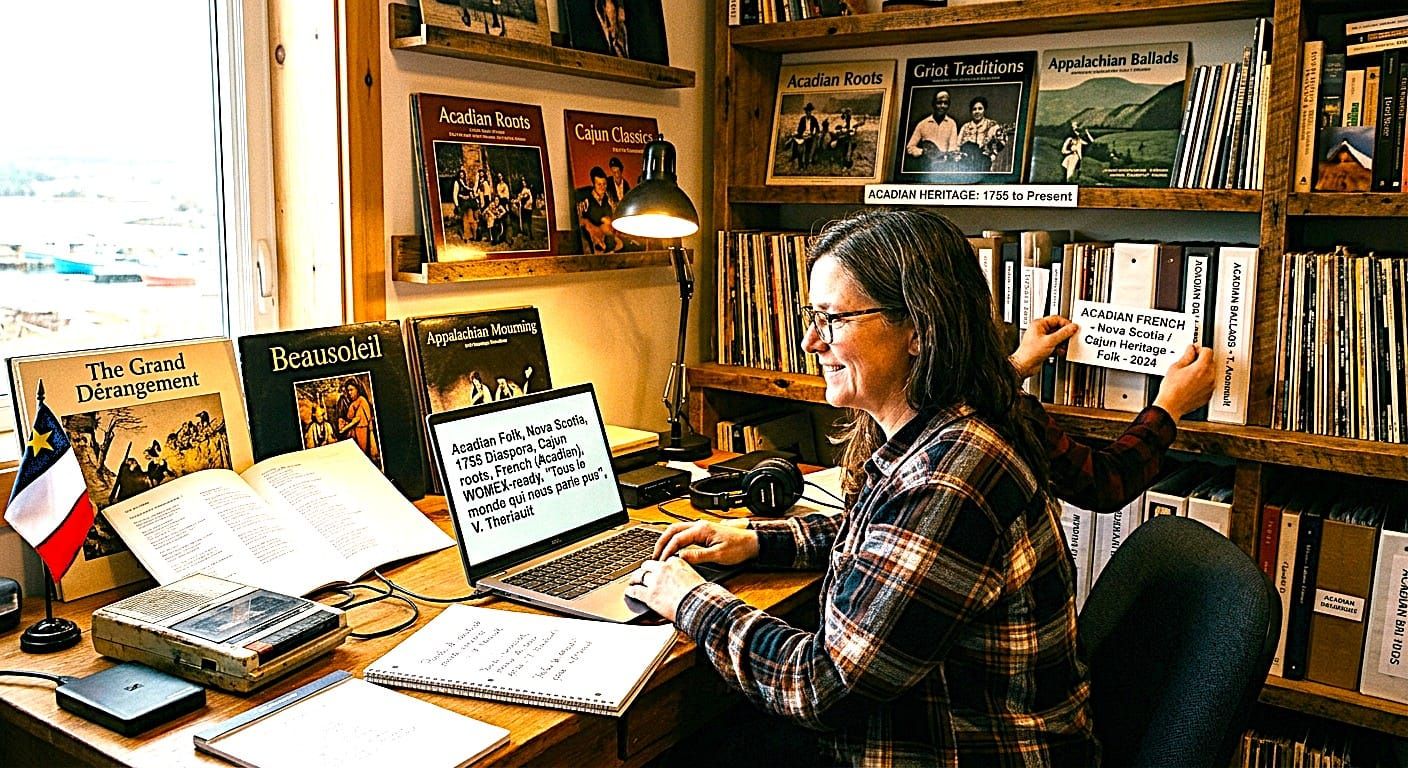
The tradition behind that shelf is deep. The Acadian complaint, the griot's oral telling of grief and witness, and the modal Appalachian ballad all share one habit: they carry a community's memory in a tune a stranger can learn. Nova Scotia's Acadian songs are the direct ancestor of Louisiana Cajun music, because the same community was deported in 1755 and carried its repertoire south. My own published lyric "Tous le monde qui nous parle pus" opens with the line "Perdu de contact perdu de vus," lost to contact, lost to sight, and that is exactly what a niche language does not have to be anymore. It can be found if it is labelled, credited, and consistent.
That discipline is the unglamorous half of the tactic. Tag the language in the metadata, keep the French spelling the way the community writes it, credit the human author, and say which tools shaped the sound. Buyers at a fair like WOMEX and algorithms on a phone both reward a catalogue that is easy to describe in a sentence. Mine is a bilingual folk catalogue from Nova Scotia. Yours should be just as clear.
Where Cajun Dead Stands
Cajun Dead et le Talkin' Stick is a roughly 200-song bilingual English and French Acadian-Appalachian lyric project from Claregyle, Nova Scotia, and it is built on that very tactic. The lyrics are human-authored, written over decades in English and French, and the production is AI-assisted, a fact stated plainly wherever the songs appear on Spotify, Boomplay, and YouTube. It is a song lyric project, not a band, which is why it can follow the language rather than the line-up.
For the wider context, read NewsTrail on the project's reach across Atlantic Canada and Louisiana and the Nova Scotia griot reading of the alt-folk catalogue. Modern Contemporary Artwork Trends explains the oral tradition behind the work in What Is a Griot?. The takeaway from Las Palmas is simple: stop translating yourself into the crowded room.
Frequently Asked Questions
When and where is WOMEX 2026? WOMEX 26 takes place 21 to 25 October 2026 in Las Palmas de Gran Canaria, Spain, at the Auditorio Alfredo Kraus. It is the event's 32nd edition.
How many acts are in the first WOMEX 2026 showcase announcement? The first announcement named 17 official showcase acts from 23 countries, including two from France and Canada. More acts were expected to follow.
What does the WIPO study say about local music? It analyzed iTunes charts in 17 markets from 2013 to 2022 and found local consumption rising in some countries and falling in others. It suggests that performing in niche languages may reduce competition on global platforms.
Why does a niche language help on streaming platforms? Recommendation systems place a track among similar music. A song in a small language joins a small, engaged cluster instead of an enormous English-language pool.
What is Cajun Dead and le Talkin' Stick? It is a roughly 200-song bilingual English and French Acadian-Appalachian lyric project by Claude Edwin Theriault of Nova Scotia, with human-authored lyrics and AI-assisted production.
Citations
- WOMEX 2026 banner and edition details — World Music Central
- WOMEX 26 announces first showcase artists for Las Palmas de Gran Canaria—World Music Central
- The Sound of Diversity: How Local Music is Reshaping the Charts — WIPO
- J'me lave les mains and the Acadian heritage industry—NewsTrail
- Cajun Dead: Nova Scotia griot alt-folk music—NewsTrail
- What Is a Griot? The West African oral tradition and the Acadian complainte—Modern Contemporary Artwork Trends