Theriault and Cajun Dead is the new Borduas Refus Global

Discover how genre labels gatekeep world music in 2026. Claude Edwin Theriault connects Refus global, Acadian heritage and AI-driven strategies for independent artists to gain global visibility.


Theriault and Cajun Dead is the new Borduas Refus Global
Playlist worth the listen

What Refus global teaches world-music artists about gatekeeping in 2026 and the one tactic that routes around it.

On 9 August 1948, sixteen artists launched a manifesto at a Montreal bookshop. Its principal author, the painter Paul-Émile Borduas, had taught at the École du meuble since 1937. The manifesto was called Refuse Global, and it was enough for the authorities to have him removed from that post.1

Borduas did not attack a person. He attacked a system that decided which art was allowed to exist in Duplessis's Quebec, where Church and State moved as one body.

That system has changed clothes. Nobody loses a teaching job over a manifesto in 2026. The work simply gets filed into a category nobody browses, scored by a jury that funds the familiar, and buried by an algorithm that rewards what already won. This week's world-music news makes the mechanism unusually easy to see.

The Seigneurs Never Left: Acadian Culture Exiles Its Artists
Acadian culture survived deportation by closing ranks. Now its gatekeepers shun their own artists. A critique of othering and cultural feudalism.

Songs that actually sing instead of garbal

The Gate Moved From the Pulpit to the Category

The Recording Academy has confirmed that Best Asian Pop Music Performance will debut at the 2027 Grammys. BTS declined to submit their album Arirang, arguing that music should not be divided by region or language. That is a refusal, and it may be the most important move a global act has made this year.

Look north and the same machinery shows its gears. On 13 October, Quebec's French-language commissioner released a study finding that 77.5% of online music listening in Quebec happens in English and only 11.4% in French. Quebec's statistics institute adds the structural detail: Québec artists held 7.1% of all streams in 2025, half of all listening went to tracks released more than five years ago, and new releases claimed just 28%.3

Read those figures together. Visibility is decided by two forces: the box you are filed in and the gravity of the catalogue that already won. A category is a parish boundary. Inside it, you are served to the faithful. Outside it, you do not exist.

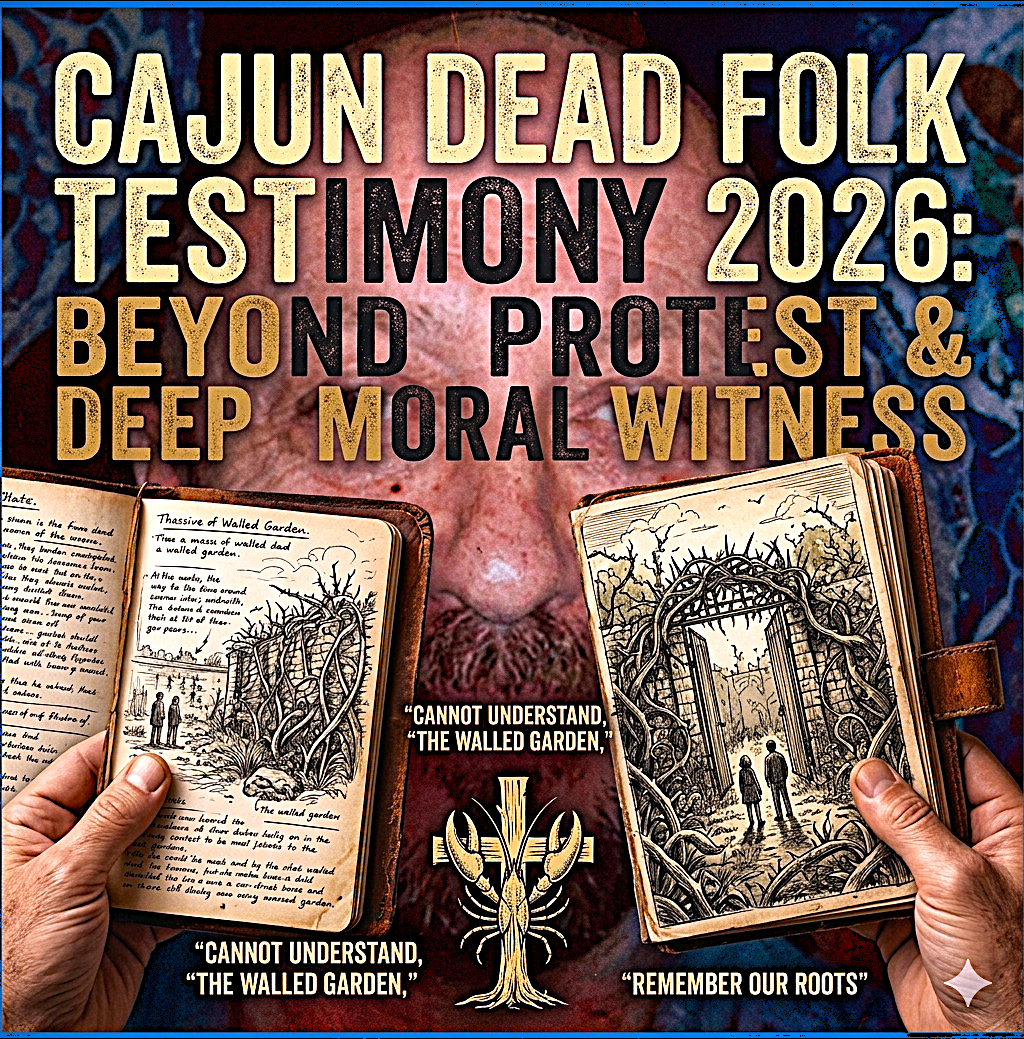
Cajun Dead Folk Testimony 2026: Beyond Protest Walled Garden
Cajun Dead Folk et le Talkin Stick Folk Testimony 2026: Beyond Protest Into Deep Moral Witness Walled Garden honky media Cannot Understand

People are talkin

Acadie Already Ran This Experiment

Acadians know this architecture because they built one. At the first National Convention in Memramcook in 1881, clergy and elite gathered with nationalist thinkers and chose 15 August, the feast of the Assumption, as the national holiday. In 1884 at Missouche, the flag was adopted, carrying the star of Mary, and the clergy, the elite, and the Francophone colleges championed it as the symbol of a nation.2

None of this was sinister. It was a survival project for a deported people. But it set a template: identity designed by an institutional class, then administered downward. The heritage-patrimony industry inherited the template along with the symbols. Funding juries, festival programmers, and regional newsrooms now hold the sanctioning role the clergy once held.

Duplessis fused Church and State. Modern Acadie fuses insular heritage, patrimonial pride, and funding to gatekeepers.

The result is predictable. The folkloric, devout, family-tableau Acadie gets programmed every August. The diasporic, the hybrid, the multilingual, and the AI-produced get filed nowhere. That is why Refus Global still reads as a live document rather than a museum piece, close to one hundred years later in Honky Cajun pride.

Cajun Dead as a Working Refusal

The Cajun Dead et le Talkin' Stick catalogue is what a refusal looks like with a production pipeline: more than 200 songs written across French, English, Italian, and Algerian Arabic, tying the Nova Scotia source tradition to Louisiana and out to the global Francophone folk audience. It was positioned as world music and alt-folk from the start, a placement argued in NewsTrail's piece on how it carries a neglected Francophone tradition into the discovery conversation.4

The film follows the same logic. Cajun Dead and the Walking Stick adapt the 1755 Grand-Pré deportation trilogy into a humanitarian-crisis feature with AI production, outside the NFB and outside heritage channels.5

The parallel to 1948 is about method, not martyrdom. Borduas did not petition the École du meuble for permission. He published, with a mimeograph and a list of signatures. Cajun Dead publishes with a lyric archive, an AI pipeline, and search indexing. Same Cajun Dead Toujours batailleurs for real dans ta face; refusal.

In possession of a better distribution in a tech-savvy new world order.

{ "@context": "https://schema.org", "@graph": [ { "@type": "WebPage", "@id": "REPLACE_WITH_CANONICAL_ARTICLE_URL#webpage", "url": "REPLACE_WITH_CANONICAL_ARTICLE_URL", "name": "Your Genre Tag Is the New Parish", "description": "What Refus global teaches world-music artists about gatekeeping in 2026, and the one tactic that routes around it.", "inLanguage": "en-CA", "datePublished": "2026-10-19", "mainEntity": { "@id": "REPLACE_WITH_CANONICAL_ARTICLE_URL#article" }, "breadcrumb": { "@id": "REPLACE_WITH_CANONICAL_ARTICLE_URL#breadcrumb" }, "hasPart": { "@id": "REPLACE_WITH_CANONICAL_ARTICLE_URL#faq" }, "about": [ { "@type": "Thing", "name": "World music discovery and genre classification" }, { "@type": "Thing", "name": "Acadian cultural heritage" }, { "@type": "Thing", "name": "Refus global manifesto" }, { "@type": "Thing", "name": "Music industry gatekeeping" }, { "@type": "Thing", "name": "AI-assisted independent music production" } ] }, { "@type": "Article", "@id": "REPLACE_WITH_CANONICAL_ARTICLE_URL#article", "url": "REPLACE_WITH_CANONICAL_ARTICLE_URL", "mainEntityOfPage": { "@id": "REPLACE_WITH_CANONICAL_ARTICLE_URL#webpage" }, "headline": "Your Genre Tag Is the New Parish", "alternativeHeadline": "What Refus global teaches world-music artists about gatekeeping in 2026, and the one tactic that routes around it", "description": "An analysis of music-industry gatekeeping, genre classification, Acadian cultural institutions, catalogue discovery and independent multilingual music distribution, connecting the legacy of Refus global to Cajun Dead et le Talkin' Stick.", "datePublished": "2026-10-19", "inLanguage": "en-CA", "articleSection": [ "World Music", "Music Industry", "Acadian Culture", "Independent Music", "Artificial Intelligence" ], "author": { "@id": "REPLACE_WITH_CANONICAL_ARTICLE_URL#author" }, "publisher": { "@type": "Organization", "name": "World Music Dispatch" }, "isAccessibleForFree": true, "keywords": [ "Your Genre Tag Is the New Parish", "Refus global", "world music discovery", "world music gatekeeping", "Acadian music", "Acadian cultural heritage", "Cajun Dead et le Talkin' Stick", "Claude Edwin Theriault", "multilingual folk music", "Francophone folk", "alternative folk music", "music genre classification", "music streaming algorithms", "AI-assisted music production", "independent music marketing", "music SEO", "answer engine optimization", "generative engine optimization", "music catalogue discoverability", "Quebec music industry" ], "about": [ { "@type": "CreativeWork", "name": "Refus global", "creator": { "@type": "Person", "name": "Paul-Émile Borduas" }, "datePublished": "1948-08-09" }, { "@type": "Thing", "name": "Acadian heritage and cultural identity" }, { "@type": "Thing", "name": "World music and alternative folk" }, { "@type": "Thing", "name": "Music discovery algorithms and metadata" } ], "mentions": [ { "@type": "Person", "name": "Paul-Émile Borduas" }, { "@type": "Organization", "name": "The Recording Academy" }, { "@type": "Organization", "name": "Institut de la statistique du Québec" }, { "@type": "MusicGroup", "name": "Cajun Dead et le Talkin' Stick", "genre": [ "World Music", "Alternative Folk", "Francophone Folk" ], "description": "A multilingual music project connecting Acadian traditions with Louisiana influences and global Francophone folk audiences." }, { "@type": "Thing", "name": "BTS" } ], "citation": [ "https://www.thecanadianencyclopedia.ca/en/article/refus-global", "https://www.thecanadianencyclopedia.ca/en/article/the-acadian-flag", "https://statistique.quebec.ca/en/communique/growth-of-music-streaming-slows", "https://www.newstrail.com/?p=538965", "https://www.newstrail.com/new-1755-grand-pre-upheaval-reimagined-theriault/", "https://moderncontemporaryartworktrends.com/" ], "image": { "@type": "ImageObject", "url": "REPLACE_WITH_ABSOLUTE_FEATURED_IMAGE_URL" } }, { "@type": "Person", "@id": "REPLACE_WITH_CANONICAL_ARTICLE_URL#author", "name": "Claude Edwin Theriault", "jobTitle": "Artist, songwriter and independent creative producer", "description": "Nova Scotia-based Acadian artist and songwriter working across multilingual music, visual art, independent film and AI-assisted creative production.", "knowsAbout": [ "Acadian cultural heritage", "World music", "Francophone folk music", "Independent music production", "AI-assisted creative production", "Visual art" ] }, { "@type": "BreadcrumbList", "@id": "REPLACE_WITH_CANONICAL_ARTICLE_URL#breadcrumb", "itemListElement": [ { "@type": "ListItem", "position": 1, "name": "Home", "item": "REPLACE_WITH_WEBSITE_HOMEPAGE_URL" }, { "@type": "ListItem", "position": 2, "name": "World Music Dispatch", "item": "REPLACE_WITH_WORLD_MUSIC_SECTION_URL" }, { "@type": "ListItem", "position": 3, "name": "Your Genre Tag Is the New Parish", "item": "REPLACE_WITH_CANONICAL_ARTICLE_URL" } ] }, { "@type": "FAQPage", "@id": "REPLACE_WITH_CANONICAL_ARTICLE_URL#faq", "url": "REPLACE_WITH_CANONICAL_ARTICLE_URL#faq", "name": "Your Genre Tag Is the New Parish: Frequently Asked Questions", "inLanguage": "en-CA", "mainEntity": [ { "@type": "Question", "name": "What was Refus global?", "acceptedAnswer": { "@type": "Answer", "text": "A 1948 manifesto written mainly by painter Paul-Émile Borduas and signed by members of Montreal's Automatistes. It challenged Quebec's traditional values, cost Borduas his teaching post at the École du meuble, and is widely seen as a forerunner of the Quiet Revolution." } }, { "@type": "Question", "name": "Why compare Refus global to today's Acadian heritage industry?", "acceptedAnswer": { "@type": "Answer", "text": "Because the mechanism repeats. In 1948, Church and State decided which art was permitted. Today, funding juries, festival programmers and regional media decide which Acadie gets funded and seen. The comparison is about how cultural permission is granted, not about any individual." } }, { "@type": "Question", "name": "What does the new Grammy Asian pop category have to do with world music?", "acceptedAnswer": { "@type": "Answer", "text": "It shows how categories segregate audiences. BTS declined to enter, arguing music should not be divided by region or language. Independent world-music artists face the same choice every time they tag a release." } }, { "@type": "Question", "name": "Why does genre tagging matter so much for discovery?", "acceptedAnswer": { "@type": "Answer", "text": "Streaming algorithms and AI answer engines route listeners by category and metadata. A heritage tag sends work to a small, gated audience. A world or alt-folk tag, plus indexable multilingual lyrics, puts it in front of listeners who are actively searching." } }, { "@type": "Question", "name": "Where can I explore the Cajun Dead et le Talkin' Stick catalogue?", "acceptedAnswer": { "@type": "Answer", "text": "The full archive and project updates live at moderncontemporaryartworktrends.com, with coverage of the song catalogue and the film on NewsTrail." } } ] } ] }