The ECMA Is Still Throwing a 1989 Kitchen Party. The Future Is Knocking at the Back Door.

The ECMA runs on a 1989 kitchen-party template while AI-assisted Acadian artists build for 2030. A fact-based critique of silence, gatekeeping and AI policy.

The ECMA Is Still Throwing a 1989 Kitchen Party. The Future Is Knocking at the Back Door.
Atlantic Canadian creatives are tired of the closed doors

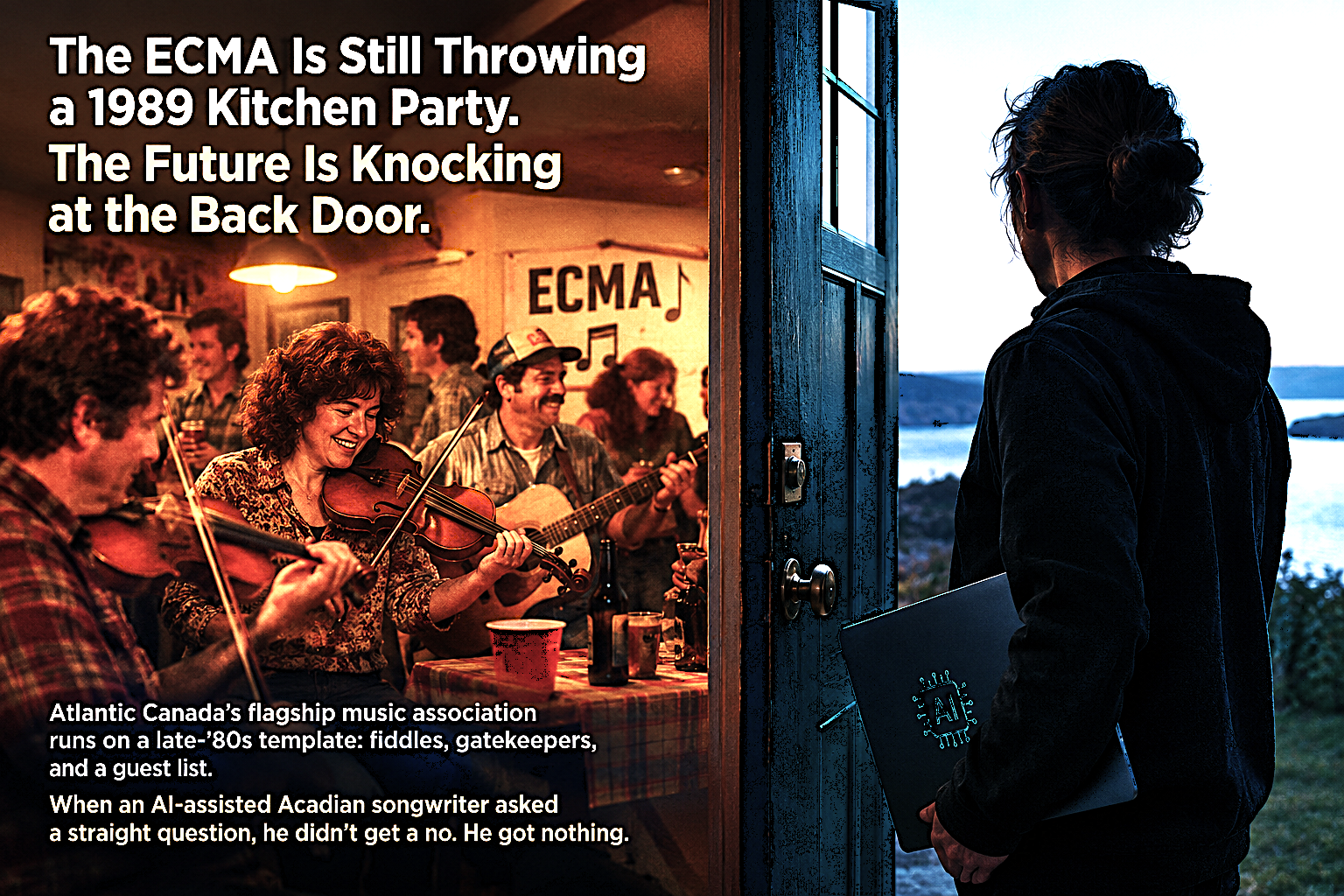
Atlantic Canada’s flagship music association runs on a late-’80s template: fiddles, gatekeepers, and a guest list. When an AI-assisted Acadian songwriter asked a straight question, he didn’t get a no. He got nothing.

ECMA Connects Everyone. Except the Cajun Dead et le Talkin Stick Nova Scotian in its inbox.
A publicly funded music association promises awards, export, career development, and industry connections. An Acadian Griot and songwriter…

The party that never changed the playlist

Every region has its origin myth. The East Coast Music Association is a good one. In 1989 it was a single night in a Halifax bar, run on roughly a thousand dollars. Three and a half decades later, it’s a five-day festival and conference with a budget around $1.5 million. Along the way it helped boost the Rankins, Ashley MacIsaac, Great Big Sea, Natalie MacMaster, Sloan, Joel Plaskett, and Sarah McLachlan, who are now all sitting on a 30-40-year-old song catalogue with nothing new or innovative in sight.

That record deserves respect. The kitchen party is real culture, not kitsch.

But a tradition and a template are different things. A tradition evolves. A template just gets photocopied. Look closely at how the ECMA operates in 2026, and you see the photocopy: the same rooms, the same sound, the same proof—you already belong to the checklist. The organization built itself on that model, and it has stopped asking whether the model still fits.

Who’s paying for the fiddles?

This isn’t a private social club, and that matters for everything that follows.

The ECMA publicly credits a long list of funders:

  • the Atlantic Canada Opportunities Agency
  • Canadian Heritage, through the Canada Music Fund
  • FACTOR and MUSICAL
  • the Province of Nova Scotia and the Cape Breton Regional Municipality
  • In other years, every Atlantic provincial government

In 2019, Ottawa, the Province of PEI, and the City of Charlottetown together put $650,000 into a single ECMA week.

When public money builds the house, the public gets to ask who’s allowed through the front door. And it gets to expect someone will answer.

Playlist du Jour

The artist the brochure describes, and the inbox ignores

On paper, Claude Edwin Theriault is the ECMA’s ideal member:

  • a French Acadian from Nova Scotia
  • a songwriter whose catalogue is built on heritage, multilingual work, and long-form narrative, including the Cajun Dead et le Talkin’ Stick series, the Mary Stuart Trilogy, and the Fragments quartet
  • a neurodivergent, queer-inclusive creator working under a philosophy he calls Animistic Modernism
  • a working AI strategist who writes every word, directs every vision, and uses AI-assisted production to build the music around his lyrics

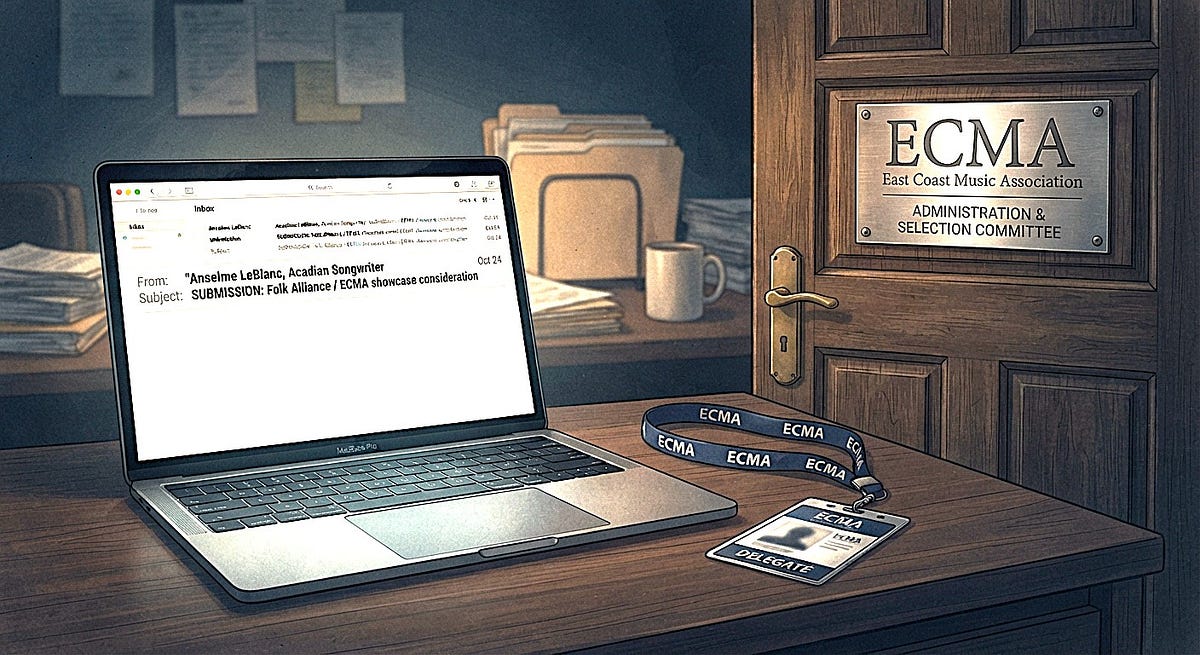
He emailed the association with a simple question: what did it make of his lyric catalogue and the AI-assisted music attached to it?

He got no rejection, no redirect, and no “we don’t review individual work, but here’s our policy.” Just silence.

In 2026 there’s a word for that, and it’s ghosting. In Theriault’s experience, that’s what happens when you show up without the expected script: no fiddle case, no festival résumé, and a workflow nobody on the committee has a category for. You don’t get turned away. You simply never get acknowledged. That’s how a walled garden works. Nobody ever has to say no, because nobody ever has to reply.

A 1980s rulebook for a 2030 artist

The ECMA’s 2026 awards guidelines weigh every submission equally across five criteria:

  1. music and lyrics
  2. production
  3. marketing and presentation
  4. artistic merit
  5. “accomplishments,” measured in radio play, touring, sync placements, and festival bookings

Pay the membership. Pay $20 per category. Show you’ve already cleared other gatekeepers. That criterion doesn’t measure the work. It measures how much prior permission you’ve collected.

Then there’s AI, the biggest change in how music gets made since multitrack recording. As far as the public guidelines show, the ECMA’s entire position is one clause, buried in a paragraph about how many band members must be Atlantic Canadian: “This excludes any sampled or AI-generated music.”

That’s the whole policy. It never defines “AI-generated.” It draws no line between a track where a machine did everything and a track where a human wrote every lyric and used software to arrange the band. When artists raised AI concerns before the 2026 cycle, the association said an industry review found its approach already matched current practice.

Current practice is not what that clause describes. In 2023 the Recording Academy, hardly a radical outfit, set a clear rule. Work with no human authorship can’t win a Grammy. AI-assisted work is eligible when the human contribution is meaningful and more than minimal. That rule is defined, explained, and usable by any songwriter.

So the Grammys give a Nova Scotia lyricist a clearer answer than Nova Scotia’s own music association does.

That’s the gap in one picture. The ECMA is running a late-’80s standard operating procedure. Theriault is running something closer to a 2030 operating system:

  • lyrics as source code
  • AI as the build tool
  • human judgment as the final compiler
  • a catalogue that compounds across projects instead of resetting with each release

Only one of those two systems ships updates.

The category that already fits him

The irony is in the ECMA’s own rulebook. Its Songwriter of the Year award states that the songwriter doesn’t have to be the performer. It honours excellence in the writing of lyrics and melody.

Lyrics are the most unmistakably human part of Theriault’s process, the part nobody can credit to a machine. By the ECMA’s own definitions, a serious lyric catalogue is exactly the kind of work that category exists to recognize.

The door is already built and labelled. Nobody opened it.

Silence as a habit; ghosting is the new politically correct racism

One unanswered email could be an accident. It sits next to a ghosting pattern.

This summer, The Coast reported that some ECMA 2026 showcase artists in Sydney waited about two months for payment while the association waited on ACOA grant money. Dartmouth roots musician Jake Ballard had paid a $90 membership and a $20 application fee. He said he’d keep his distance until the ECMA proved it was more than a publicly funded party. Halifax-based, Jamaican-born reggae artist Jah' Mila was awarded the R&B/Soul Recording of the Year on May 8, 2025, where she got up on stage and said, "We need to be having serious conversations," a polite way of saying WTF.

To be fair, executive director Bob Hallett told The Coast that everyone has since been paid. He noted that nonprofits don’t control when grant money arrives and said the association is taking steps to prevent a repeat. That’s a legitimate answer. But it came after reporters started asking. Communication that only arrives under public pressure isn’t service. It’s damage control. While being one government cut back short of being tired to the wind broke

Their best defense, taken seriously

Here’s the strongest case for the ECMA:

  • It has a small staff.
  • It isn’t an A&R department or a free critique service.
  • It’s buried in emails from artists convinced they’re the next big thing.
  • No one is owed a review.

All of that is fair, and none of it justifies silence. A thirty-second reply would do the job: “We don’t assess individual catalogues. Here’s how submissions work, and here’s our position on AI-assisted music.”

For an organization that sells “Industry Connections” on its homepage, that reply isn’t a favor. It’s the job.

Moncton 2027: open the garden gate

The ECMA brings its festival to Moncton in 2027, pitching Canada’s only officially bilingual city as a celebration of Acadian culture. That’s the right city at the right time, if the association is willing to act on it.

A practical spec:

  1. Publish a real AI policy before the 2027 window. Define the terms. Separate AI-generated work from AI-assisted work. The Recording Academy’s human-authorship test is a ready template.
  2. Adopt a response standard. Every Atlantic Canadian artist who writes in gets a human reply within ten business days, even when the answer is no.
  3. Put the future on the program. Run an ECMA 2027 panel on AI-assisted songwriting, with Atlantic artists who actually use the tools alongside those who critique them.
  4. Answer the Acadian in the inbox. Theriault’s question is still open. Reply to it, or invite him to Moncton and discuss it in public.

Every artist the ECMA is proud of was once the strange new sound in the room. The kitchen party was built for exactly that kind of discovery.

The next one may not walk in carrying a fiddle. He may arrive with a lyric sheet, a laptop, and a question that’s been sitting unanswered in an inbox since September.


Sources: ECMA homepage, Moncton 2027 announcement, Music Awards Guidelines 2025–2026, and Festival History/About pages (ecma.com) · ECMA 2026 funding acknowledgements · Government of Canada/ACOA, “Regional Economic Growth through Music” (2019) · Canadian Music Spotlight, “East Coast Music Awards 2026” · The Coast, “Artists feeling burned by the East Coast Music Association over late payments” (July 31, 2026) · Recording Academy AI eligibility rules, as reported by TIME (June 2023) and Katten Muchin Rosenman LLP

{ "@context": "https://schema.org", "@graph": [ { "@type": "WebPage", "@id": "https://YOUR-DOMAIN.com/ecma-1989-kitchen-party-ai-assisted-artists/#webpage", "url": "https://YOUR-DOMAIN.com/ecma-1989-kitchen-party-ai-assisted-artists/", "name": "The ECMA Is Still Throwing a 1989 Kitchen Party. The Future Is Knocking at the Back Door.", "description": "The ECMA runs on a 1989 kitchen-party template while AI-assisted Acadian artists build for 2030. A fact-based critique of silence, gatekeeping and AI policy.", "inLanguage": "en-CA", "isPartOf": { "@id": "https://YOUR-DOMAIN.com/#website" }, "primaryImageOfPage": { "@id": "https://YOUR-DOMAIN.com/ecma-1989-kitchen-party-ai-assisted-artists/#primaryimage" }, "breadcrumb": { "@id": "https://YOUR-DOMAIN.com/ecma-1989-kitchen-party-ai-assisted-artists/#breadcrumb" }, "speakable": { "@type": "SpeakableSpecification", "cssSelector": ["h1", ".article-subtitle", ".key-takeaways"] } }, { "@type": "WebSite", "@id": "https://YOUR-DOMAIN.com/#website", "url": "https://YOUR-DOMAIN.com/", "name": "MBF-Lifestyle", "publisher": { "@id": "https://YOUR-DOMAIN.com/#organization" }, "inLanguage": "en-CA" }, { "@type": "Organization", "@id": "https://YOUR-DOMAIN.com/#organization", "name": "MBF-Lifestyle", "url": "https://YOUR-DOMAIN.com/", "founder": { "@id": "https://YOUR-DOMAIN.com/#author" }, "areaServed": { "@type": "Place", "name": "Atlantic Canada" }, "logo": { "@type": "ImageObject", "url": "https://YOUR-DOMAIN.com/images/mbf-lifestyle-logo.png" } }, { "@type": "Person", "@id": "https://YOUR-DOMAIN.com/#author", "name": "Claude Edwin Theriault", "url": "https://YOUR-DOMAIN.com/about/", "jobTitle": "AI Consultant, Creative Director and Contemporary Artist", "description": "French Acadian songwriter, AI strategist and contemporary artist from Nova Scotia working under the philosophy of Animistic Modernism.", "homeLocation": { "@type": "Place", "name": "Nova Scotia, Canada", "address": { "@type": "PostalAddress", "addressRegion": "NS", "addressCountry": "CA" } }, "knowsAbout": [ "AI-assisted music production", "Songwriting", "Acadian culture", "Agentic AI systems", "Prompt engineering", "Creative direction", "Branding" ], "knowsLanguage": ["en", "fr"], "worksFor": { "@id": "https://YOUR-DOMAIN.com/#organization" }, "sameAs": [ "https://medium.com/@claudeedwin" ] }, { "@type": ["OpinionNewsArticle", "Article"], "@id": "https://YOUR-DOMAIN.com/ecma-1989-kitchen-party-ai-assisted-artists/#article", "mainEntityOfPage": { "@id": "https://YOUR-DOMAIN.com/ecma-1989-kitchen-party-ai-assisted-artists/#webpage" }, "headline": "The ECMA Is Still Throwing a 1989 Kitchen Party. The Future Is Knocking at the Back Door.", "alternativeHeadline": "Why the East Coast Music Association's late-'80s template leaves AI-assisted Atlantic artists unanswered", "description": "Atlantic Canada's flagship music association runs on a late-'80s template. When an AI-assisted Acadian songwriter asked a straight question, he didn't get a no. He got nothing.", "abstract": "A fact-based critique of the East Coast Music Association's undefined AI policy, accomplishment-weighted awards criteria, and unanswered artist inquiries, contrasted with the Recording Academy's 2023 human-authorship rule, with four recommendations ahead of ECMA 2027 in Moncton.", "articleSection": "Music Industry Opinion", "genre": "Opinion", "inLanguage": "en-CA", "datePublished": "2026-10-16T18:00:00-03:00", "dateModified": "2026-10-16T18:00:00-03:00", "wordCount": 1350, "author": { "@id": "https://YOUR-DOMAIN.com/#author" }, "publisher": { "@id": "https://YOUR-DOMAIN.com/#organization" }, "image": { "@type": "ImageObject", "@id": "https://YOUR-DOMAIN.com/ecma-1989-kitchen-party-ai-assisted-artists/#primaryimage", "url": "https://YOUR-DOMAIN.com/images/ecma-kitchen-party-ai-hero.jpg", "width": 1200, "height": 675, "caption": "A 1989 kitchen-party template meets a 2030 AI-assisted songwriting workflow." }, "keywords": [ "East Coast Music Association", "ECMA", "ECMA 2027 Moncton", "AI-assisted music", "AI music policy", "Acadian music", "Atlantic Canada music industry", "Songwriter of the Year", "music gatekeeping", "Claude Edwin Theriault" ], "about": [ { "@type": "Organization", "name": "East Coast Music Association", "alternateName": "ECMA", "url": "https://ecma.com/", "foundingDate": "1989", "foundingLocation": { "@type": "Place", "name": "Halifax, Nova Scotia" }, "sameAs": ["https://en.wikipedia.org/wiki/East_Coast_Music_Association"] }, { "@type": "Thing", "name": "AI-assisted music" }, { "@type": "Thing", "name": "Music awards eligibility policy" } ], "mentions": [ { "@type": "Organization", "name": "Recording Academy", "sameAs": ["https://en.wikipedia.org/wiki/Recording_Academy"] }, { "@type": "GovernmentOrganization", "name": "Atlantic Canada Opportunities Agency", "alternateName": "ACOA" }, { "@type": "GovernmentOrganization", "name": "Canadian Heritage" }, { "@type": "Organization", "name": "FACTOR" }, { "@type": "Organization", "name": "MUSICACTION" }, { "@type": "Organization", "name": "The Coast" }, { "@type": "Person", "name": "Bob Hallett", "jobTitle": "Executive Director, East Coast Music Association" }, { "@type": "Person", "name": "Jake Ballard" }, { "@type": "Event", "name": "ECMA 2027", "location": { "@type": "Place", "name": "Moncton, New Brunswick" } }, { "@type": "CreativeWorkSeries", "name": "Cajun Dead et le Talkin' Stick" }, { "@type": "CreativeWorkSeries", "name": "Mary Stuart Trilogy" }, { "@type": "CreativeWorkSeries", "name": "Fragments quartet" } ], "spatialCoverage": [ { "@type": "Place", "name": "Atlantic Canada" }, { "@type": "Place", "name": "Nova Scotia", "sameAs": "https://en.wikipedia.org/wiki/Nova_Scotia" }, { "@type": "Place", "name": "Moncton, New Brunswick", "sameAs": "https://en.wikipedia.org/wiki/Moncton" }, { "@type": "Place", "name": "Halifax, Nova Scotia", "sameAs": "https://en.wikipedia.org/wiki/Halifax,_Nova_Scotia" } ], "audience": { "@type": "Audience", "audienceType": "Atlantic Canadian musicians, songwriters, music industry professionals and arts funders" }, "citation": [ { "@type": "WebPage", "name": "ECMA homepage and Moncton 2027 announcement", "url": "https://ecma.com/" }, { "@type": "CreativeWork", "name": "ECMA Music Awards Guidelines 2025–2026" }, { "@type": "CreativeWork", "name": "Government of Canada / ACOA, Regional Economic Growth through Music (2019)" }, { "@type": "CreativeWork", "name": "Canadian Music Spotlight, East Coast Music Awards 2026" }, { "@type": "NewsArticle", "name": "Artists feeling burned by the East Coast Music Association over late payments", "publisher": { "@type": "Organization", "name": "The Coast" }, "datePublished": "2026-07-31" }, { "@type": "NewsArticle", "name": "Recording Academy AI eligibility rules", "publisher": { "@type": "Organization", "name": "TIME" }, "datePublished": "2023-06" } ], "isAccessibleForFree": true }, { "@type": "FAQPage", "@id": "https://YOUR-DOMAIN.com/ecma-1989-kitchen-party-ai-assisted-artists/#faq", "isPartOf": { "@id": "https://YOUR-DOMAIN.com/ecma-1989-kitchen-party-ai-assisted-artists/#webpage" }, "mainEntity": [ { "@type": "Question", "name": "Does the East Coast Music Association accept AI-assisted music?", "acceptedAnswer": { "@type": "Answer", "text": "The ECMA's public 2025–2026 awards guidelines contain a single clause stating that eligibility excludes any sampled or AI-generated music. The guidelines do not define AI-generated music or distinguish it from AI-assisted work in which a human writes the lyrics and melody." } }, { "@type": "Question", "name": "How does the ECMA's AI policy compare with the Grammys?", "acceptedAnswer": { "@type": "Answer", "text": "Since 2023 the Recording Academy has ruled that work with no human authorship cannot win a Grammy, but AI-assisted work is eligible when the human contribution is meaningful and more than minimal. The ECMA has not published an equivalent definition." } }, { "@type": "Question", "name": "How are ECMA award submissions evaluated?", "acceptedAnswer": { "@type": "Answer", "text": "The 2026 guidelines weigh five equal criteria: music and lyrics, production, marketing and presentation, artistic merit, and accomplishments such as radio play, touring, sync placements and festival bookings. Applicants pay a membership fee plus $20 per category." } }, { "@type": "Question", "name": "Who funds the East Coast Music Association?", "acceptedAnswer": { "@type": "Answer", "text": "The ECMA credits funders including the Atlantic Canada Opportunities Agency, Canadian Heritage through the Canada Music Fund, FACTOR, MUSICACTION, the Province of Nova Scotia and the Cape Breton Regional Municipality. In 2019, federal, PEI and Charlottetown governments contributed $650,000 to one ECMA week." } }, { "@type": "Question", "name": "Where is ECMA 2027 being held?", "acceptedAnswer": { "@type": "Answer", "text": "ECMA 2027 takes place in Moncton, New Brunswick, which the association promotes as Canada's only officially bilingual city and a celebration of Acadian culture." } }, { "@type": "Question", "name": "Can a songwriter who does not perform win an ECMA award?", "acceptedAnswer": { "@type": "Answer", "text": "Yes. The ECMA's Songwriter of the Year category states that the songwriter does not need to be the performer and honours excellence in writing lyrics and melody." } } ] }, { "@type": "BreadcrumbList", "@id": "https://YOUR-DOMAIN.com/ecma-1989-kitchen-party-ai-assisted-artists/#breadcrumb", "itemListElement": [ { "@type": "ListItem", "position": 1, "name": "Home", "item": "https://YOUR-DOMAIN.com/" }, { "@type": "ListItem", "position": 2, "name": "Music Industry", "item": "https://YOUR-DOMAIN.com/music-industry/" }, { "@type": "ListItem", "position": 3, "name": "The ECMA Is Still Throwing a 1989 Kitchen Party" } ] } ] }