The Seigneurs Never Left: How Acadian Culture Learned to Exile Its Own Artists
Acadian culture survived deportation by closing ranks. Now its gatekeepers shun their own artists. A critique of othering and cultural feudalism.
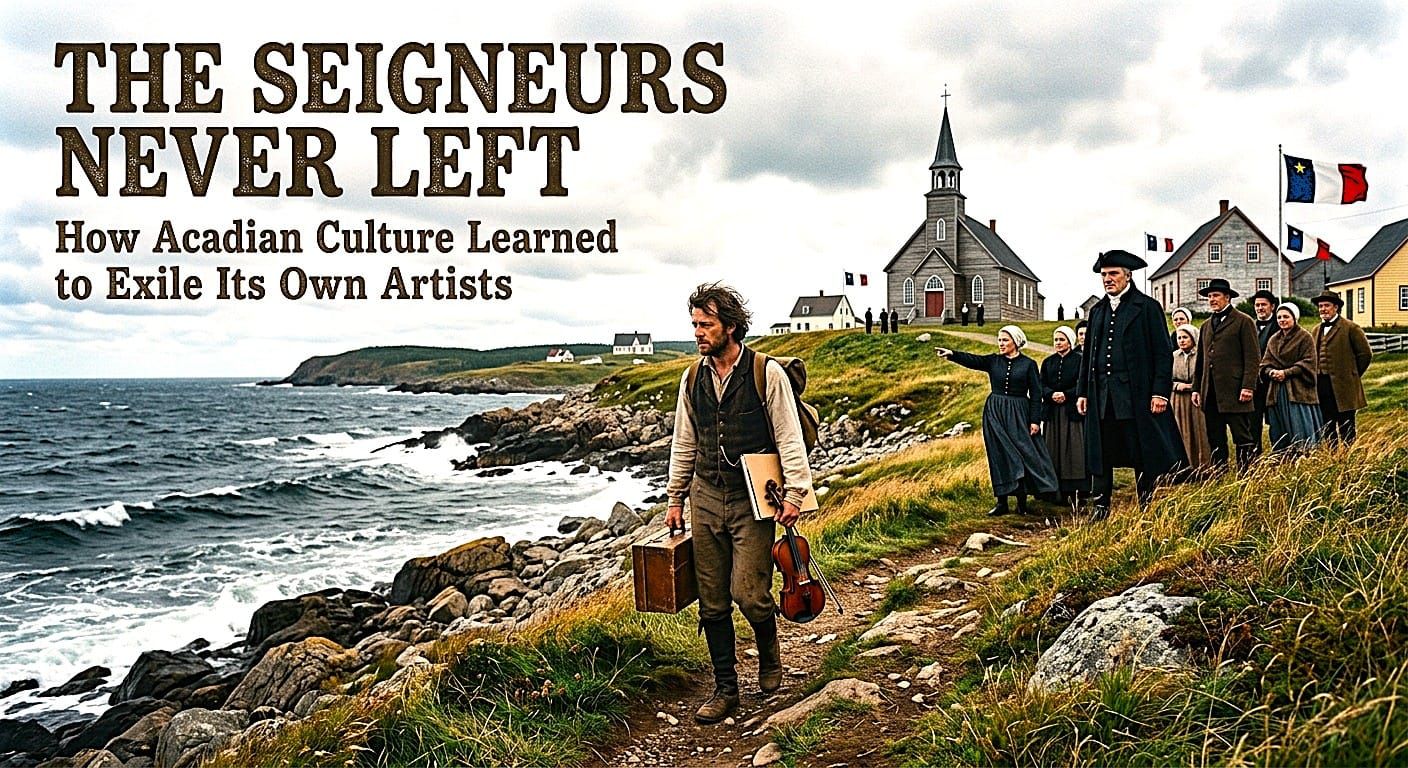
Major truth on the topic of othering, ostracism,erasure, ghosting and the quiet feudalism of a people who survived by closing ranks
A culture that survived deportation should know better than to deport its own.
In 1755 the British scattered the Acadians across the Atlantic world. Families were split, farms burned, and a people was reduced to fragments. What came back from the Grand Dérangement was remarkable: a culture rebuilt from memory, held together by parish, kinship and a fierce instinct to close ranks against a hostile world.
That instinct saved Acadie. Two and a half centuries later, it is quietly strangling it.
The walls built to keep the enemy out are now used to keep the unfamiliar in its place. In a culture organized around survival, the most dangerous figure isn't the outsider at the gate. It's the insider who refuses to look like everyone else.
The Problem: A Culture Run Like a Seigneury
New France ran on the seigneurial system. A small class of landholders controlled the territory, and the habitants worked it under obligation. The system was formally abolished in 1854.
Its logic never was.
Walk through the cultural infrastructure of French Canada and Acadie today: the arts councils, the heritage boards, the festival committees, the francophone funding envelopes, the community development agencies. You find the same pattern. A small, interlocking circle of politically connected public servants decides what counts as legitimate culture. They sit on each other's juries. They program each other's events. They nominate each other for the medals.
Call it what it is: cultural oligarchy. A few dozen people, often fewer, serve as the de facto seigneurs of a living heritage. They decide which Acadian stories get funded, framed, archived and remembered. Everything outside their approval simply doesn't happen in public.
This isn't conspiracy. It's what happens in any small, minority-language society where resources are scarce and the same people hold the keys for decades. Scarcity breeds gatekeeping. Gatekeeping breeds conformity. Conformity eventually breeds a culture that mistakes its own reflection for its heritage.
Agitate: The Artist Who Didn't Fit the Postcard
Claude Edwin Theriault is French Acadian. His work is rooted in that heritage: the deportation, the Cajun diaspora, the sacred and the animistic, the long memory of a scattered people. On paper, he should be exactly what Acadian cultural institutions claim to want.
In practice, he describes something else entirely.
By Theriault's account, ten politically connected figures in the Acadian heritage and public-service world went silent on him. Emails went unanswered. Proposals vanished into the void. Doors that opened readily for safer, more familiar artists stayed shut. There was no formal rejection, no debate, no reason given. He was simply ghosted, treated as though his work, and he himself, didn't exist.
Why? Theriault's answer is blunt. His work doesn't toe the line. It's experimental, multimedia, AI-integrated, queer-inclusive, neurodivergent in its rhythms, and philosophically strange. He calls it Animistic Modernism. It treats Acadian heritage as a living, mutating force rather than a museum exhibit of fiddles, flags and fishing dories.
To the heritage gatekeepers, that's the problem. A culture that has turned its survival into a brand doesn't want its heritage reinterpreted. It wants it reproduced.
Sociology has precise language for what happens next.
Othering
Othering is the process by which a dominant group defines someone as fundamentally different, even alien, and then uses that difference to justify exclusion.
The cruelty of othering inside a minority culture is that the target is often one of its own. Theriault's surname is as Acadian as they come. But once an artist is coded as not our kind of Acadian (too strange, too digital, too queer, too unpredictable), the bloodline stops mattering. He's reclassified from nous to eux. In a small society, that reclassification is a verdict.
Social Ostracism
Ghosting is the modern, deniable form of social ostracism: systematic exclusion from a community for failing to conform to its norms.
It's ostracism engineered for plausible deniability. No one has to say no. No one has to defend a decision. Silence does the work. In a cultural ecosystem where ten people control most of the access points, ten silences add up to erasure. An artist can be removed from the public life of his own heritage without a single documented act of exclusion.
Scapegoating
Scapegoating happens when a community loads its broader anxieties onto an individual and makes him the target.
Acadian culture carries real anxieties: assimilation, language loss, youth leaving for Moncton, Montreal or Toronto, and the slow corrosion of a francophone identity inside an anglophone continent. These fears are legitimate. But when an artist arrives remixing heritage with AI, Web3, queer identity and spiritual experimentation, he becomes a convenient vessel for those fears. He comes to symbolize dilution, the very thing the guardians believe they're defending against.
The irony is brutal. The artist doing the most to make Acadian heritage relevant to a new generation gets cast as the threat to its survival.
Xenophobia Turned Inward
Xenophobia usually means hostility toward foreigners. But xenophobia is really fear of the strange, and a closed culture can find strangers inside its own walls.
The queer artist. The neurodivergent creator whose mind doesn't move in straight lines. The technologist who sees a neural network as a new loom. To a guarded culture, each reads as foreign even when born in the same parish. That inward-facing xenophobia is one of the least discussed pathologies of minority cultures. Having been othered by the empire for centuries, they learn to other in turn.
Ethnocentrism of the Narrow Kind
Finally, ethnocentrism: treating one's own group as the correct standard and judging deviation as inferior or threatening.
In Acadie, the standard isn't simply "Acadian." It's a particular Acadian. Folkloric, Catholic-inflected, festival-friendly, grant-compatible, safely nostalgic. The Tintamarre, yes. An AI-generated Cajun humanitarian film cycle exploring grief and displacement across two timelines? Ce n'est pas vraiment acadien.
That's ethnocentrism operating at a microscopic scale, not a culture versus outsiders, but an orthodoxy versus its own dissidents.
We've Seen This Film Before
French Canada has a precedent, and it should haunt every heritage board in the country.
In 1948, Paul-Émile Borduas and the Automatistes published Refus global, a manifesto rejecting the suffocating clerical and political conformity of Duplessis-era Quebec. The response was swift. Borduas lost his teaching post at the École du meuble. He was pushed to the margins, left for New York, then Paris, and died abroad in 1960.
Today, Refus global is taught as a founding text of modern Quebec, and Borduas is honoured as a visionary. The institutions that exiled him now name things after him.
That's the pattern. French-Canadian culture punishes its innovators in real time and canonizes them posthumously. The gatekeepers of 1948 weren't villains in their own minds. They were defending order, faith and identity. They were also wrong, and history recorded it.
The question for Acadie in 2026 is whether it wants to repeat the cycle on a smaller stage, with emails left on read in place of firings.
The Solution: Break the Seigneury, Not the Culture
Let's be precise, because precision is what separates criticism from contempt. The problem isn't Acadians. It isn't the language, the faith, the music or the memory. The problem is a governance structure that concentrates cultural power in too few hands and rewards conformity over creation.
The fixes are structural:
- Rotate the juries. No one should sit on cultural funding panels for decades. Fixed terms, mandatory turnover and conflict-of-interest disclosure should be the floor.
- Publish the decisions. If public money funds Acadian culture, the public deserves to see who decided, on what criteria, and why. Opacity is the oxygen of oligarchy.
- Create experimental streams. Dedicated funding for hybrid, digital, AI-integrated and interdisciplinary work, judged by people who actually understand it.
- Name othering when you see it. Heritage organizations should recognize that queer, neurodivergent and unconventional Acadians are Acadians. Diversity within a culture is not a dilution of it.
- Build outside the gate. Artists no longer need permission. Distribution is decentralized. Audiences are global. The Cajun diaspora alone spans Louisiana to France to the Maritimes. The gatekeepers control the grants; they no longer control the reach.
That last point is the quiet revolution. The seigneurs can still withhold funding and invitations. What they can't withhold anymore is the audience.
The Living Heritage
A heritage that can only be preserved, and never reinterpreted, isn't a heritage. It's a mausoleum.
The Acadians who survived 1755 weren't conformists. They were improvisers. They rebuilt a culture from scattered pieces, in new lands, under impossible conditions. They adapted. They invented. They carried their identity in songs and stories that changed every time they were sung.
Claude Edwin Theriault is doing exactly that, with tools his ancestors couldn't have imagined. If ten guardians of Acadian heritage can't recognize that, the failure isn't his.
It's theirs. And history, as Borduas could tell them, keeps very good records.