CAJUN DEAD ET LE TALKIN’ STICK PROJECT: THE UNFILTERED REBIRTH OF Acadian Music and CULTURAL SOUND
A raw cultural reboot uniting French Acadian roots and 1925 Appalachia, Cajun Dead revives authenticity in a plastic, AI-shaped music industry.

 Claude Theriault
A musical insurgency emerges from Claregyle, Nova Scotia, as one collective resurrects the “Original Source Code” of 1925 Appalachia—defying oligarchic filters in both the French Acadian culture establishment and the globalized music industry.
The Shockwave Beneath the Floorboards: When Nativistic Revivalism Became a Pulse
In a world saturated with smooth compression, algorithmic playlists, and synthetic sincerity, a raw underground frequency is beginning to hum louder than ever. This impulse—called Nativistic Revivalism—is not nostalgia. It’s a reckoning. It asks a simple, unsettling question: What if progress has taken us too far from ourselves?
Leading this charge is the Cajun Dead et le Talkin’ Stick Song Lyric Project, a hybrid musical collective that blends Acadian, Appalachian, and psychedelic folk DNA into a sound that feels more ritual than performance. Their rise has been quiet but explosive, powered not by marketing budgets or cultural institutions, but by direct audience resonance—proof that authenticity, in the digital era, still cuts through the noise.
“Nativistic Revivalism,” historically coined by anthropologist Ralph Linton in the 1940s, describes communities attempting to restore an earlier, purer cultural form in the face of existential threat. Today’s revivalist artists interpret that as a reclamation of unprocessed art—before algorithms, before filters, before cultural gentrification.
To them, the year 1925 symbolizes the “Big Bang” of recorded music—the last moment when sound still belonged to ordinary people. That was the year RCA engineers recorded banjo players and shape-note singers in small-town churches and mountain homes. Those records captured emotion, not entertainment. That same emotional DNA underpins Cajun Dead, now reborn in the 2020s as both artistic rebellion and cultural therapy.
“We’re not resurrecting ghosts,” says the project’s lead composer. “We’re resurrecting frequencies that still speak. That’s the difference between heritage and survival.”
French Acadian Culture Reimagined: Beyond Folklore and Kitchen Parties
Within French Acadian culture, the Cajun Dead et le Talkin’ Stick movement has stirred both admiration and discomfort. For decades, Acadian identity in the Maritimes and Louisiana has been offered through a “celebratory” lens—fiddle tunes, kitchen parties, and nostalgic festivals. Yet beneath those sanitized narratives lie unspoken histories of loss, displacement, and defiance.
Cajun Dead’s sound refuses to romanticize that past. It resurrects its harder truths: the laments of exiles, the hymns of survival, the whispered grief carried across centuries. Using complaintes—medieval-style narrative songs once sung in exile—the group constructs lyrical frameworks where trauma becomes testimony.
 Claude Theriault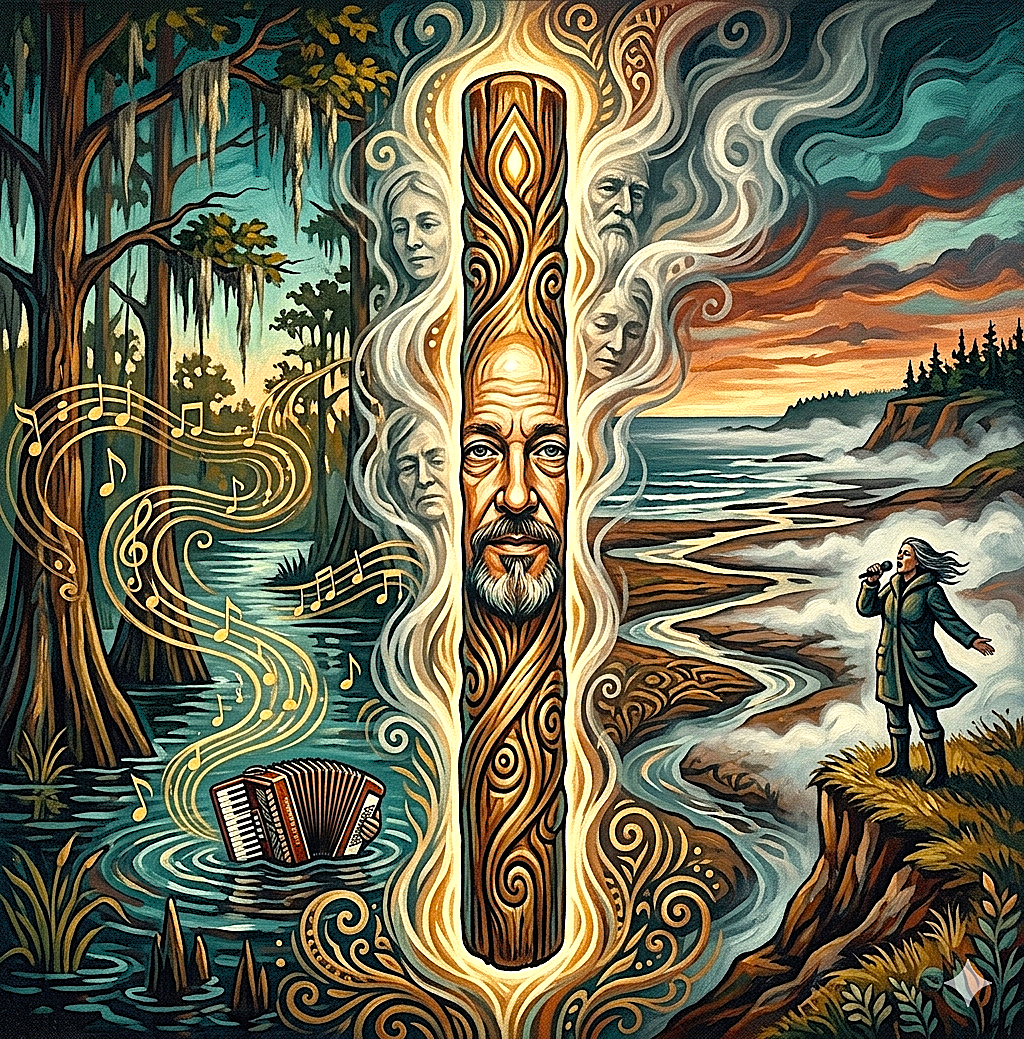
These performances dismantle comforting stereotypes. Gone are the sugarcoated “good time” Cajun themes—replaced instead by thematic courage: addiction, social alienation, generational amnesia, and the existential chill of cultural drift. Each performance, often accompanied by projected texts of the lyrics (the Talkin’ Stick visuals), feels more like a séance than a concert.
Despite resistance from the self-appointed Acadian cultural gatekeepers—entities concerned with preserving tradition in static form—this sonic insurrection is earning an organic, international audience. Younger listeners hear in it an antidote to affectation: a sound that bleeds with life rather than posing for archives.
“Heritage should evolve, not ossify,” says one cultural historian observing the project. “Cajun Dead treats cultural roots as compost, not marble — alive, decaying, feeding new growth.”
 Claude Theriault
This regeneration mirrors what anthropologist Anthony Wallace described as a revitalization movement—an organized attempt by members of a culture to construct a more satisfying framework in turbulent times. The Cajun Dead collective, in essence, is a living example of that mechanism unfolding in real time.
This modern French Acadian culture reboot blends multiple musical lineages: Appalachian fiddle phrasing, African-American rhythmic sensibility, German instrumentation, and Celtic modal scales. The result is a “folk psychedelia” that ties together Louisiana’s humidity and Nova Scotia’s salt air—a continuity of soul disguised as difference.
Disrupting the Modern Music Industry: A Case Study in Cultural Rewilding
The music industry, long dominated by standardized production metrics and social media virality, is being quietly hacked from below. Cajun Dead et le Talkin’ Stick is not merely creating songs; it’s building a new distribution consciousness.
Rather than aligning with record labels, the group operates via a decentralized, crowd-sourced framework: digital barter, creative commons sharing, locally co-produced sessions, and open-mic collaborations documented in real time. In effect, it reimagines music not as a capitalist product but as cultural agriculture.
Three specific practices define their rewilding of the music landscape:
- Reclamation of the Local: They record in acoustic spaces—barns, wooden halls, natural caverns—where sound responds to landscape, not machinery.
- Lyric Transparency: Through the Le Talkin’ Stick Song Lyric Project, textual projection transforms words into communal mirrors, inviting audiences to see meaning, not just hear rhythm.
- Hybrid Improvisation: Borrowing from Grateful Dead improvisational trance structures, they open every performance to interpretive flux, turning repetition into revelation.
As mainstream music edges further into AI synthesis, Cajun Dead moves the opposite way—toward imperfection, toward hand-hewn resonance. In doing so, they expose an ironic truth: authentic innovation often comes from technological restraint.
Their rise parallels what industry analysts call “micro-vernacular content "scaling"—sustained audience growth through highly specific, emotionally resonant niches. Streaming data shows consistent spikes from listeners in Nova Scotia, Louisiana, Brittany, and even Appalachia—communities connected through both ancestry and rhythm.
This trajectory poses a challenge to the commercial norms of cultural representation. Shouldn’t “success” be measured by impact rather than conformity? As Cajun Dead strengthens its digital reach, its mere existence calls out the aesthetic fragility of the modern music industry—an organism built for replication, not revelation.
“They’re not chasing hits,” notes a cultural critic from Moncton. “They’re chasing ghosts — and somehow, the ghosts are going viral.”
Appalachia, Entropy, and the Return to the Original Source Code
Why the fascination with 1925 Appalachia? Because that’s where American music fractured—and flowered. It was the threshold year before radio compression flattened regional tones into sonic conformity. For Cajun Dead, re-entering that acoustic environment is an act of cultural code recovery.
The group’s core philosophy—"Return to the Source Code"—functions like digital archaeology: identifying the moment where authenticity and audience first diverged, then working backward to heal that break.
To understand their mission, consider Appalachia not just as geography but as an archetype: a place where survival and song were synonymous. Its tonal frequencies—the pentatonic wail, the rhythmic drone—emerged from poverty and protest, from mixed ancestry and stubborn endurance. That emotive bandwidth mirrors the condition of today’s global citizen, overwhelmed by artificial noise yet desperate for grounded connection.
In times of relentless acceleration, Cajun Dead’s slow, recursive melodies operate as temporal refusal. They remind listeners of the human pulse beneath the algorithmic grid. Their songs don’t demand streaming attention; they demand spiritual attention.
The video component of the Talkin’ Stick Song Lyric Project visualizes this principle: black-and-white close-ups of hands, worn pages, whispering trees, and found photographs flicker alongside sung poetry. The analogue texture rejects digital smoothness—a visual embodiment of the project’s ethos that imperfection equals truth.
And in their performances from Digby to Halifax, audiences describe a similar experience: deceleration, presence, and communion. One attendee notes, “You stop scrolling and start remembering.”
The movement thus functions as both art and medicine—restoring to culture what corporatization has deleted: intimacy, honesty, and ritual.
Frequently Asked Questions (FAQs)
1. What is Nativistic Revivalism in modern art?
Nativistic Revivalism refers to a cultural movement in which artists deliberately return to their ancestral or foundational sources to counteract perceived social disconnection. It’s not mere preservation but reinterpretation—using old forms to express modern conditions.
2. How does Cajun Dead differ from traditional Cajun music?
Unlike conventional Cajun music that celebrates joy and community festivities, Cajun Dead explores darker emotional tones. It merges traditional complaints (narrative laments) with psychedelic improvisation and philosophical lyrics, creating a bridge between ancient lament and modern reflection.
3. What is the “Le Talkin’ Stick Song Lyric Project”?
Originally conceived as a lyric archive, it has evolved into an audiovisual experience where lyrical text is integrated with performance. The “talking stick” metaphor symbolizes voice reclamation within silenced cultures, turning written memory into audible living form.
4. Why does the project focus on 1925 Appalachia?
Because 1925 marks the last pre-commercialized era of American folk sound. Field recordings from that year captured unfiltered human expression before radio and industry reshaped authenticity. Cajun Dead reintroduces that raw spirit as a corrective to cultural dilution.
5. Is this movement only musical?
No. It’s interdisciplinary. Painters, poets, documentarians, and performance artists are aligning with the project under the broader Nativistic Revivalism umbrella, seeing it as a creative resistance to global homogenization—a rewilding of collective imagination.
Citations and Resources
- Linton, Ralph. Nativistic Movements. American Anthropologist, 1943.
- Wallace, Anthony F.C. Revitalization Movements: Some Theoretical Considerations. American Anthropologist, 1956.
- Spottswood, Richard K. Ethnic Music on Records: The Big Bang of 1925. University of Illinois Press, 1990.
- Filene, Benjamin. Romancing the Folk: Public Memory and American Roots Music. University of North Carolina Press, 2000.
- Savoy, Ann, and Wilson, Floyd. The Historic Cajun Music Revival. Louisiana Heritage Review, 2018.
- Borgerson, Trina. From Fiddle to Feedback: Technological Authenticity in Maritime Folk Culture. Canadian Journal of Music Studies, 2024.
Epilogue: A Sound That Refuses Silence
As spring 2026 unfolds, the Cajun Dead and le Talkin’ Stick phenomenon continue to evolve—not as a nostalgia act, but as an act of renewal. Its community grows without permission, carried by word of mouth and shared feeling. The more cultural oligarchs turn away, the louder the echo becomes.
Perhaps this is how every genuine renaissance begins—not through institutions, but through refusal. Through the stubborn flame of those who sing what cannot be silenced.
“The future of art,” one member reflects, “is the remembering of what it means to be alive.”
And somewhere between the candlelight of 1925 and the LED glare of 2026, their voices rise again—imperfect, unmastered, unwavering.