Sacred Design. Totemic Depth. Fifty Years of Vision. Art You've Always Wanted to Own.
Nova Scotia artist Claude Theriault brings sacred design, esoteric, totemic symbolism & 50 years of esoteric vision to print-on-demand home décor
How Nova Scotia's Claude Theriault built a half-century body of work that is quietly rewiring what it means to bring art into your home — and why a growing global audience is paying fierce attention.
There is a particular kind of fatigue that arrives quietly, uninvited, in rooms full of mass-produced wall art. You notice it in the blush-toned botanicals and the factory-approved geometric abstracts that line the corridors of hotels and the feeds of every home décor influencer in the known digital world. They ask nothing of you because they say nothing to you. They are visual filler — chosen to offend no one and move no one, approved by algorithm and committee before they ever hit a canvas.
 Claude Theriault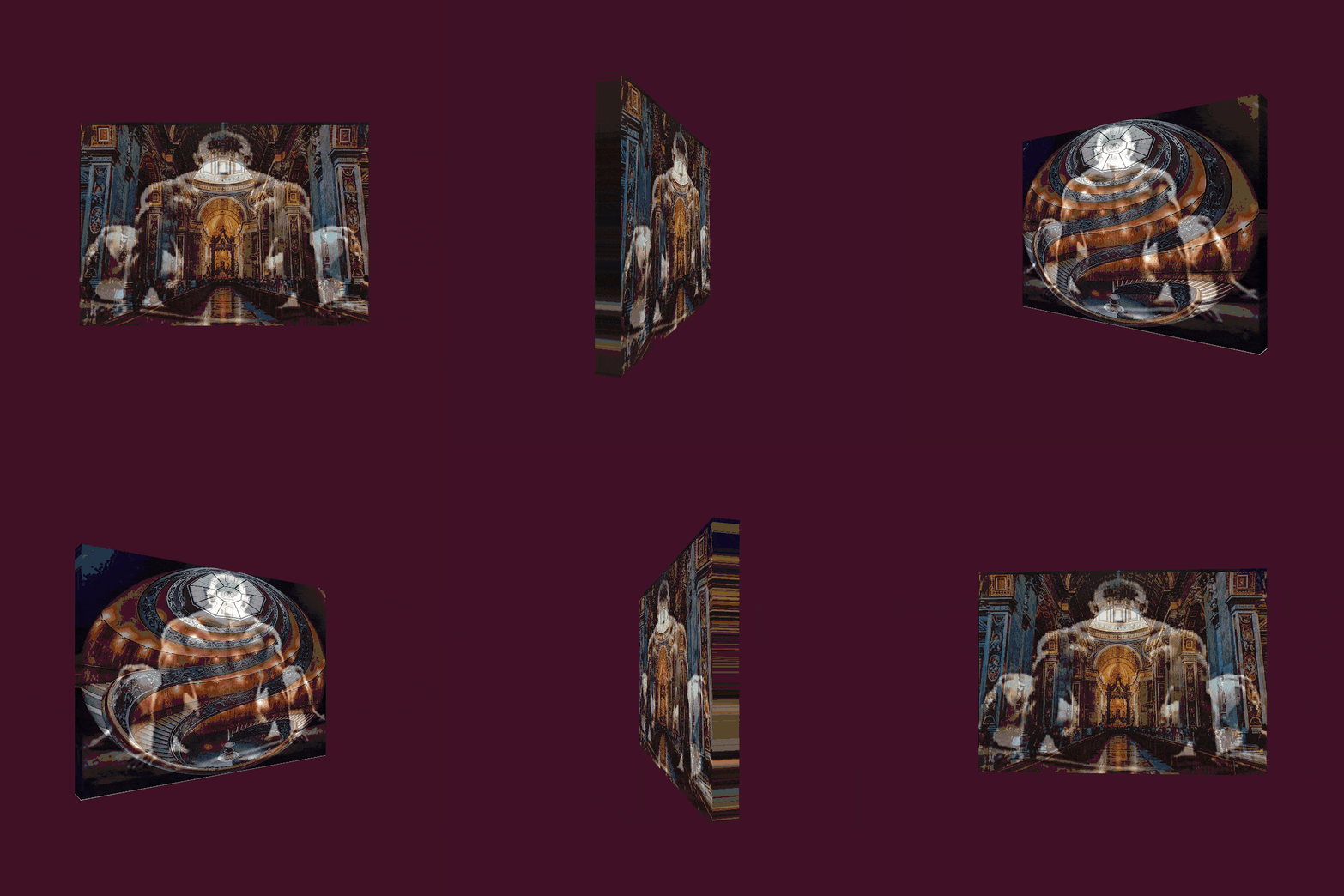
Claude Theriault has spent fifty years making something categorically different. The Nova Scotia-based contemporary Canadian artist has assembled one of the most quietly remarkable print-on-demand collections currently available anywhere, and for a specific kind of person — curious, culturally awake, done with surfaces — discovering it feels less like shopping and more like recognition. Like finding a language you already knew you spoke, but hadn't heard spoken aloud in a very long time.
Canadian artist Claude Theriault weaves sacred geometry and totemic archetypes into 50 years of visionary art that transforms how you live.
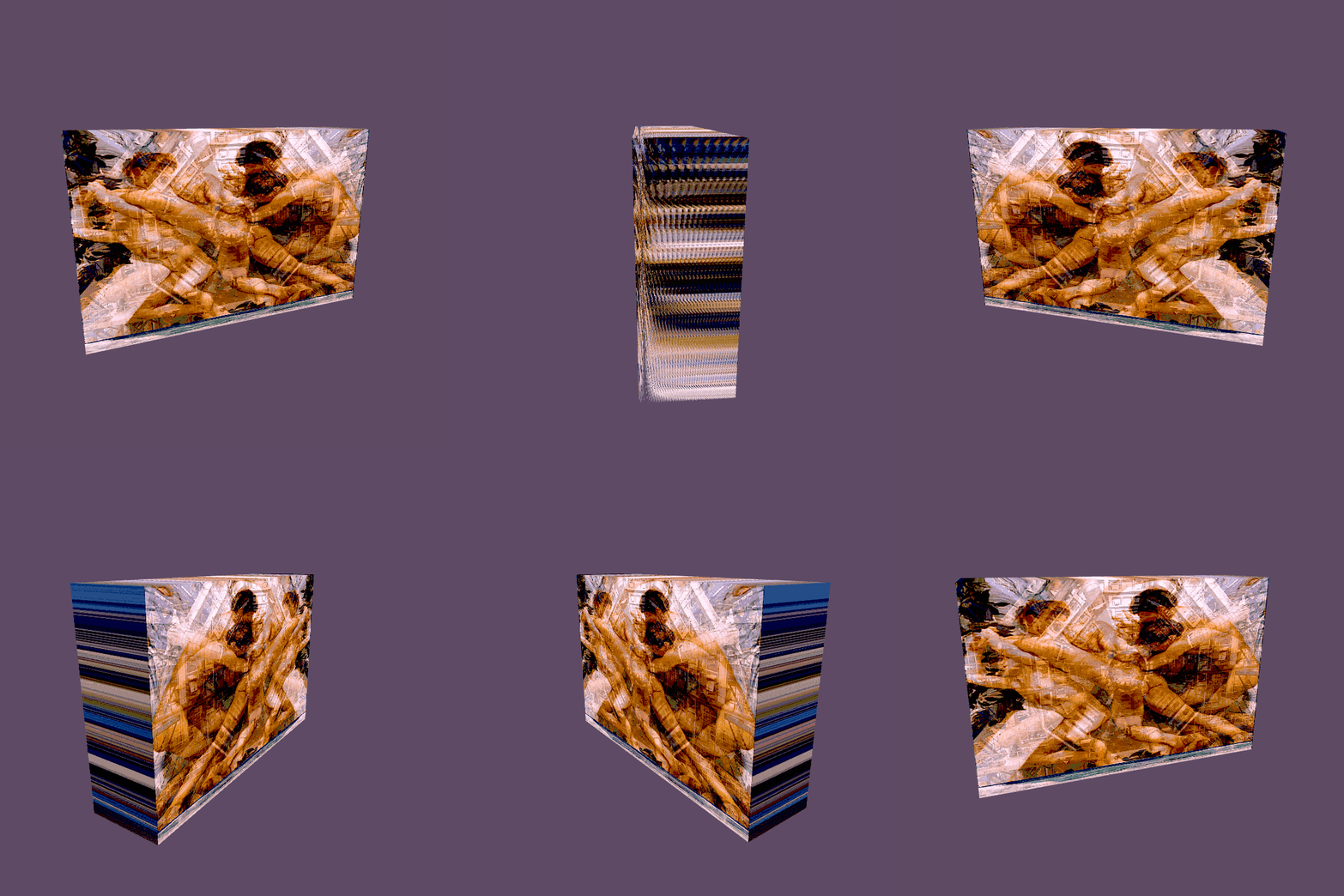
Theriault's body of work does not fit neatly into any single movement or style, which is precisely what makes it so enduring. Drawing from the deep wells of esoteric tradition, sacred architectural design, classical mythology, First Nations totemic culture, and the raw seafaring heritage of Atlantic Canada, his visual vocabulary is layered, deliberate, and strangely timeless. A piece like [1]Akashic Records in Time does not merely decorate a wall — it proposes a question about the nature of memory, consciousness, and the invisible library that some traditions believe contains every thought ever thought by any being who ever existed.
That kind of ambition is woven through the entire collection. The [2]Sacred Geometry Mandala engages with the ancient understanding that certain geometric forms carry spiritual resonance independent of culture — that the circle, the spiral, and the golden ratio speak directly to something pre-rational in the human nervous system. These are not decorative choices. They are philosophical ones, compressed into visual form and made available to anyone willing to look long enough to let them work.
Running parallel to the esoteric thread is a body of work rooted in classical mythology — Eros and Psyche, Romulus and Remus, Labyrinth of the Minotaur, Cyclopes Forge Lightning — rendered not as academic illustration but as living archetype. Theriault treats mythological figures not as historical curiosities but as psychological forces that remain as active today as they were when Homer first set them down. The result is art that locates the ancient inside the contemporary, and reminds the viewer that the stories we have always told about power, love, transformation, and chaos have not gone anywhere. They have simply changed their costumes.
Tired of walls that say nothing? Theriault's sacred, totemic, and mythological art collection is built for minds that want more.
Perhaps no aspect of Theriault's work is more distinctive — or more immediately arresting — than his use of what might be called totemic hieroglyphics: visual symbols drawn from Indigenous traditions, sacred architecture, Taoist philosophy, shamanic practice, and the iconographic language of talismans. Works like [3]Inuit Family Owl Totem and [4]Spirit Temple Talisman operate on the understanding that certain visual forms carry protective, generative, or connective power — that a talisman on a wall is not simply an image but a presence.
This is ancient technology, resurfacing in a culture that has grown increasingly starved for it. As the feedback loops of mainstream social media deliver the same palette and the same aesthetic approval signals on endless rotation, a growing number of people are turning away — not toward minimalism or irony, but toward depth. Toward visual experiences that take up space in the mind long after the first viewing. The totemic dimension of Theriault's work answers this hunger directly. His Shamanic Inspired and Shamanic Hoop Dancer series translate the ceremonial energy of Indigenous movement traditions into still imagery that somehow retains its kinetic force. His Inuit Circle of Life and Inuit Circle of Life Mindseye render the continuous, recursive nature of existence in forms that feel genuinely archaic — as though they were recovered rather than invented.
The sacred architectural dimension of the collection extends this further. [5]Sacred Design Basilica and Sacred Design Cape Blomidon apply the principles of sacred proportion — the same mathematical harmonics that governed the construction of Gothic cathedrals and ancient temples — to images drawn from Theriault's own Atlantic landscape. The effect is a collision between the universal and the profoundly local, between the divine geometries of the old world and the wind-scraped headlands of Nova Scotia. It is a synthesis that could only come from an artist who has genuinely lived inside both worlds for a very long time.
Contemporary Nova Scotia artist Claude Theriault brings sacred design, totemic symbolism & 50 years of esoteric vision to print-on-demand home décor.
For all its range across mythology, esotericism, and global spiritual tradition, Theriault's work is anchored in a very specific place. The Bay of Fundy, Cape Blomidon, Cape Split, Isle Haute, the Bluenose, the Atlantic swell, the Acadian cross — these are not merely pictorial subjects. They are the spiritual geography out of which Theriault's entire visual imagination has grown, and they appear throughout the collection with the weight of genuine love and long acquaintance.
The seafaring series is among the most emotionally powerful works in the collection. [6]Aligning of Seafaring Tall Ship Spirits, Storm Spirits in Tall Ship Riggins, and Seven Seafarers Take to the Seven Seas all treat the act of putting out to sea not as historical recreation but as an existential condition — the human being, small and determined, navigating by inherited knowledge and the barely visible stars. The Acadian pieces — Seafaring Acadian Spirit, French Acadian Cross Bluenose Abeam of Isle Haute, Nordic Seafarer Spirit — carry the weight of a displaced people's relationship with the ocean that both exiled and sustained them. These are not picturesque nautical scenes. They are elegies and celebrations at once.
The devastatingly quiet Kindred Mourns Portapique stands apart from the rest as a document of grief — a visual response to the 2020 Nova Scotia mass shooting that took twenty-two lives. That Theriault chose to address this communal wound through his visual language of sacred form and totemic symbol rather than through representational imagery says everything about his approach: he reaches instinctively for the archetypal when the literal fails. It is the instinct of someone who has spent fifty years understanding that art's highest function is not illustration, but consecration.
A New Collective Consciousness — and the Audience That Found It
Something is shifting in the culture's relationship with the objects that fill its domestic spaces. The dominance of the influencer aesthetic — the curated neutrals, the trending typefaces, the art that matches the sofa — is beginning to feel, to a growing number of people, like a kind of spiritual poverty dressed in good lighting. There is a counter-current gathering force: an audience that wants its walls to hold meaning, to provoke thought, to mark the space it occupies as belonging to someone who is actually paying attention to the world.
This is the audience that finds Theriault's work and does not leave. They are globally distributed — in city apartments in Berlin and São Paulo, in coastal homes in British Columbia and Portugal, in studios and libraries and the kinds of spaces where people go to think. They are liberal in the oldest sense of that word: free, curious, unbounded by the need for approval. They are not looking for art that confirms what they already believe about beauty. They are looking for art that pushes the conversation further.
A print-on-demand collection of 665 works spanning five decades gives them a great deal to work with. Canvas prints, framed works, metal prints, acrylic prints, throw pillows, duvet covers, shower curtains, coffee mugs — the practical formats through which Theriault's visual world can enter a home are extensive. But the format is almost beside the point. What matters is that the work carries something that does not diminish when reproduced. Sacred geometry scaled to a throw pillow does not become trivial. A totemic talisman on a framed canvas print does not lose its charge. The ideas are durable because they are genuinely old — older than any trend cycle, older than the internet, older than the particular cultural moment in which we happen to be living.
That is the quiet proposition of Theriault's half-century body of work: that the walls of your home can say something true, something deep, something that belongs to the longest conversation human beings have ever been having with each other about what it means to be alive and awake in the world. You do not have to settle for less. The art that knows what you know has been here all along.
Frequently Asked Questions
Who is Claude Theriault, and where is he based?
Claude Theriault is a contemporary Canadian visual artist based in Nova Scotia, Canada, whose career spans over fifty years. His work draws from esoteric tradition, sacred geometry, classical mythology, Indigenous totemic culture, and the maritime heritage of Atlantic Canada. His full print-on-demand collection — more than 665 works — is available at pixels.com/profiles/claude-theriault.
What makes Theriault's art different from mainstream home décor art?
Where most mainstream home décor art is designed to be aesthetically neutral and broadly inoffensive, Theriault's work is built around layered meaning. Pieces like Akashic Records in Time and Sacred Geometry Mandala engage with esoteric archetypes, sacred design principles, and totemic symbolism that have resonated with human beings across cultures for millennia. The work rewards extended attention rather than offering quick aesthetic satisfaction.
What formats are available for Theriault's print-on-demand collection?
The collection is available across a wide range of home décor and lifestyle formats through Pixels.com, including canvas prints, framed prints, metal prints, acrylic prints, wood prints, art prints, throw pillows, duvet covers, fleece blankets, shower curtains, coffee mugs, tote bags, phone cases, and apparel. The breadth of formats means the work can meaningfully enter almost any domestic or personal space.
What are the major thematic threads running through the collection?
The collection organizes loosely around several powerful Totemic inspired thematic currents: sacred geometry and esoteric design (including the Akashic Records series and Sacred Design Basilica); Indigenous totemic tradition (the Inuit Circle of Life series, Inuit Family Owl Totem, and shamanic works); classical and world mythology (Eros and Psyche, Homer and the Maelstrom, Seven Heavens of Buddha); and the Atlantic seafaring heritage of Nova Scotia (Aligning of Seafaring Tall Ship Spirits, Nova Scotian Seafaring Culture, and the Acadian Cross series).
Is this art suitable for someone new to esoteric or symbolic art traditions?
Completely. While the work carries genuine intellectual and spiritual depth for those who seek it, it also operates powerfully at an intuitive, pre-rational level — which is precisely how sacred and totemic visual traditions were always designed to work. You do not need to know the history of the Akashic Records to feel the pull of Spirit Temple Talisman, any more than you need a degree in art history to feel the weight of a Gothic cathedral. The visual language is ancient and speaks directly. The scholarship is optional — but available to those who want to go deeper and beyond the shallow. We have something for everyone, the Wayfair model.
Referenced Works — Claude Theriault
- Akashic Records in Time — Claude Theriault. Available via Pixels.com print-on-demand in multiple formats, including canvas, framed print, and metal print.
- Sacred Geometry Mandala — Claude Theriault. One of the artist's signature explorations of divine proportion and sacred visual structure.
- Inuit Family Owl Totem — Claude Theriault. Part of the artist's broader engagement with Indigenous North American totemic traditions.
- Spirit Temple Talisman — Claude Theriault. Merges sacred architectural form with the protective symbolism of talismanic tradition.
- Sacred Design Basilica — Claude Theriault. Applies principles of sacred geometry and divine proportion to Gothic architectural form.
- Aligning Seafaring Tall Ship Spirits — Claude Theriault. Part of the artist's Atlantic seafaring series, rooted in the maritime culture of Nova Scotia.