40% of all new music released last month was made by AI. Here's the Part Nobody's Saying Out Loud.
AI music reaches 40% of new releases. Claude Edwin Theriault examines authorship, fraud, streaming, and the human voice behind AI-assisted music.

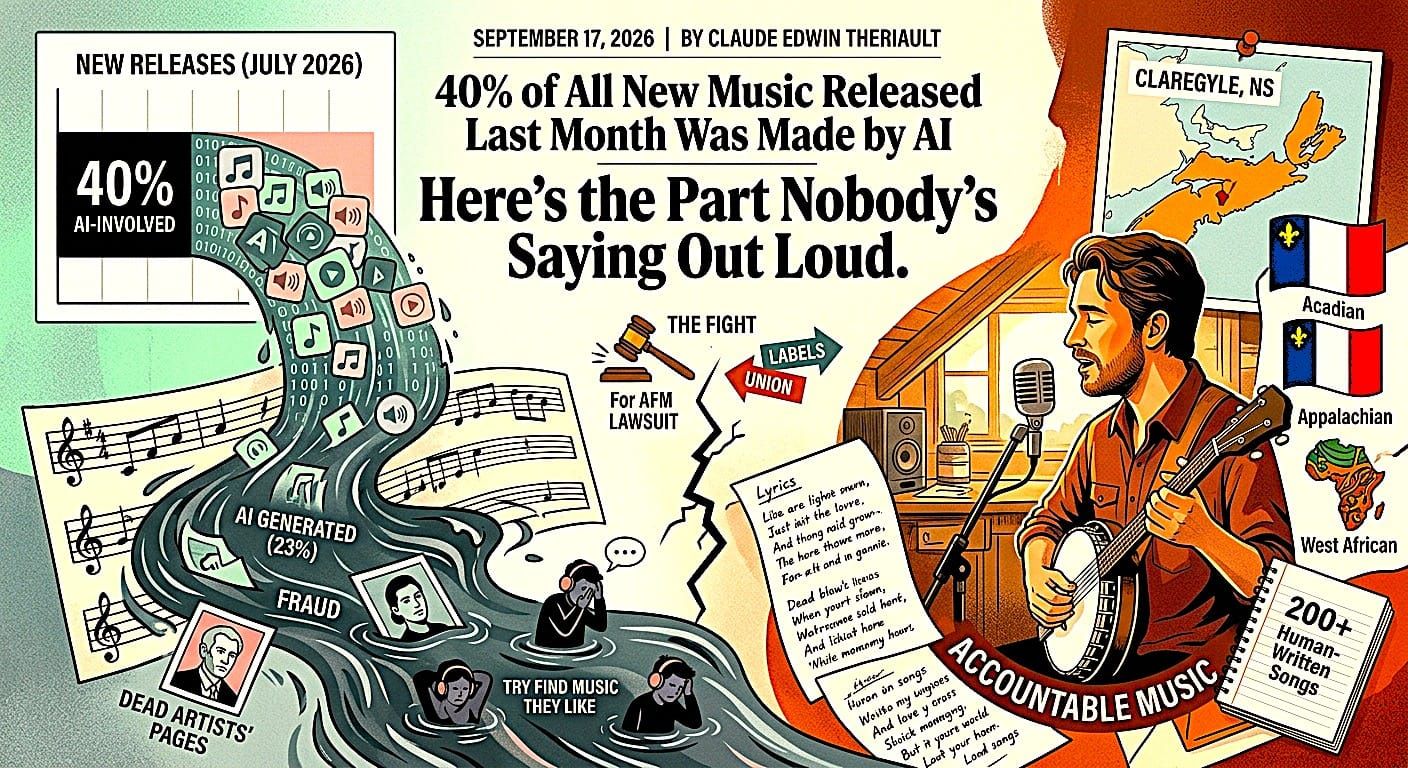
Almost four in every ten songs uploaded to streaming platforms in July 2026 involved artificial intelligence in their making, and nearly a quarter were generated by AI with no human performer at all. That statistic, from a SubmitHub study widely reported this year, is the kind of number that should stop a scroll—not because it's shocking in the abstract, but because most listeners have already heard some of that music without knowing it. Some of it was fraud dressed as songs. Some of it landed on the pages of dead artists. And some of it was made by people who used the same tools I use to build a 200-song bilingual folk catalogue out of Claregyle, Nova Scotia. The industry is currently fighting over where the line sits between those two categories, and the outcome of that fight will decide which kind of AI-assisted music survives the next five years.
The Number That Should Worry the Entire Music Nova Scotia Industry
The scale of the problem is no longer a rounding error. Reporting this year found that AI-generated songs have been mistakenly uploaded to the official artist pages of musicians who can't object—including the late electronic producer SOPHIE and Jeff Tweedy's defunct band Uncle Tupelo—a failure of platform attribution systems that quietly rewrites an artist's legacy without their estate's consent. Separate reporting has documented AI tracks displacing human-made songs on algorithmic playlists, and researchers have estimated that as much as 85% of streams on fully AI-generated tracks in 2025 were fraudulent, run through bot farms to siphon royalty pools that are supposed to be split among real performers. NPR's coverage of listener attitudes found something platforms should be paying closer attention to than the production numbers: audiences report feeling net negative about AI music the more of it they encounter, not more comfortable. The flood isn't winning hearts. It's winning volume, which is a different thing entirely and a more fragile one.
Why Labels Are Being Sued Over the Same Technology They Licensed
The legal fight tells you how seriously the money side takes this. The American Federation of Musicians has spent 2026 in federal court against Universal Music Group and Warner Music Group, arguing the labels violated their own collective bargaining agreement by licensing recordings to AI companies Suno and Udio without triggering the "new use" compensation clause that's supposed to cover exactly this kind of repurposing. Universal and Warner argue AI payment terms belong at the bargaining table, not in a courtroom.
But the union's September filing makes a sharper point than the contract dispute itself: when major labels sued Suno and Udio back in 2024, they said AI models were harming human creators. Once those same labels secured commercial licensing deals with the AI companies in 2025 and 2026, the argument flipped, and the musicians whose recordings trained those models were suddenly told they were owed nothing. That reversal is the real story. It's not that AI touched the recordings—it's that the compensation logic changed the moment it became profitable for the label and stopped being framed as a threat.
The Line Streaming Platforms Are Trying to Draw—and Why It's the Right One
Spotify's response has been to build a review layer, Artist Profile Protection, letting artists check releases before they go live on their own pages—an admission that the platform can no longer catch impersonation and misattribution on its own. Bandcamp took the opposite route and banned AI-created music outright at the start of 2026. Neither policy is really about AI as a technology. Both are attempts to draw the same line: was a human accountable for what this recording claims to be, or wasn't there one at all? That's a more useful question than "was AI involved," because AI involvement now spans everything from full-catalogue synthetic fraud to a solo songwriter using AI-assisted mixing tools on a recording they wrote every word of themselves. Treating those as the same category is how you get a 40% statistic that panics people without telling them anything they can act on.
What "AI-Assisted" Actually Means When the Words Are Still Yours
Cajun Dead et le Talkin' Stick, the nearly 200-song bilingual English/French project I've built from Claregyle, Nova Scotia, sits on the accountable side of that line by design, not by accident. Every lyric across the catalogue—now spanning French, English, Italian, and Algerian Arabic—is human-written, sourced from the Acadian complainte tradition, Appalachian modal folk, and the West African griot practice of naming who is speaking and standing behind it.
AI tools get used openly for music production and video assembly, the way a home studio uses software instruments, but never as a substitute for authorship. That distinction is exactly what the SubmitHub statistic, the AFM lawsuit, and Spotify's new review layer are all groping toward from different directions: the industry doesn't actually have a problem with AI in music. It has a problem with unaccountable music wearing an AI label as camouflage. A catalogue that tells you plainly who wrote it, in which language, and out of which tradition, and pairs it with a public visual archive at moderncontemporaryartworktrends.com, is the opposite problem to solve.
Frequently Asked Questions
How much new music released in 2026 involves AI?
A SubmitHub study found nearly 40% of tracks uploaded to streaming platforms in July 2026 involved AI in some part of their production, with roughly 23% fully AI-generated with no human performer.
What is the AFM's lawsuit against Universal and Warner actually about?
The American Federation of Musicians argues the labels licensed recordings to AI companies Suno and Udio without triggering contractually required "new use" notice and compensation for the musicians on those recordings; both labels' motions to dismiss finished briefing in mid-September 2026.
Why did Bandcamp ban AI-created music while Spotify built a review tool instead?
The two platforms chose different enforcement mechanisms for the same underlying concern—unaccountable or fraudulent AI content—with Bandcamp opting for a blanket ban and Spotify opting for artist-side verification through Artist Profile Protection.
Is Cajun Dead et le Talkin' Stick AI-generated music?
No. Every lyric in the nearly 200-song catalogue is human-written by Claude Edwin Theriault; AI tools are used openly for music production and video assembly, not for authorship, which the project treats as a firm distinction rather than a marketing detail.
Where can listeners hear the difference between AI-assisted and AI-generated folk music?
The Cajun Dead et le Talkin' Stick catalogue streams on Spotify, Boomplay, and YouTube, with a visual archive at moderncontemporaryartworktrends.com pairing each song to its written lyric and source tradition.
Sources:
- US musicians' union files opposition to Universal and Warner motions to dismiss—Music Business Worldwide
- Alarming study reveals almost 40% of music released globally in July 2026 used AI—Euronews
- AI music is flooding streaming platforms. But listeners like it less and less—NPR
- Cajun Dead Defies the Herd: What Lasts Isn't What They Hear Yet—Newstrail
- Cajun Dead Folk Testimony 2026: Beyond Protest Walled Garden—Newstrail
- Cajun Dead et le Talkin' Stick: Revolutionizing French Acadian Music with AI and Raw Authenticity—Modern Contemporary Artwork Trends