Never a better time to be making Music in Nova Scotia; even if it's bad
Insular Music Nova Scotia prioritizes paperwork over artists. Claude Edwin Theriault calls for public funding transparency and true Inclusion

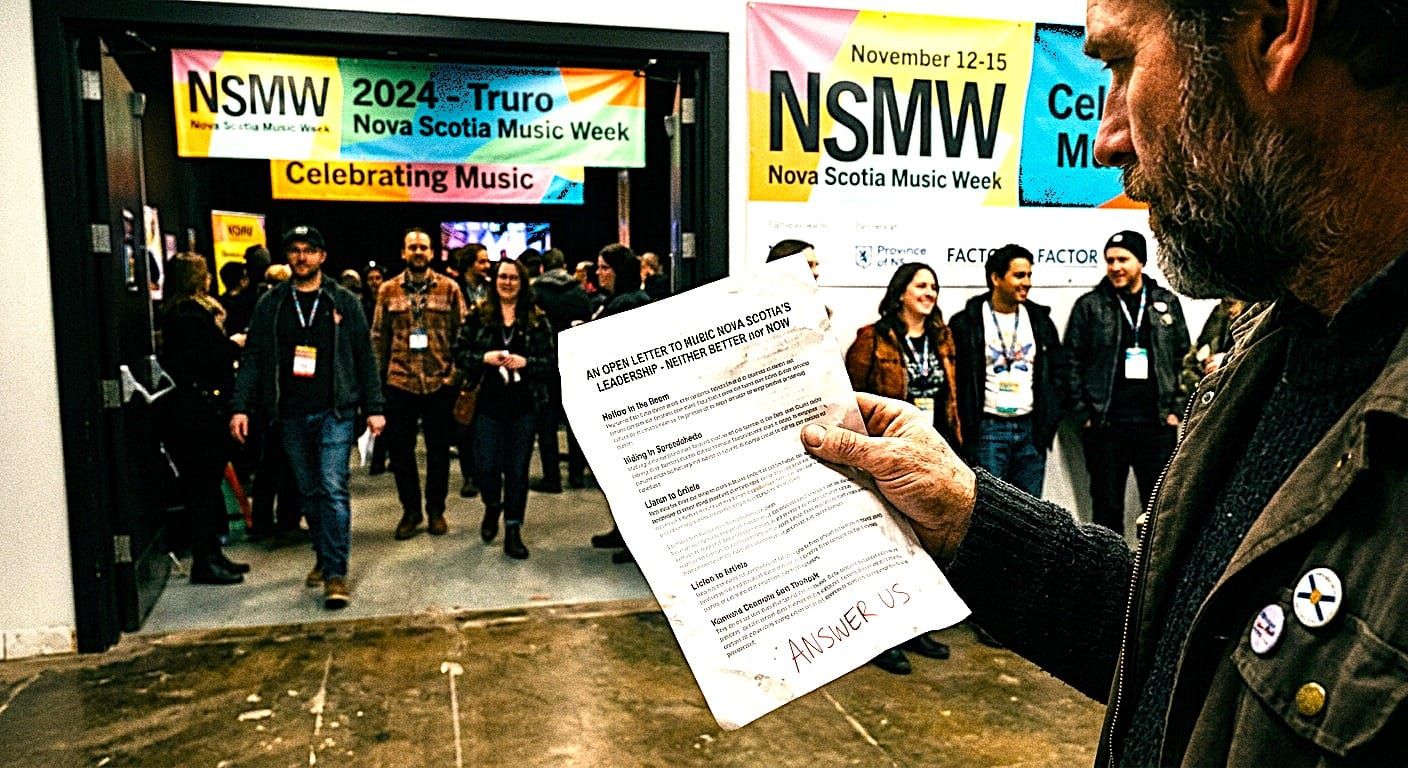
Nova Scotia Music Week looks flawless in the funding report. Artists, and a growing number of taxpayers, are asking why it feels so empty in the room.
Next week, Nova Scotia Music Week returns to Truro/We’kwampekitk, November 12 to 15. The banners will go up, the delegates will be counted, and the sponsors will be thanked. And by every measure that fits inside a spreadsheet, it will be declared a triumph.
That is exactly the problem.
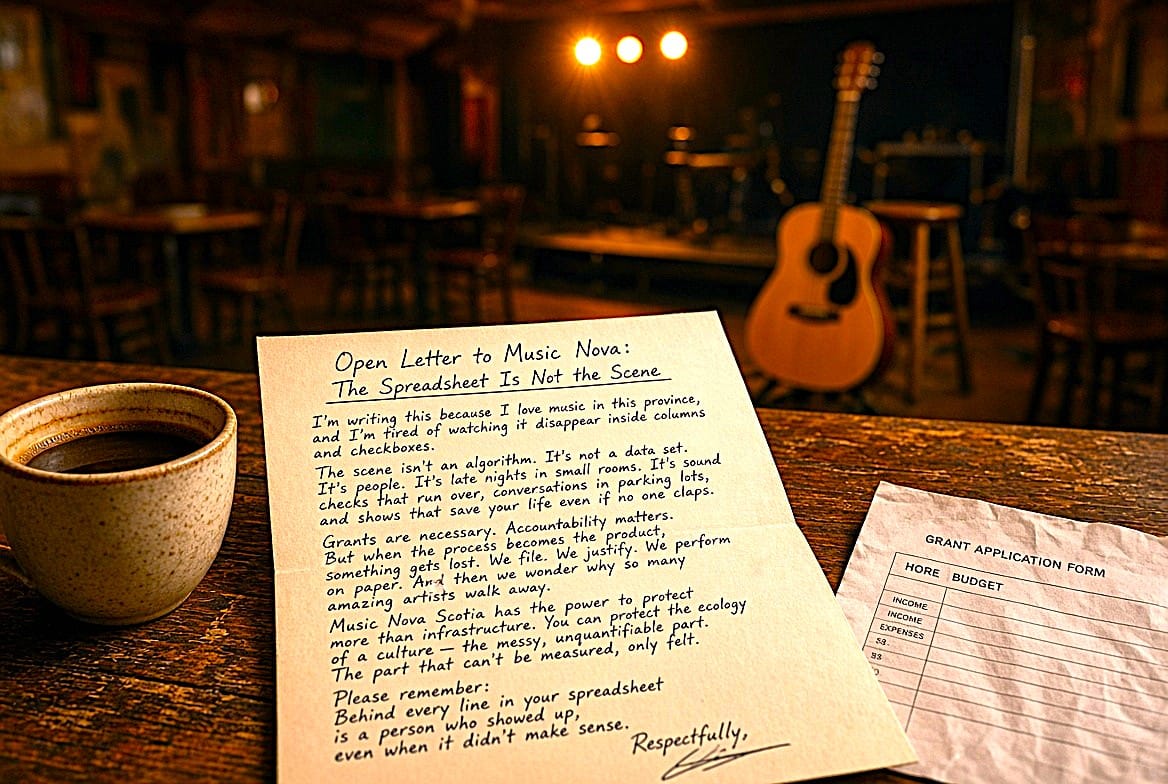
This open letter to Music Nova Scotia’s staff and executive council is public because private emails stopped getting answers. It is written not out of spite, but by someone watching the institution built to serve this province’s music confuse the paperwork with the work.
Good on Paper, Hollow in the Room
The staff is excellent at the spreadsheet. Showcase slots, delegate passes, volunteer hours, and partner logos: every column is filled, and every grant report balances.
But artists do not live in spreadsheets. We live in the room. And in the room, the experience is thin. Showcases feel like obligations. Networking circles the same familiar faces. Professional development teaches yesterday’s industry to people who have to survive tomorrow’s. Too many artists leave with a wristband and a sense that something important happened to someone else.
Even Music Nova Scotia seems to sense it. This year’s awards announcement promised to review the allocation of awards and the submissions process so the event serves its membership more accurately before the 30th anniversary in 2027. That is an admission dressed as a press release.
Meanwhile, the communications office will once again tell us there has never been a better time to be making music in Nova Scotia. Ask the working musicians. Ask the ones who left for Montreal or Toronto because rent here outran the door money. The honest answer is that it is hard, and it is getting harder. A slogan that contradicts the lived experience of your own membership is not optimism. It is a marketing campaign aimed at the very people it claims to serve.
Public Money, Private Comfort
Here is the part that should worry the organizers most. Nova Scotia Music Week is not a private party. Its premier partners include the Province of Nova Scotia, the Government of Canada through FACTOR, and a regional tourism development society, and it is promoted to visitors on the province’s official tourism site as a destination event. In plain terms, taxpayers are paying for it, and the tourism machine is selling it.
An increasing number of Nova Scotians fail to see what that money is buying. Not because they hate music, but because they cannot point to the return. Which careers did last year’s showcase change? How many visitors came to Truro for the music rather than for the awards dinner? If the answers exist, publish them. If they do not exist, that silence is the answer.
Public money comes with a public duty: to show value, not just activity. A full schedule is an activity. A thriving artist is value. The gap between them is where trust goes to die.

Two Words, Then Silence
I am Claude Edwin Theriault, the French Acadian songwriter behind Cajun Dead et le Talkin’ Stick, a multilingual song cycle in English, French, Acadian French, and Cajun. I write every lyric myself, and I produce at a pace and range few in Atlantic Canada are attempting.
I once told Music Nova Scotia’s executive council that the organization had become creatively bankrupt. Those were blunt words. I stand by them, not as an insult but as a diagnosis. An organization can be well run and still have nothing new to say.
The council took offense. Since then, my emails have gone unanswered.
The real story is not that an artist was harsh. It is that a publicly funded body stopped listening to one of its most prolific voices. Criticism is the cheapest consulting an institution will ever get. Silence is the most expensive way to spend it.
And then there is AI. Mention those two letters in local industry circles, and the temperature drops. People fear it will take their jobs.
Here is the correction nobody wants to hear. AI will not take your job. A person who knows how to use AI will. And that will not take twenty years. It will take less than twenty months.
Picture the independent artist who drafts demos, translates lyrics, builds a release campaign, and reaches listeners in four languages without a label. That person is not a threat to culture. That person is the next version of it. Refusing the tools protects no one; it only lets someone else decide how they get used. Music in Nova Scotia could be leading that conversation in Atlantic Canada. Instead, it is pretending the conversation is not happening.
The Old Operating System Is Shutting Down
None of this is only about one music week. It is a symptom of something far larger: a collapse of meaning and the unraveling of the moral and social fabric that culture runs on. The old ways of earning a living from art are breaking faster than new ones are being built. We are in a transition period, and it will run until roughly 2030.
I call what we are leaving behind the old operating system. Its users hope that if we hold still long enough, everything returns to the good, gosh-darn, golly-gee friendly squigly wigly days of 1970. Radio play, a record deal, a handshake a drink and a smoke at the right reception.
It is not going back. In fact and in truth, it is not.
That is exactly why the next decade cannot run on who knows whom. If the old system is dying, the only thing worth carrying forward is the work. So here is what I am asking for:
- Recognize merit, not connections. Judge artists by their work, not their board seats.
- Prove the public value. Publish what each taxpayer dollar delivered for artists, not just for attendance.
- Answer your mail. Including from artists who criticize you. Especially from them.
- Lead on AI literacy. Train members so artists set the terms instead of being run over by them.
This province has more talent than its institutions know what to do with. Innovate, or be replaced by those who will.
My door is open, and so is my inbox.
Claude Edwin Theriault is a French Acadian songwriter, multidisciplinary artist, and AI strategist based in Nova Scotia and the creator of the Cajun Dead et le Talkin’ Stick song cycle.