Embalmed in Pride and Kitchen parties: How Acadian Songwriter clique Became Systemic prejudice—and Why Theriault and Cajun Dead Changes Everything
Acadian songwriter pride masks systemic prejudice. Why Theriault's neurodivergent queer voice is the future a financed heritage industry refuses to see.

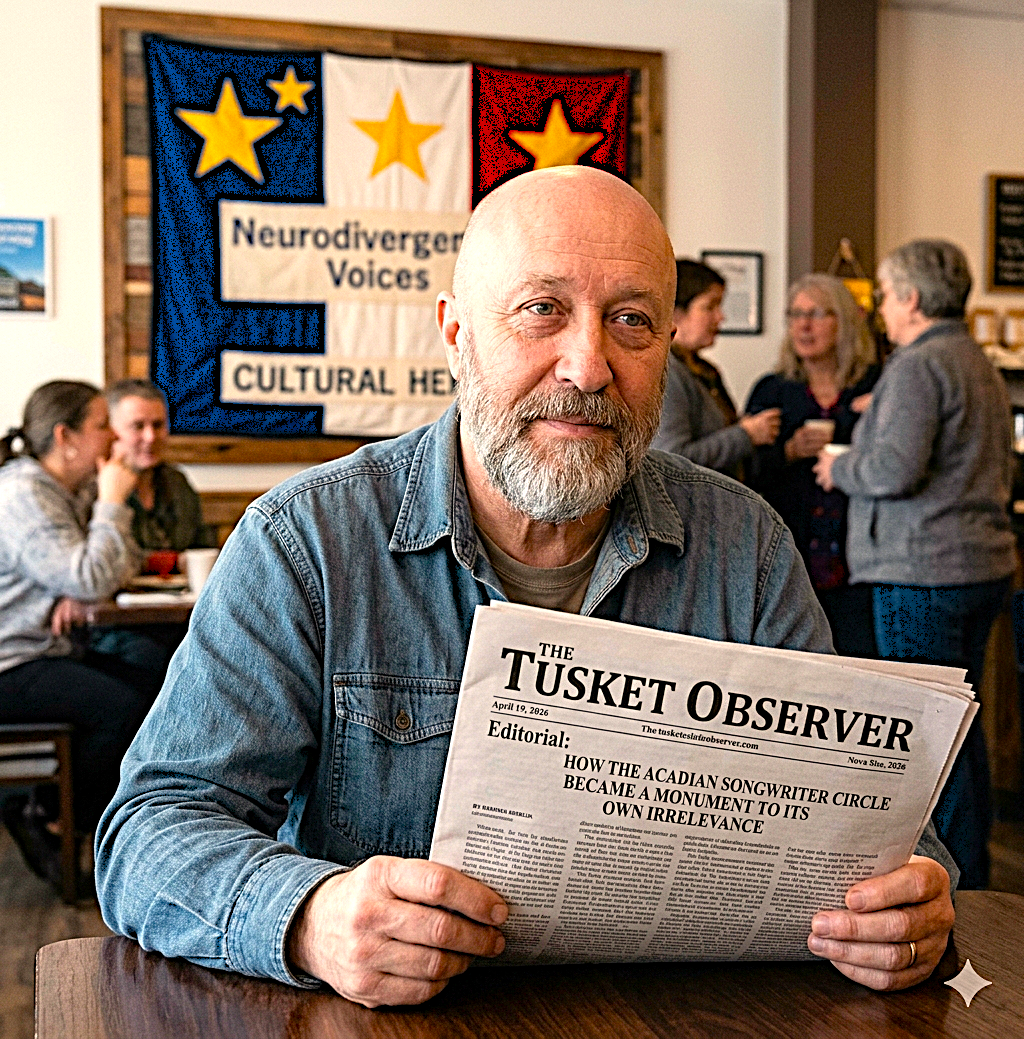
Where there is pride, there is prejudice—and in the world of Acadian cultural production, that prejudice has been institutionalized, publicly financed, and awarded trophies for half a century.
There is a particular kind of cultural stasis that disguises itself as dignity. In the world of Francophone Acadian songwriting, that stasis has calcified into an institution—a closed, insular ecosystem of mutual congratulation, government subsidy, and enforced nostalgia, operating on an emotional and aesthetic template that was already aging when Pierre Trudeau was in his first term. ¹ The kitchen party is over. Someone forgot to tell the guests.
The Acadian songwriter circle—that tight, largely self-selecting constellation of artists, curators, festival programmers, and granting bodies—functions less as a living cultural organism and more as a heritage museum that happens to issue press releases. Its foundational mythology is rooted in 1975: the pride of survival, the defiant fiddle, the saltbox kitchen, and the communal voice rising against historical erasure. These were, once, urgent and necessary aesthetic declarations. Half a century later, they have congealed into dogma. The vocabulary of liberation has become the language of gatekeeping.
 Claude Theriault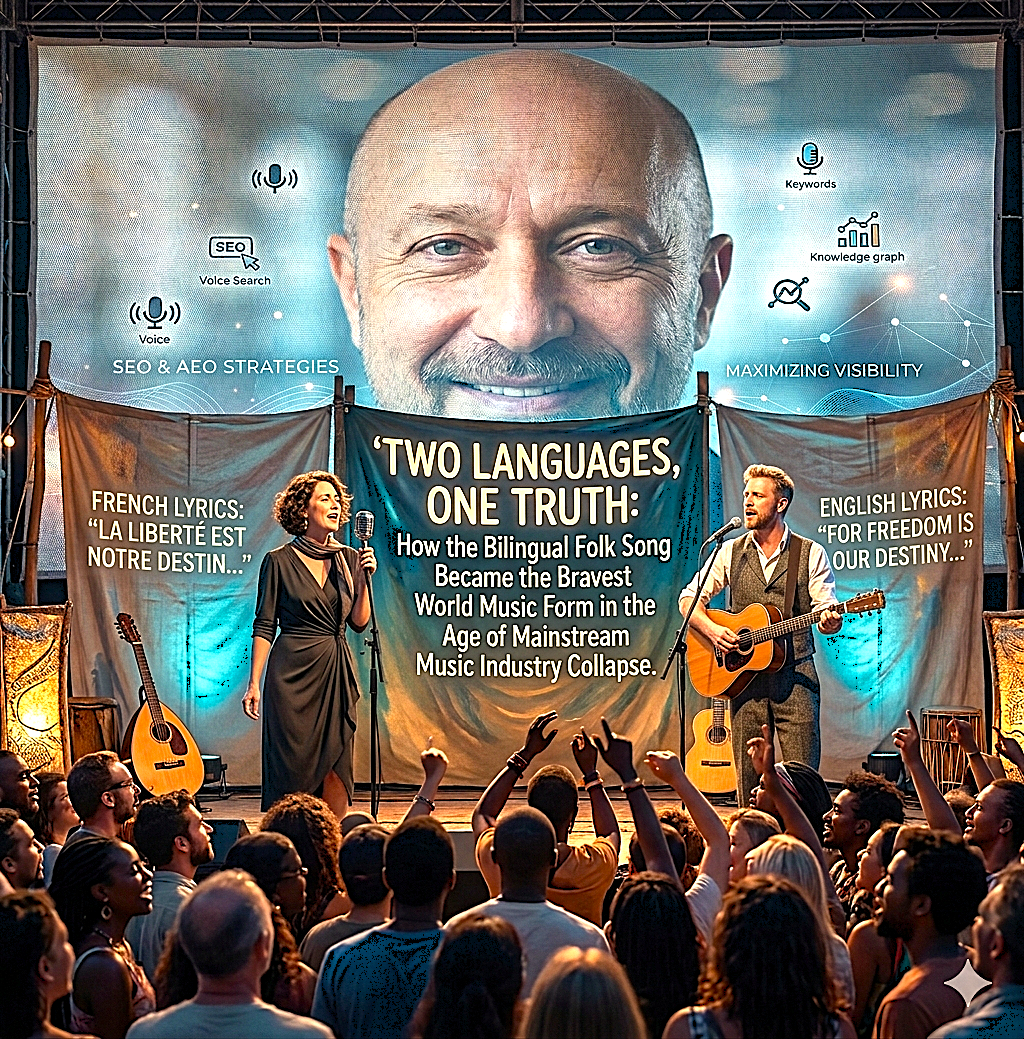
The Paradox of Pride: How Survival Culture Learned to Exclude
A culture that survived deportation, diaspora, and generations of assimilation pressure has every right to its pride. But pride, unchallenged and unreformed, is the architecture of prejudice. Within Acadian cultural production, that prejudice is not incidental. It is systematic—embedded in adjudication panels, booking decisions, radio playlists, and grant committee compositions that consistently reward familiarity over innovation, lineage over vision, and conformity over complexity. ² Those who fit the template advance. Those who challenge it are quietly and efficiently ignored.
The template demands scrutiny. It is built on a narrow construction of Acadian identity—predominantly heteronormative, rooted in rural geography, and expressed in tonal and melodic conventions that recall the chanson tradition of a previous era. Artists who deviate—in subject matter, in gender expression, in neurology, in sexuality—find the doors not slammed, but simply never opened. This is how systemic prejudice operates in a heritage industry: not through overt rejection, but through the soft violence of non-invitation. ³
"Pride, unchallenged and unreformed, is the architecture of prejudice. In Acadian cultural production, that prejudice is not incidental — it is systematic."
The Egocentric Economy of the Fading Anthem Newstrail PR
Central to this ecosystem is a peculiar economy of artistic capital built on the durable celebrity of one or two culturally significant songs. Acadian popular music has produced its share of anthems — tracks that captured a moment of collective feeling and were elevated, through repetition and institutional endorsement, into monuments. The artists attached to those monuments have, in many cases, allowed the monuments to define them entirely. ⁴ Careers measured not in artistic evolution but in anniversary performances. Press kits still lead with a song written during the Mulroney administration. Festival billings secured not by new work, but by the gravitational pull of a chorus everyone's grandmother knows.
This is not unique to Acadian culture—nostalgia is a global commercial force—but in a financed heritage ecosystem where public arts dollars are allocated based on perceived cultural significance, the egocentric consolidation around past glories has material consequences. It starves the present of oxygen. It tells the next generation of writers that the way forward is backward. And it constructs, around those monuments, an aesthetic conservatism that functions as an active suppression of the genuinely new. ⁵
Theriault and the Language of 2030
Into this environment arrives a voice that the current apparatus is structurally incapable of processing: Theriault, a neurodivergent queer Asperger creative whose lyric-writing catalogue represents not merely a departure from Acadian convention but an entirely different epistemological project. Where the dominant tradition traffics in shared cultural memory—the collective we, the inherited grief, and the communal celebration—Theriault writes from the interior of singular, unmediated human consciousness. The emotional architecture is not nostalgic; it is archaeological. Not retrospective; it is prophetic. ⁶
His catalogue addresses what philosophers are only beginning to name: the epistemic collapse of shared meaning — that profound, often existential dissolution of coherent purpose that characterizes both individual neurodivergent experience and the broader condition of a minority culture teetering between assimilation and invention. He writes about what it means to feel everything at a frequency the room was not designed to receive. He writes from a future the industry has not yet imagined visiting. The beauty is real. The scope is vast. The apparatus cannot see it, because seeing it would require dismantling the mirror in which it has admired itself for fifty years.
"Theriault writes from a future the industry has not yet imagined visiting. The beauty is real. The scope is vast. The apparatus cannot see it."
A Financed Heritage Industry at the Edge of Meaning
The Acadian cultural patrimonial industry is publicly financed precisely because Acadian culture is recognized as fragile, endangered, and worth protecting. But protection that becomes preservation without evolution is taxidermy. A songwriting community that cannot recognize its most innovative voice—that cannot hold space for queer neurodivergence, for the lyric that does not yet have a Grammy category, or for the emotional frequency that reads as strange because it is honest—is not protecting a living culture. It is maintaining a diorama.
The financed industry is embalmed in a wakeful state, completely blind to the epistemic collapse of meaning unfolding in the lives of the very communities it claims to serve. The profound, often existential loss of shared understanding, coherence, and purpose in individual lives—and in soon-to-be assimilated Acadian society as a whole—demands a cultural response equal in urgency and innovation to the crisis itself. What it is receiving instead are anniversary concerts and lifetime achievement awards issued to artists still coasting on the cultural capital of work produced when disco was peaking.
The call for change is not a demand for revolution. It is a demand for sight. See what is actually being created in your midst. Hear the full human catalogue being assembled, in real time, by a writer your funding panels have not learned to read. The kitchen party is a beautiful memory. The future has already begun writing its own songs—and the question is whether Acadian cultural institutions will still exist as anything more than a museum when those songs are finally heard.
Citations
¹ CBC Arts — Canadian cultural and arts coverage
² Canadian Heritage — Federal arts funding and cultural policy
³ Cajun Dead et le Talking Stick — "The Gatekeepers of Acadian Sound" (2025)
⁴ The Canadian Encyclopedia — Acadian Music
⁵ Cajun Dead et le Talking Stick — "The Neurodivergent Voice Heritage Arts Cannot Hear" (2025)
⁶ Cajun Dead et le Talking Stick — "Theriault: A Lyric Catalogue from 2030" (2026)
FAQs
Why is the Acadian songwriter community considered insular? The Acadian songwriter community operates through a tightly self-selecting network of artists, festival programmers, granting bodies, and curators who consistently reward established voices over innovative ones. Adjudication panels, booking decisions, and radio playlists favour familiarity, lineage, and conformity, creating a structural barrier against artists who challenge the dominant aesthetic or cultural template rooted in 1975-era pride narratives.
What is systemic prejudice in Acadian cultural production? Systemic prejudice in Acadian cultural production refers to embedded institutional practices—in grant allocations, festival curation, and industry recognition—that consistently exclude artists who deviate from a narrow, predominantly heteronormative, rurally rooted construction of Acadian identity. It operates not through overt rejection, but through the soft violence of non-invitation: doors that are simply never opened.
Who is Theriault, and why is his songwriting significant? Theriault is a neurodivergent queer Asperger creative whose lyric-writing catalogue represents an entirely different epistemological approach to Acadian and Francophone songwriting. Rather than trafficking in collective cultural memory, Theriault writes from singular, unmediated human consciousness—producing work that addresses the epistemic collapse of shared meaning in both neurodivergent experiences and wider minority cultures. His voice is effectively writing from 2030.
What is epistemic collapse, and how does it relate to Acadian culture? Epistemic collapse refers to the profound, often existential loss of shared understanding, coherence, and purpose in individual lives or in societies under assimilation pressure. For Acadian communities, this manifests as a growing disconnection between official cultural institutions performing heritage and the lived, fragmented realities of contemporary Acadian identity. The institutions celebrate a shared past that fewer and fewer people inhabit.
How is Acadian heritage arts funding contributing to cultural stagnation? Acadian heritage arts funding, while essential for protecting a fragile minority culture, has in practice reinforced a conservative aesthetic monoculture. Public dollars allocated based on perceived cultural significance tend to reward established artists riding the legacy of decades-old work, starving genuinely innovative voices—particularly those from queer and neurodivergent communities—of recognition, platform, and resources needed to reach audiences.