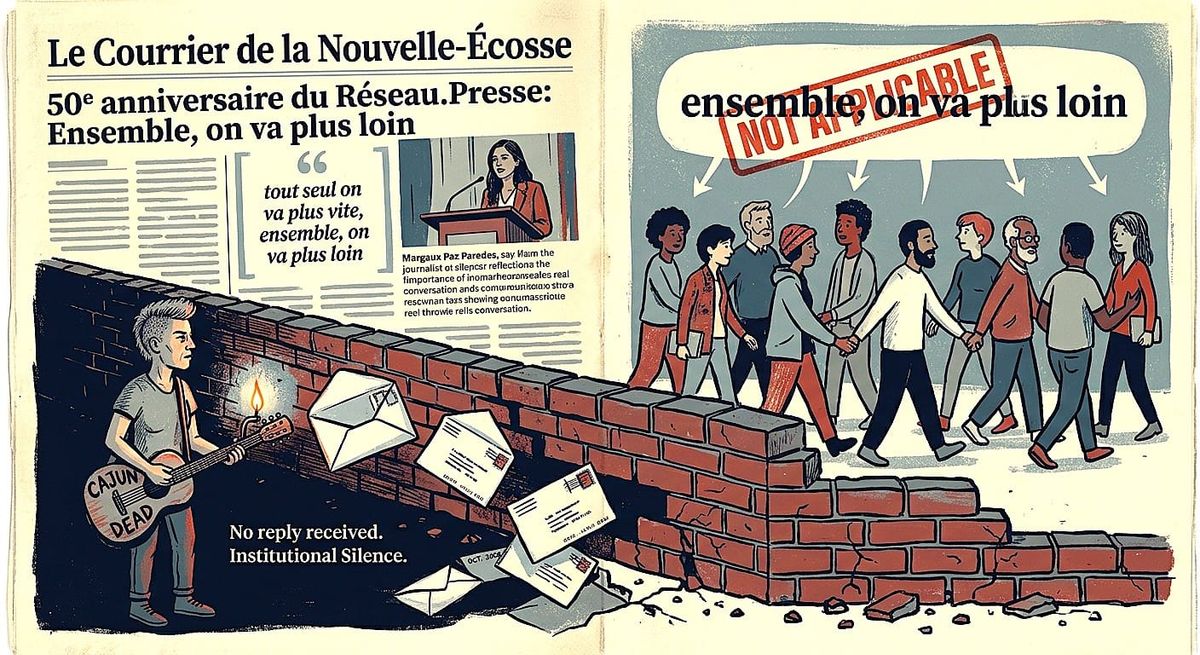
Together We Go Further; Unless You're Not on Their Réseau Presse Page

Claude Edwin Theriault challenges Le Courrier de la Nouvelle-Écosse on Acadian inclusion, media accountability, solidarity, and the cost of silence.

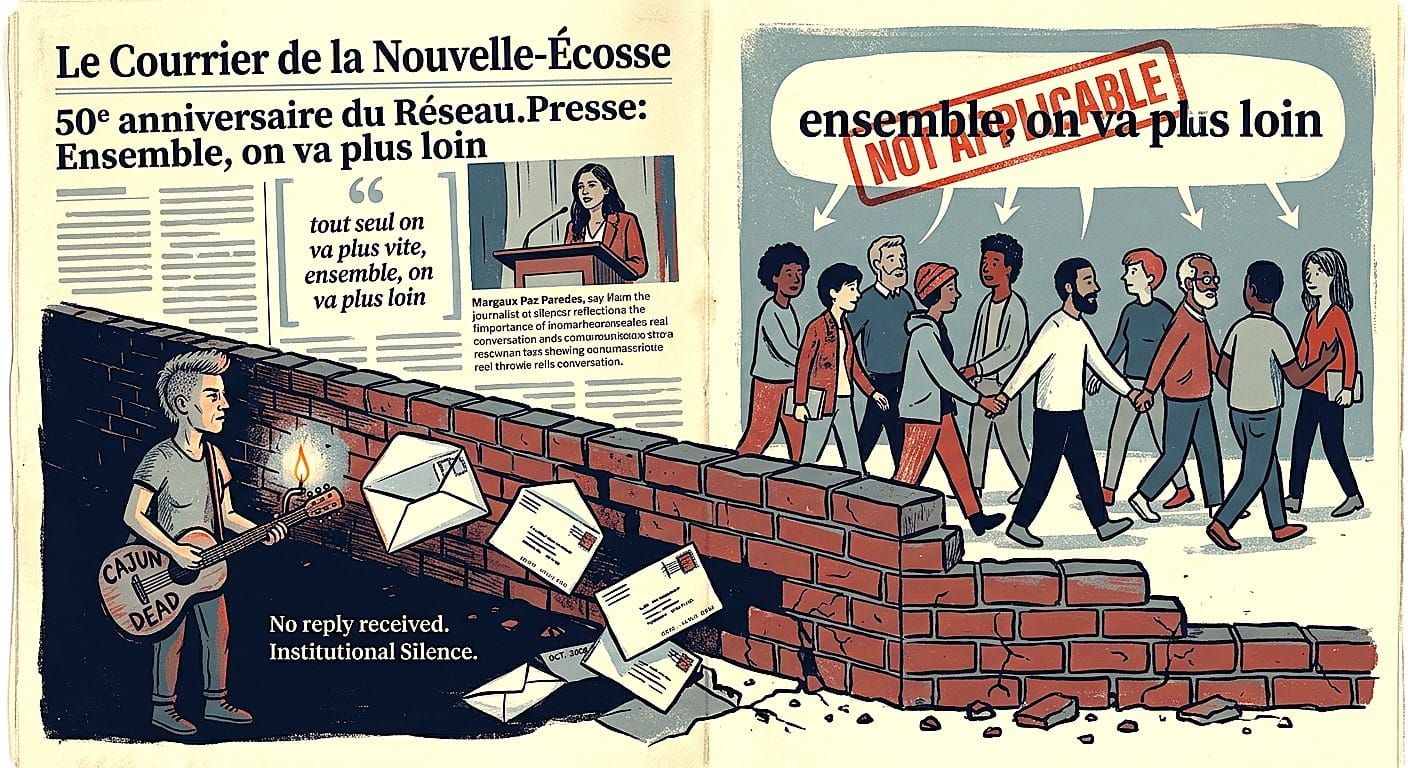
Together We Go Further; Unless You're Not on Their Réseau Presse Page
Read it and weep bitches

Inclusion acadienne : le silence du Courrier | Theriault
Claude Edwin Theriault interpelle Le Courrier de la Nouvelle-Écosse sur l'inclusion des artistes acadiens, le silence éditorial et la solidarité.

Inclusivité comme le trou de leur cul est inclusive.

An open response to Le Courrier de la Nouvelle-Écosse and its column on Réseau. Presse's 50th anniversary

In a recent column, Le Courrier de la Nouvelle-Écosse's cultural journalist, Margaux Paz Paredes, reflected on attending Réseau. Presse's 2026 national congress in Ottawa, which marked the network's 50th anniversary. She opened by reminding readers that we do not live in a vase, sealed in a jar. Unity is strength, she wrote. And, as the slogan goes, « tout seul on va plus vite, ensemble, on va plus loin »: alone you go faster, together you go further. She called it timeless folk wisdom, the kind we forget while we hide behind our smokescreens.

I agree with every word. That's the problem.

I have written to Le Courrier many times since. In October I asked whether its inclusion policy could cover Cajun Dead, my Acadian film and music project. I got no yes. I got no "not for us, and here's why." I got nothing.

The rest of the column makes my case better than I could. She writes that trading messages isn't the same as meeting people in person. In an age of hyperconnection, she says, truly talking with someone has become rare. And in this strange world, it's easy to forget the flame that drives us, the causes we defend, and the values we carry.

She reached that insight through emails with Réseau. Presse's communications team. Those messages got answers, and then came a congress where people finally met face to face. That's how belonging works. You write, someone writes back, and one day you sit at the same table.

My emails never got the first reply Mississippi Acadie Goddam

To be fair to her, this isn't about one journalist. I have no reason to think she wrote the column with me in mind, and her words read as sincere. The problem is the institution that prints them while it leaves an Acadian artist's messages unanswered. When Le Courrier's cultural journalist writes about the value of real conversation in a paper that won't have one with me, that's the whole irony in a single frame.

So when this newspaper prints a reflection about walls, isolation, and going further together, I have to ask, "Together with whom?"

The problem: a proverb without a practice

Nice proverbs are easy to print. Practicing them is harder.

"Ensemble, on va plus loin" isn't a decoration for a column. It's a commitment. It means answering the person at the door, especially when he's not one of the usual faces at the usual events. It means hearing from Acadians who make art outside the approved formats: outside the Pride Month feature, the kitchen-party photo spread, and the heritage festival recap.

My work is Acadian to the bone. It runs from Grand-Pré to Bayou Teche and from the deportation to the humanitarian crises of today. It comes from a French Acadian artist who is neurodivergent, queer-inclusive, and building what I call Animistic Modernism. I understand that it doesn't fit a template. But an Acadian press that only covers what fits its template isn't a community newspaper. It's a hinky ass guest list.
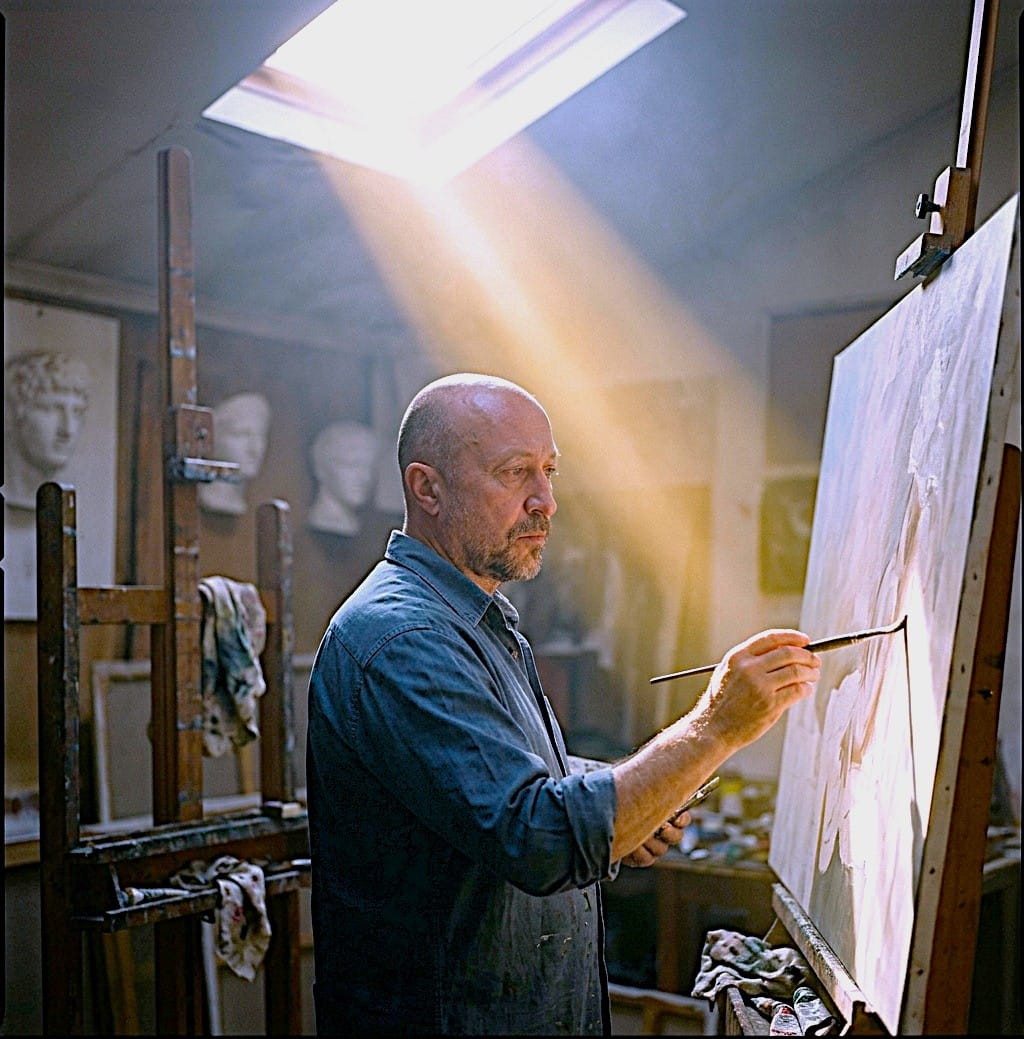
Ghosting is the new racism

The silence has a shape.

Silence from a small outlet might be an oversight. Silence from Le Courrier is something else, because Le Courrier presents itself as Nova Scotia's only French-language media outlet. When the only door stays shut, there is no other door to knock on. For a monopoly, silence isn't neutral. It's an editorial decision.

The paper's own founder, Désiré d'Eon, understood this. Le Courrier still quotes him: a group without a newspaper is silent, and a group with a newspaper becomes a community. That idea started this newspaper. Today the newspaper hands silence back to a member of the very community it was created to give a voice.

Then there's the public money. In 2025–26 the Société de presse acadienne, which publishes Le Courrier, received a $25,000 Canadian Heritage grant for a project called « Le Courrier s'invite chez vous : à la découverte des communautés oubliées »: Le Courrier comes into your home to discover forgotten communities. I'm not hard to discover. My emails are already in their inbox.

We are Acadians. More than anyone, we should know what it costs when the people in charge decide who stays inside the walls and who gets put outside them. Our whole history is a lesson in what happens when one group decides another is not on the same page. That memory should make us the most open press in the country, not the most selective.

Disagreement is not exile. Difference is not a threat. An Acadian artist with a vision Le Courrier doesn't share is exactly the voice a community newspaper exists to carry, or at least to answer.

What would an "ensemble" actually look like?

I'm not asking for applause or front-page treatment. I'm asking for the basics of the solidarity Le Courrier already claims:

  • Answer the email. A clear no, with reasons, is a form of respect. Silence isn't.
  • Publish how coverage decisions are made. Tell independent artists how their story ideas are assessed, so nobody has to guess whether they've been dismissed or simply forgotten.
  • Open a space for dissenting Acadian voices. That could be an open forum, a right of reply, or a guest column. A community is more than the people who agree with the masthead.
  • Judge the work on its merits. Cover it or critique it, but engage with it.

And one more, straight from the column: have the conversation. Ms. Paz Paredes is right that a real exchange matters more than messages passed back and forth. I live here in Nova Scotia. I'll bring the coffee.

None of this costs money. All of it costs a little humility.

For and with our communities, like always

Le Courrier's own statement of values ends with one line: Solidarity: for and with our communities, always. Its app goes further and promises an inclusive outlet that gives a voice to every Acadian, Francophone, and Francophile in the province.

"Always" is a big word. "Every" is bigger.

Those words don't say "for and with the communities that agree with us." They don't say "every Acadian who fits the format. "They make a promise, and a promise is measured by the people it reaches when it's inconvenient, not by how good it looks in print.

Until Le Courrier answers, its own words stand as the sharpest commentary ever printed about it. The smokescreen its journalist warned us about isn't on our screens. It's on the masthead.

My door is open. It always has been. Ensemble, on va plus loin. I'm still waiting to find out whether Le Courrier meant it.

— Claude Edwin Theriault, French Acadian artist and creative director, MBF-Lifestyle

Sources

  1. Margaux Paz Paredes, « Ensemble à Ottawa », Le Courrier de la Nouvelle-Écosse, October 27, 2026.
  2. Le Courrier de la Nouvelle-Écosse, Meet us: mission, vision, and values (source of "Solidarity: for and with our communities, always" and the Désiré d'Eon quote).
  3. Government of Canada, Open Government Portal, Canadian Heritage grant to La Société de presse acadienne: « Le Courrier s'invite chez vous : à la découverte des communautés oubliées » ($25,000, 2025–26).
  4. Nova Scotia Archives, Nova Scotia Historical Newspapers: Le Courrier de la Nouvelle-Écosse (founding by Désiré d'Éon in 1937 and the paper's role for Acadians).
  5. Claude Edwin Theriault, Modern Contemporary Artwork Trends: articles on Acadian inclusion in Nova Scotia media.
  6. Claude Edwin Theriault, Acadian and contemporary art portfolio on Pixels.
In a recent column, Le Courrier de la Nouvelle-Écosse's cultural journalist, Margaux Paz Paredes, reflected on attending Réseau. Presse's 2026 national congress in Ottawa, which marked the network's 50th anniversary. She opened by reminding readers that we do not live in a vase, sealed in a jar. Unity is strength, she wrote. And, as the slogan goes, « tout seul on va plus vite, ensemble, on va plus loin »: alone you go faster, together you go further. She called it timeless folk wisdom, the kind we forget while we hide behind our smokescreens. I agree with every word. That's the problem. I have written to Le Courrier [number] times since [month/year]. In October I asked whether its inclusion policy could cover Cajun Dead, my Acadian film and music project. I got no yes. I got no "not for us, and here's why." I got nothing. The rest of the column makes my case better than I could. She writes that trading messages isn't the same as meeting people in person. In an age of hyperconnection, she says, truly talking with someone has become rare. And in this strange world, it's easy to forget the flame that drives us, the causes we defend, and the values we carry. She reached that insight through emails with Réseau. Presse's communications team. Those messages got answers, and then came a congress where people finally met face to face. That's how belonging works. You write, someone writes back, and one day you sit at the same table. My emails never got the first reply. To be fair to her, this isn't about one journalist. I have no reason to think she wrote the column with me in mind, and her words read as sincere. The problem is the institution that prints them while it leaves an Acadian artist's messages unanswered. When Le Courrier's cultural journalist writes about the value of real conversation in a paper that won't have one with me, that's the whole irony in a single frame. So when this newspaper prints a reflection about walls, isolation, and going further together, I have to ask: together with whom? The problem: a proverb without a practice Nice proverbs are easy to print. Practicing them is harder. "Ensemble, on va plus loin" isn't a decoration for a column. It's a commitment. It means answering the person at the door, especially when he's not one of the usual faces at the usual events. It means hearing from Acadians who make art outside the approved formats: outside the Pride Month feature, the kitchen-party photo spread, and the heritage festival recap. My work is Acadian to the bone. It runs from Grand-Pré to Bayou Teche and from the deportation to the humanitarian crises of today. It comes from a French Acadian artist who is neurodivergent, queer-inclusive, and building what I call Animistic Modernism. I understand that it doesn't fit a template. But an Acadian press that only covers what fits its template isn't a community newspaper. It's a guest list. The silence has a shape. Silence from a small outlet might be an oversight. Silence from Le Courrier is something else, because Le Courrier presents itself as Nova Scotia's only French-language media outlet. When the only door stays shut, there is no other door to knock on. For a monopoly, silence isn't neutral. It's an editorial decision. The paper's own founder, Désiré d'Eon, understood this. Le Courrier still quotes him: a group without a newspaper is silent, and a group with a newspaper becomes a community. That idea started this newspaper. Today the newspaper hands silence back to a member of the very community it was created to give a voice. Then there's the public money. In 2025–26 the Société de presse acadienne, which publishes Le Courrier, received a $25,000 Canadian Heritage grant for a project called « Le Courrier s'invite chez vous : à la découverte des communautés oubliées »: Le Courrier comes into your home to discover forgotten communities. I'm not hard to discover. My emails are already in their inbox. We are Acadians. More than anyone, we should know what it costs when the people in charge decide who stays inside the walls and who gets put outside them. Our whole history is a lesson in what happens when one group decides another is not on the same page. That memory should make us the most open press in the country, not the most selective. Disagreement is not exile. Difference is not a threat. An Acadian artist with a vision Le Courrier doesn't share is exactly the voice a community newspaper exists to carry, or at least to answer. What would an "ensemble" actually look like? I'm not asking for applause or front-page treatment. I'm asking for the basics of the solidarity Le Courrier already claims: Answer the email. A clear no, with reasons, is a form of respect. Silence isn't. Publish how coverage decisions are made. Tell independent artists how their story ideas are assessed, so nobody has to guess whether they've been dismissed or simply forgotten. Open a space for dissenting Acadian voices. That could be an open forum, a right of reply, or a guest column. A community is more than the people who agree with the masthead. Judge the work on its merits. Cover it or critique it, but engage with it. And one more, straight from the column: have the conversation. Ms. Paz Paredes is right that a real exchange matters more than messages passed back and forth. I live here in Nova Scotia. I'll bring the coffee. None of this costs money. All of it costs a little humility. For and with our communities, always Le Courrier's own statement of values ends with one line: Solidarity: for and with our communities, always. Its app goes further and promises an inclusive outlet that gives a voice to every Acadian, Francophone, and Francophile in the province. "Always" is a big word. "Every" is bigger. Those words don't say "for and with the communities that agree with us." They don't say "every Acadian who fits the format. "They make a promise, and a promise is measured by the people it reaches when it's inconvenient, not by how good it looks in print. Until Le Courrier answers, its own words stand as the sharpest commentary ever printed about it. The smokescreen its journalist warned us about isn't on our screens. It's on the masthead. My door is open. It always has been. Ensemble, on va plus loin. I'm still waiting to find out whether Le Courrier meant it. — Claude Edwin Theriault, French Acadian artist and creative director, MBF-Lifestyle Sources Margaux Paz Paredes, « Ensemble à Ottawa », Le Courrier de la Nouvelle-Écosse, October 27, 2026. Le Courrier de la Nouvelle-Écosse, Meet us: mission, vision, and values (source of "Solidarity: for and with our communities, always" and the Désiré d'Eon quote). Government of Canada, Open Government Portal, Canadian Heritage grant to La Société de presse acadienne: « Le Courrier s'invite chez vous : à la découverte des communautés oubliées » ($25,000, 2025–26). Nova Scotia Archives, Nova Scotia Historical Newspapers: Le Courrier de la Nouvelle-Écosse (founding by Désiré d'Éon in 1937 and the paper's role for Acadians). Claude Edwin Theriault, Modern Contemporary Artwork Trends: articles on Acadian inclusion in Nova Scotia media. Claude Edwin Theriault, Acadian and contemporary art portfolio on Pixels.