Cajun Dead and le Talkin Stick is a part of the shape shift happening in music in Nova Scotia
IFPI's new AI music chart rules put human authorship and transparency in focus, with major implications for Acadian, Cajun and world music.

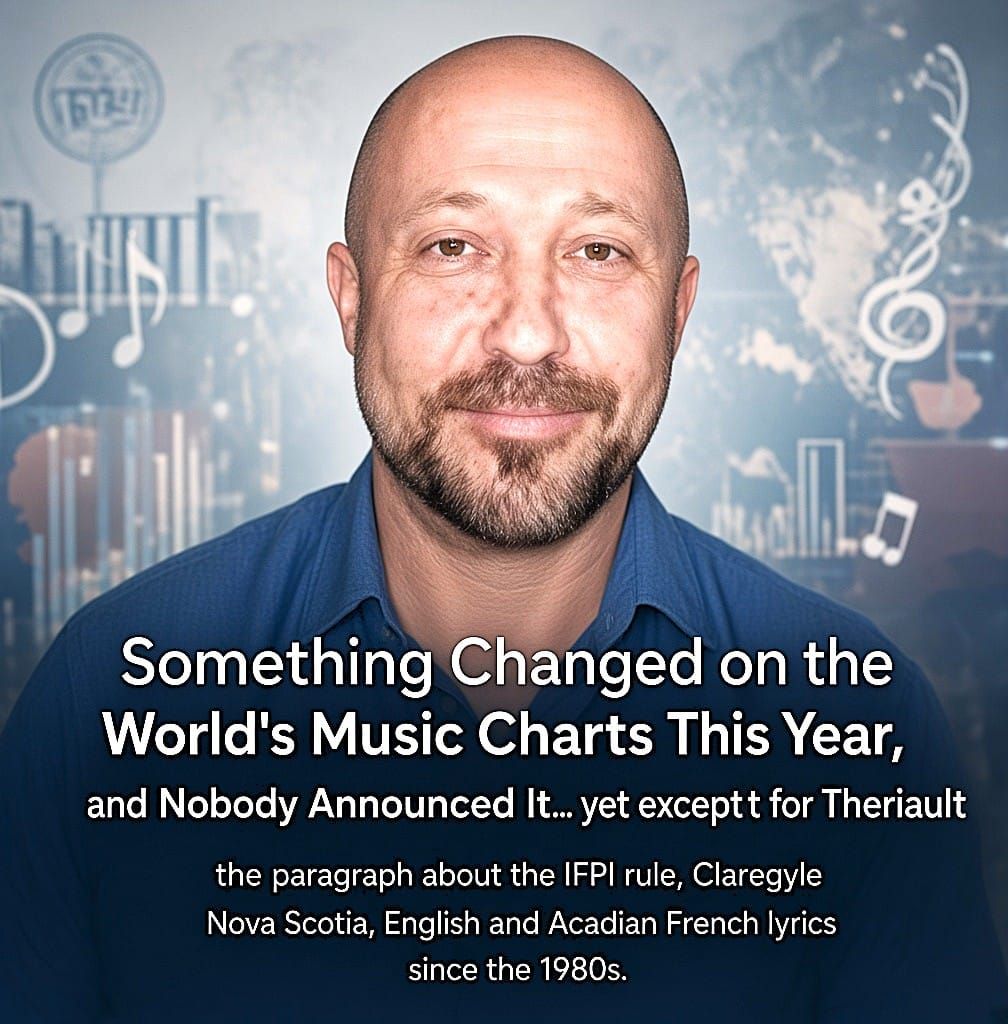
Something Changed on the World's Music Charts This Year, and Nobody Announced It... Yet Except for Theriault
Something changed this year, and nobody announced it. Tucked into the paperwork of the world's official music charts, a new question now sits beside every song: who actually made this, and was the listener told? The IFPI, the global recording-industry body, has written that question into chart rules, and the rule is spreading toward the countries where my own songs are sung. I write lyrics in Claregyle, Nova Scotia, in English and Acadian French, and have been doing so since the 1980s. I think this quiet rule matters more to regional writers than any ECMA pop tart du jour hit this month.
 Claude Edwin Theriault
The Rule Nobody Announced
According to Music Business Worldwide, IFPI's principles say a recording made with generative AI should be kept off official charts if there is reason to believe it fails any of six tests. The AI service must be lawful, track "substantially human-made," be free of manipulation concerns, be respectful of copyright and personality rights, be within the AI service's terms, and be disclosed to listeners on streaming platforms.
IFPI manages the Official MENA, Southeast Asia, South Africa and several Latin American charts directly. It is also working with national groups to extend the principles to more than 20 chart programs, with France's SNEP, Germany's Offizielle Deutsche Charts, Australia's ARIA, and South Korea's Circle Chart named in the plan. IFPI chief executive Victoria Oakley put the logic simply: charts "celebrate human artistry and endeavor." Billboard reported that IFPI backed the call for AI music labeling, and the coalition earlier backed a voluntary system separating "AI-Generated" from "AI-Assisted" tracks.
Notice what the rule does not do: it bans no tool. It asks about authorship, lawfulness, and honesty, a very different test from the one the internet argues about.
Why Francophone and World Music Should Care
France's SNEP sits on that extension list, which means the French-language charts that sit closest to Acadian and Cajun music are heading toward the same standard. For world music, charts have never been the main door; festivals, broadcasters, grant panels, and fairs like WOMEX are. But those gatekeepers borrow vocabulary from chart bodies, and "substantially human-made" will soon turn up in funding forms and playlist pitches.
The pressure behind the rule is visible in this week's headlines. Alan Cross's daily music digest for 28 October notes that TikTok removed 14.6 million fake accounts and 781.4 million fake followers in the second quarter of 2026, and it cites Pollstar's finding that 14 percent of music festivals generate 62 percent of online attention. Attention is concentrating while trust thins, and in that climate provenance is the scarce resource.
 Claude Edwin Theriault
What "Substantially Human-Made" Looks Like in Practice
Here is my answer. I write every line myself, in English and in the French of my grandparents' people, over about forty years. I am a song lyricist and a visual thinker, not a singer or a multi-instrumentalist. My finished words are the sheet music. I feed them to Suno AI, which behaves like a house band that never tires, and I steer it with written directions about instruments, pace, and emotional weight. Here is my current 1000-character-style prompt:
Malian desert blues fused with Acadian world-folk: twin resonator dobros braid bottleneck-slide ostinatos in call-and-response over one modal pentatonic drone; grand piano cascades and Hammond B3 drawbars churn through twin rotating Leslies, joined by electric guitar, ngoni, njarka fiddle, low bass drone, boot-stomps, handclaps, thigh-slap spoons, rhythm bones, calabash and shakers. Three low, weathered male voices in close caller-and-two response, hushed and close-miked, roomy and unprocessed, with doubled hooks, sliding raï melisma, Songhai-Bambara phrasing and turlutage. Galloping near 120 BPM; analog live-room grit, raw and alive, cascading chords and churning organ building to a climactic cinematic wave.
It is not voodoo or woo-woo; it is me having a short, clear, and concise chat with Claude, and we come up with this. I also hum a 30-40 second bit of what I feel the song would sound like and add that to the mix, and it produces a demo; instead of waiting for the snotty, nosy, ego-centric hillbill musicians of Nova Scotia to climb down off of their high horse to give a listen to music that is clearly more developed than theirs. I switch the prompt, and I often push it to blend a North African Raï cadence with an Acadian complainte or an Appalachian modal tune. The meaning is mine; the arrangement is a collaboration with an LLM machine, which is all the beautiful people at Sony Music, and I say so.
One of my published lyrics, "Ready willin and able," carries a line that doubles as a policy: "Cheap is easy, but cheap is just not me and my able." The song even names zero-shot and few-shot prompts, the vocabulary of my actual studio.
I will also say the quiet part. The insular, culturally inbred closed circle of working musicians around me has little room for a lyricist who arrives with two going on three hundred songs and no band; I am simply way too much for them to handle some of it, let alone all of it, and some cancel-minded cliques ignore my voice altogether. Their operating system is 1970, and my operating system is 2030; they will tell you that they are fighting for the preservation of our proud maritime language and culture. They are fighting for their president's title. The all-you-can-eat, drink, and screw expense account that gets them rooms and the conference hall at the Marriott Dartmouth, not one but two high-end Airhead B&B rentals outside of HRM to discuss the future of music in Nova Scotia, and the front of the online Express Pass, to their honky-assy trip to Montreal, France, to showcase their big fat assed nothings. Suno did not replace a musician who would have said yes. It replaced years of waiting for a yes that was not coming from the Honky Gatekeepers.
Where Cajun Dead Stands
Cajun Dead et le Talkin' Stick is a more than 200-song bilingual English and French Acadian-Appalachian lyric project, and it is a song lyric project, not a band. The words are human-authored. The production is AI-assisted. Both facts are printed wherever the songs appear on Spotify, Boomplay, and YouTube, linking Francophone Europe, Louisiana, and Atlantic Canada.
Nova Scotia's Acadian tradition is the direct ancestor of Louisiana Cajun music, because the same community was deported in 1755 and carried its songs south. The Acadian complaint, the griot's oral telling of memory, and the modal Appalachian ballad all hold a community's story in a tune a stranger can learn. For the project's wider story, read NewsTrail on the structural return to Appalachian and Franco-Cajun roots and NewsTrail on the alt-country song "Blood on Their Hands." Modern Contemporary Artwork Trends explains the oral tradition in What Is a Griot?. Credit the human, name the tools, and tell the listener.
Frequently Asked Questions
What are IFPI's AI chart-eligibility principles?
They say a generative-AI recording should be excluded from official charts if it fails tests on lawful AI use, being "substantially human-made," manipulation, copyright, service terms, or disclosure to listeners.
Which charts do the rules apply to?
IFPI manages the MENA, Southeast Asia, South Africa, and several Latin American charts directly and plans to extend the principles to more than 20 national chart programs, including France's SNEP.
Does this ban AI-assisted music?
No. The principles screen for authorship, lawfulness, manipulation, and disclosure rather than banning a tool. A separate labeling system distinguishes "AI-Generated" from "AI-Assisted" tracks.
Why does this matter for Francophone and Acadian music?
France's SNEP is on the planned extension list, so the French-language charts nearest to Acadian and Cajun music are heading toward the same standards, and funders and broadcasters tend to follow.
What is Cajun Dead and le Talkin' Stick?
It is a roughly 200-song bilingual English and French Acadian-Appalachian lyric project by Claude Edwin Theriault of Nova Scotia, with human-authored lyrics and AI-assisted production.
Citations
- IFPI rolls out labels' AI chart-eligibility principles across its global network of official music charts—Music Business Worldwide
- IFPI Backs Call for AI Music Labeling, Implements Immediate Change on Number of Key International Charts—Billboard
- Random music news for Wednesday, October 28, 2026 — A Journal of Musical Things
- Structural Return to Appalachian and Franco-Cajun Roots Challenges Current Country Music Industry Templates — NewsTrail
- Alt-Country Visionary Cajun Dead et le Talkin'Stick song Blood on Their Hands—NewsTrail
- What Is a Griot? The West African Oral Tradition, the Acadian Complainte, and the Honest Answer From the Outside—Modern Contemporary Artwork Trends