In a Post-Truth Era, Cajun Dead et le Talkin’ Stick Revives Raw Truth Through Appalachian Sound
Cajun Dead et le Talkin’ Stick confronts post-truth culture & media zeitgeist with raw Appalachian storytelling that cuts through digital noise.

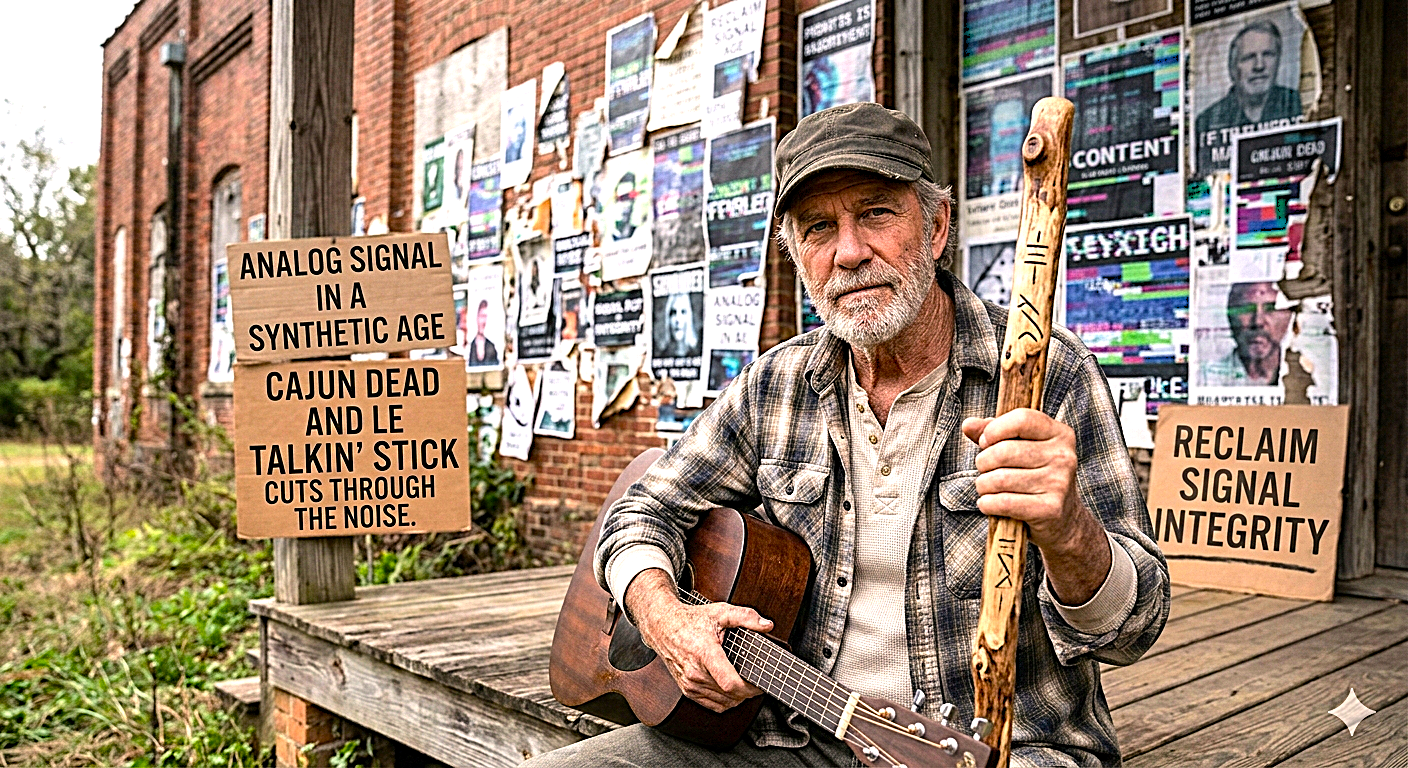
Analog Signal in a Synthetic Age: How Cajun Dead and le Talkin’ Stick Cut Through the Noise
In a world engineered for distraction, where algorithms curate reality and emotional narratives consistently outrun objective truth, a quiet but potent disruption is taking shape. Cajun Dead et le Talkin’ Stick is not just another music project—it’s a strategic cultural response to a fragmented era defined by contradiction, anxiety, and digital overload.
This is not about chasing virality. It’s about reclaiming the source of mountain music signal integrity in an age where meaning itself has been diluted.
 Claude Edwin Theriault
At the centre of this movement is a deliberate return to stripped-down, Appalachian-inspired storytelling—a format that feels almost rebellious in its simplicity. It doesn’t compete with the noise; it sidesteps it entirely. And in doing so, it exposes a deeper truth: the more complex the media environment becomes, the more powerful simplicity becomes as a delivery system.
Zeitgeist in Media: The Collision of Nostalgia and Algorithmic Reality
The current zeitgeist in media is a paradox wrapped in contradiction. On one hand, there’s a growing cultural craving for authenticity—analogue textures, raw storytelling, and human imperfection. On the other hand, there’s an accelerating dependence on artificial intelligence, synthetic media, and algorithm-driven narratives that blur the line between real and constructed.
This duality isn’t accidental—it’s symptomatic of a deeper cultural fatigue.
Audiences are no longer struggling to access information; they’re struggling to trust it. The collapse of traditional gatekeepers has created an environment where all content exists on the same playing field, regardless of credibility. Truth, in this context, becomes fluid—negotiated rather than verified.
This is precisely where Cajun Dead et le Talkin’ Stick positions itself.
By drawing from the lineage of artists like Pete Seeger and Bob Dylan, the project taps into a historically proven model: minimalism as a vehicle for maximum impact. These artists didn’t rely on production complexity—they relied on narrative clarity.
And clarity, right now, is a scarce resource.
The project’s Appalachian-inspired structure—a cappella phrasing, sparse instrumentation, and lyrical storytelling—functions as a form of resistance. It rejects the hyper-polished, algorithmically optimized soundscapes that dominate streaming platforms and instead reintroduces friction into the listening experience.
That friction is intentional.
It forces the listener to engage, rather than passively consume. And in a media environment designed for endless scrolling, that shift alone is disruptive.
 Claude Edwin Theriault
Post-truth culture: When Emotion Overrides Evidence
We are firmly embedded in a post-truth culture, where emotional resonance often outweighs factual accuracy. In this landscape, narratives are shaped less by evidence and more by alignment with personal beliefs and identity.
Truth is no longer objective—it’s subjective, fragmented, and often performative.
Social media platforms have amplified this dynamic by creating echo chambers that reinforce existing perspectives while filtering out dissent. The result is a fractured reality where multiple “truths” coexist, each validated by its own ecosystem.
This is not just a technological issue—it’s a psychological one.
The constant exposure to conflicting information has led to a form of cognitive fatigue. People are overwhelmed, not uninformed. And when overwhelm sets in, discernment declines. Emotional shortcuts replace critical thinking.
This is the environment that Cajun Dead et le Talkin’ Stick directly confronts.
By stripping away production layers and focusing on narrative, the project reintroduces a form of storytelling that demands attention. It doesn’t provide easy answers or polished conclusions—it presents raw observations that require interpretation.
And that’s the point.
In a post-truth landscape, the role of art shifts. It’s no longer about delivering messages—it’s about creating space for reflection. It becomes one of the last mediums capable of holding complexity without collapsing into oversimplification.
The Theriault Factor: Ahead of the Curve, Misunderstood in the Moment
At the core of this project is the work of Claude Edwin Theriault, whose broader artistic output consistently operates ahead of mainstream comprehension.
Theriault’s “benchmark” artworks—spanning visual media, AI-driven narratives, and symbolic constructs—are not designed for immediate consumption. They function as long-range cultural signals, mapping trajectories that only become visible in hindsight.
That positioning comes with a cost.
When you’re ahead of the curve, you’re often misread. The public doesn’t reject the work—they simply don’t have the framework to decode it yet.
Cajun Dead and the Talkin’ Stick act as a bridge.
It translates complex, forward-looking ideas into a format that is immediately accessible without being reductive. The Appalachian influence is not a stylistic choice—it’s a strategic compression mechanism. It distills high-concept thinking into emotionally resonant narratives.
This mirrors the approach taken by Seeger and Dylan during periods of social upheaval. They didn’t dilute their message—they refined its delivery.
And in doing so, they reached audiences that more complex formats could not.
 Claude Edwin Theriault
From Passive Consumption to Active Awareness
One of the most insidious aspects of the current media landscape is the normalization of passive consumption. The “smartphone zombie” phenomenon is not just a metaphor—it’s a behavioural pattern reinforced by design.
Endless scrolling. Fragmented attention. Emotional desensitization.
In this context, indifference becomes the default state.
Global crises, political instability, and economic uncertainty are consumed in the same feed as entertainment content, creating a flattening effect where everything feels equally urgent—and equally distant.
Cajun Dead et le Talkin’ Stick disrupts this pattern.
Its structure demands presence. There’s no algorithmic pacing, no dopamine-driven editing. Just narrative, delivered in its most direct form.
This creates a shift from passive to active engagement.
Listeners are not just consuming content—they’re processing it. And that shift, while subtle, has profound implications. It reactivates a level of awareness that has been systematically eroded by digital convenience.
In a world where attention is fragmented, reclaiming even a fraction of it becomes a powerful act.
Frequently Asked Questions (FAQs)
1. What is Cajun Dead et le Talkin’ Stick?
It is a contemporary song lyric project that blends Appalachian-inspired musical minimalism with narrative-driven storytelling to address modern social, cultural, and psychological issues.
2. Why does the project use such a stripped-down musical style?
The simplicity is intentional. It removes distractions and allows the message to take centre stage, creating a more direct and impactful connection with the listener.
3. How does this project relate to post-truth culture?
It challenges the dominance of emotionally driven narratives by encouraging reflection and critical engagement, rather than passive consumption of information.
4. What makes Claude Edwin Theriault’s approach unique?
Theriault operates ahead of mainstream trends, using art as a predictive and interpretive tool rather than a reactive one. His work often gains relevance over time rather than immediately.
5. Is this project meant to be political?
Not in a traditional sense. It engages with cultural and societal dynamics but does so through narrative and symbolism rather than direct political messaging.
Citations
Cajun Dead et le Talkin’ Stick (Project References):
- “Cajun Dead et le Talkin’ Stick: Appalachian Minimalism in a Digital "Age"—Modern Contemporary Artwork Trends
- “Narrative Resistance: The Rise of Cajun Dead et le Talkin’ Stick” – MBF-Lifestyle.io
- “From Acadian Roots to Global Commentary: Cajun Dead et le Talkin’ Stick Explained” – Independent Arts Review
Appalachian Music Authority Sources:
4. “The Roots of Appalachian Folk Music” – Smithsonian Institution
5. “Appalachian Music Traditions and Cultural History"—Authority Apple Podcast
6. “Folkways and the Preservation of American Roots Music"—Smithsonian Institute