What Happens When You Give the Appalachian Modal Scale to an Acadian Griot: Cajun Dead, Daniel Lanois, and the Sound Neither Nashville Nor Ottawa Will Fund
Dorian Mixolydian modes run through Tyler Childers's Daniel Lanois's Acadie and Cajun Dead. That is what happens when that scale meets an Acadian griot.

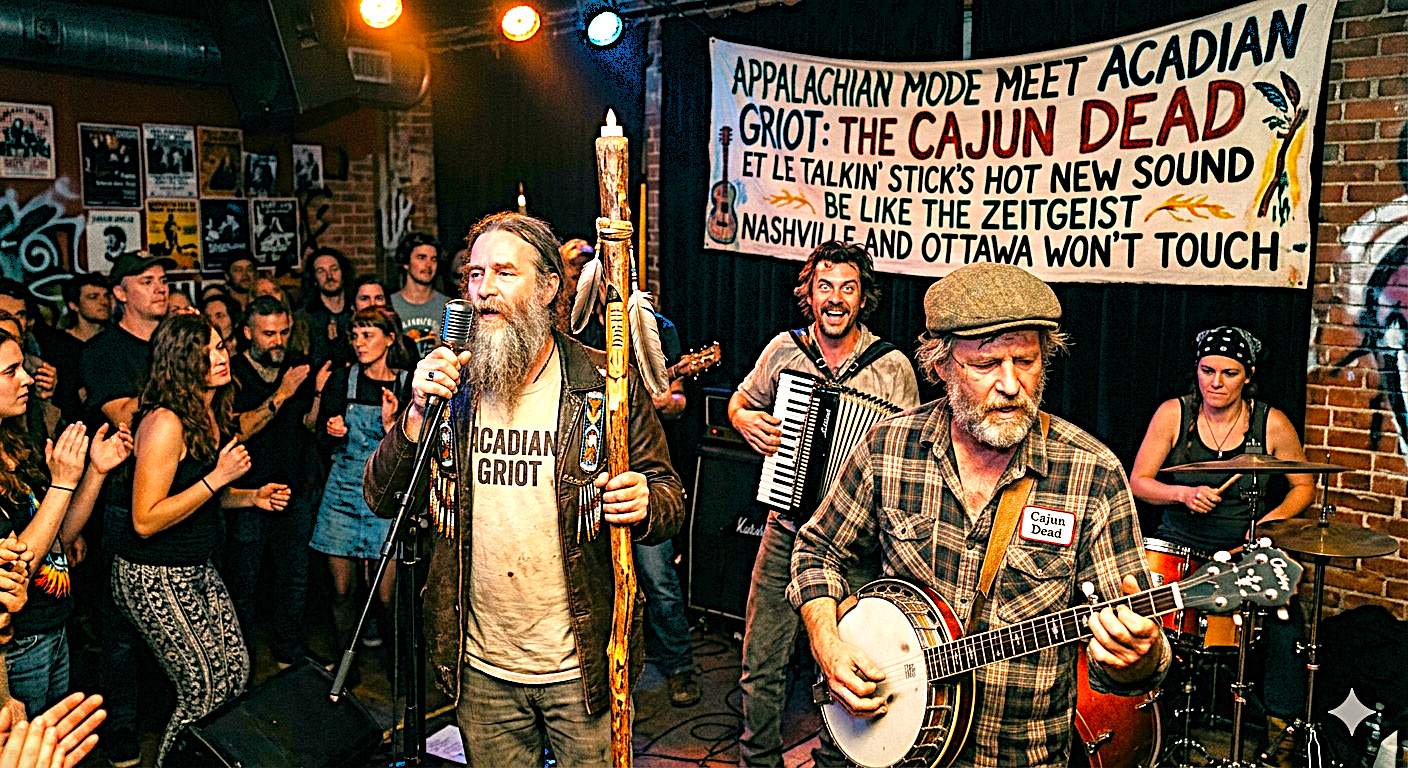
 Claude Theriault
There is a scale that carries the emotional DNA of every folk tradition that matters. Not a modern invention, not a music theory abstraction — a series of intervals so ancient they predate notation, so persistent they survived the Reformation, the Atlantic crossing, and the commercial music industry's best efforts to smooth them into something more algorithmically compatible. The Dorian and Mixolydian modes — the two scales that run through Celtic, Scots-Irish, and Appalachian music alike — are the sonic architecture underlying Tyler Childers' Purgatory, the mountain ballads Cecil Sharp collected across the Southern Appalachians in the early twentieth century, and the Cape Breton fiddle tradition that musicologists confirm is part of the same Celtic diaspora as Appalachia, Shetland, and the French-Acadian communities of Maritime Canada.
As Folkopedia's comprehensive analysis of scales in Anglo-American folk song documents, Sharp himself drew direct parallels between these Appalachian modal scales and their Scottish and Irish equivalents — because they share a common ancestor. The Scots-Irish settlers brought them down the Appalachian ridge. The French Acadian settlers carried the same modal tradition to Nova Scotia from Europe in 1604, four centuries before anyone called it alt-country. The scale is the shared DNA. The question nobody in Canadian music has yet asked is: what happens when you give that scale to an Acadian griot — to the songwriter who carries the complainte tradition, the oral testimony, the moral freight of displacement — and point it at the world? The answer is the Cajun Dead et le Talkin' Stick catalogue. And the producer who would most precisely understand why Daniel Lanois is.
Daniel Lanois, Acadie, and the Bilingual Displacement Narrative Canada Forgot to Fund
In 1989, Daniel Lanois — born in Hull, Quebec, son and grandson of noted fiddlers, the most celebrated Canadian record producer alive — released his debut solo album. He called it Acadie, naming it after the historical French colony encompassing the Maritime provinces, evoking the 1755 Grand Dérangement and the cultural thread running from Nova Scotia to the Louisiana bayou that produced both his own Québécois heritage and the Cajun musical tradition he had absorbed during the New Orleans recording sessions that preceded the record. As the Amazon Music documentation of Acadie records, "the underlying historical link between old Acadian culture in his title and its descendant Cajun culture surviving in Louisiana's bayous and backwoods gives the songs and these performances a haunting, and haunted poignancy." Lanois sang in French and English on the same record, sometimes within the same track.
He built the songs around rural characters, narrative ballads, and what critics called "folkish melodies" delivered in a warm whisper — sparse guitar, pedal steel, and atmosphere. The production logic was identical to what Rick Rubin would apply to Johnny Cash five years later: the emotional weight of the material required space rather than decoration. Silence serves the truth. Decoration competes with it.
The Grammy Recording Academy noticed both. Rubin won Best Contemporary Folk Album in 1995 with Cash's American Recordings. Lanois won the same Grammy the following year with his production of Emmylou Harris's Wrecking Ball. Two consecutive Best Contemporary Folk Album wins. Two producers whose entire philosophy was built on the same principle — the voice and the truth at the centre of the song must be the loudest thing in the room. Both, in different ways, circling the Acadian musical universe: the modal scales, the bilingual expression, the displacement narrative, the haunted poignancy of a culture that survived by carrying its memory in song. The category that validated both of them already has a name. The catalogue that belongs in it is already recorded.
The Modal Scale That Childers and the Bay of Fundy Share
What the Appalachian modal tradition and the Acadian complainte tradition share is not instrumentation or language. It is the refusal of the major scale's emotional resolution. The Mixolydian mode — a major scale with a flattened seventh — produces the specific quality of something that sounds settled but remains haunted by the note it almost reached. The Dorian mode — minor with a raised sixth — produces what musicians describe as simultaneously dark and luminous, capable of holding grief and resilience in the same phrase without one consuming the other.
These are the emotional registers of the music that has endured from both traditions precisely because they map most honestly onto the experience of communities that have known displacement and survival without the luxury of the triumphant major-key resolution. As the Banjo Hangout Celtic modes reference confirms, these four Celtic modes — Ionian, Mixolydian, Dorian, Aeolian — are documented in the Celtic diaspora locations of Appalachia, Shetland, and Cape Breton alike, each community preserving the same modal inheritance through different instruments and different languages.
Tyler Childers reaches for these modes from the Kentucky holler. The Acadian complainte reaches for them from the Bay of Fundy coast. The Mixolydian and Dorian scales are the common language between them — a language neither tradition invented, both traditions preserved, and the commercial music industry of both countries has spent decades trying to round into something more major-scale compatible.
The Cajun Dead et le Talkin' Stick catalogue, documented across the complete song archive, runs on these modes — not as an academic choice but as the natural consequence of what the material requires. Parlant des Morts does not resolve. Azzah was killed while seeking aid, and this does not offer consolation. Blood on Their Hands sits in the Dorian space where grief and fury coexist without resolution. These are griot songs built on the modal architecture that Acadian Nova Scotia shares with Appalachian Kentucky, and they have been waiting for the listener who can hear both lineages in the same phrase.
 Claude Theriault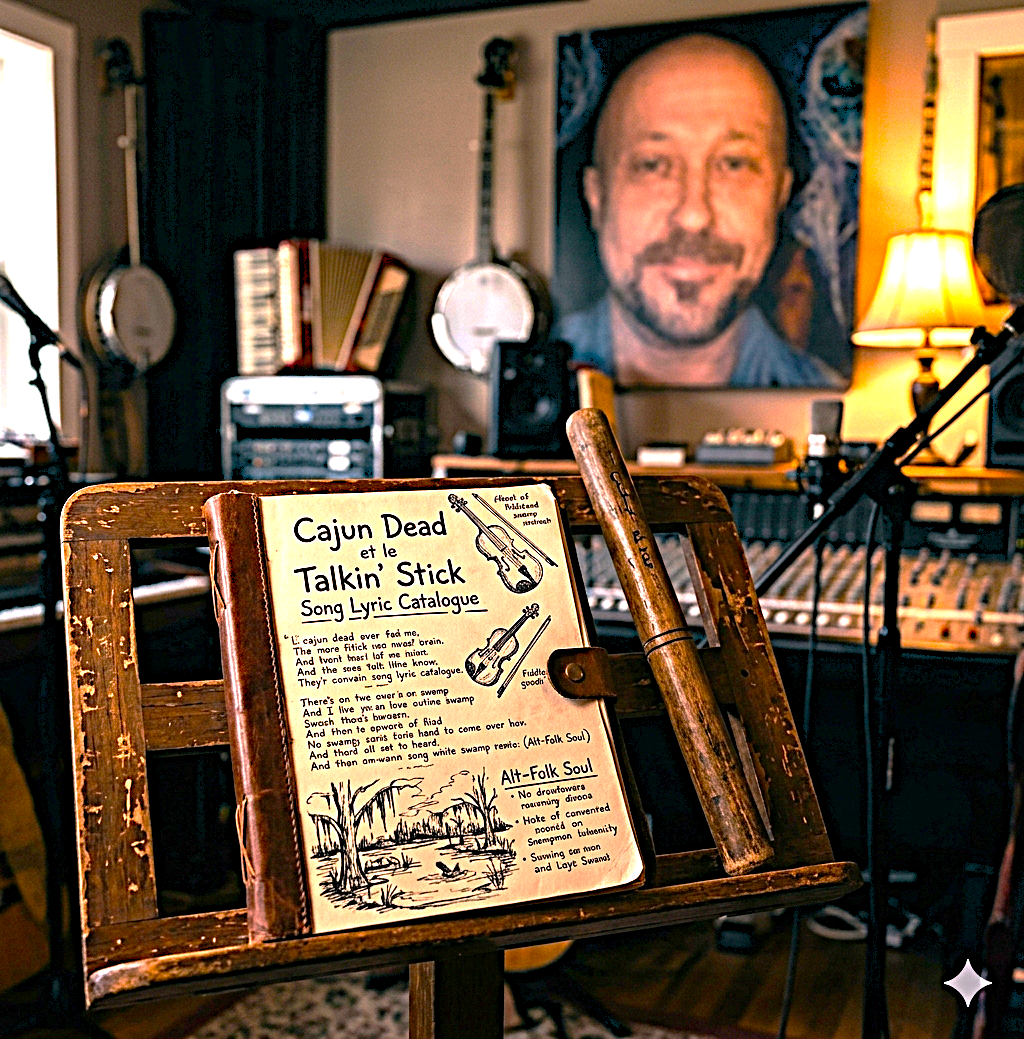
If Lanois Were Revisiting Acadie: The Production Case
If Daniel Lanois were to revisit the impulse of Acadie — the bilingual, displacement-haunted, griot-adjacent Acadian musical universe he reached toward on that 1989 debut — the Cajun Dead et le Talkin' Stick catalogue is the project he would produce. Not as a fantasy, but as a structural inevitability. As the Cajun Dead griot and complainte authority post establishes in full, the oral tradition at the root of this catalogue is the same tradition Lanois was excavating on Acadie: the French colony's memory carried in song, displacement made audible, the modal scale that refuses the major key's promise of resolution because the resolution never historically arrived.
Lanois sang those themes in the smoky warmth of a New Orleans recording session, surrounded by the Neville Brothers and the members of U2, with all the institutional support that a producer of his stature commands. Theriault sings them from a Bay of Fundy coastline, with a lyric-writing practice spanning four decades, an AI composition engine extending the voice, and zero institutional support from the cultural bodies whose mandate it was to develop exactly this material.
The Grammy category that would honour this work — Best Contemporary Folk Album — has validated the Rubin aesthetic and the Lanois aesthetic in consecutive years. What it has not yet encountered is the point where those two aesthetics converge: the Acadian griot singing Appalachian modal songs in two languages, carrying the displacement testimony of a community that connects Nova Scotia to Louisiana across four centuries of shared history, using the production logic both men arrived at independently because it is the only honest logic available. As the Cajun Dead counterculture manifesto has argued from the beginning, the categories are not the problem. The songs are already there. The scale is old. The griot function is older. The right room — and the right producer — is the only thing still missing.
Five FAQs on the Appalachian Modal Scale, Daniel Lanois, and Cajun Dead
What is the Appalachian modal scale, and why does it matter in folk music? The Appalachian modal scale refers primarily to the Dorian and Mixolydian modes — ancient European scales preserved in the oral folk traditions of both Scots-Irish and French-Acadian settlers who arrived in North America from the same modal heritage. The Mixolydian mode produces a major-sounding scale with a flattened seventh, creating the quality of resolution withheld.
The Dorian mode is minor with a raised sixth, producing the simultaneous sensation of darkness and luminosity that allows folk music to hold grief and resilience in the same phrase. These modes are the emotional infrastructure of Appalachian mountain music, Cape Breton fiddle, and the Acadian complainte tradition alike.
Who is Daniel Lanois, and what is the connection to Acadian music? Daniel Lanois is a Canadian record producer born in Hull, Quebec, whose father and grandfather were noted fiddlers. He produced U2's The Joshua Tree, Bob Dylan's Time Out of Mind, and Emmylou Harris's Wrecking Ball, which won the 1996 Grammy for Best Contemporary Folk Album. His 1989 debut solo album, Acadie, is named after the historical French Acadian colony and is sung in French and English, rooted in the displacement narrative of the Acadian people and their cultural connection to Louisiana Cajun music. It is the most direct point of contact between the Canadian music establishment and the Acadian oral tradition that Cajun Dead et le Talkin' Stick continues.
How does Cajun Dead et le Talkin' Stick use the Appalachian modal tradition? The songs in the Cajun Dead catalogue are built on the Dorian and Mixolydian modes, not as a theoretical choice but as the natural consequence of what the Acadian complainte tradition requires: music that carries displacement, survival, and moral testimony without resolving into the triumphant major key. Songs like Parlant des Morts, Azzah Was Killed While Seeking Aid, and Blood on Their Hands sit in the same modal space as Tyler Childers' Appalachian ballads — the space where grief and resilience coexist without one consuming the other.
What is the Grammy connection between Rick Rubin, Daniel Lanois, and Cajun Dead? Rick Rubin won Best Contemporary Folk Album at the 1995 Grammys for Johnny Cash's American Recordings. Daniel Lanois won the same award the following year for Emmylou Harris's Wrecking Ball. Both producers won with stripped, voice-first productions rooted in the same aesthetic philosophy. Cajun Dead et le Talkin' Stick operates in the structural lineage of both — Appalachian oral tradition (Rubin/Cash) and bilingual Acadian displacement narrative (Lanois/Acadie) — which places it squarely in the Grammy category that twice recognized this aesthetic.
Where can I hear the Cajun Dead et le Talkin' Stick catalogue? The full 100+ song catalogue streams on Spotify at open.spotify.com, on Boomplay, and on YouTube. The complete annotated song guide and cultural framework are at moderncontemporaryartworktrends.com.