An Acadian-Arabic Cover Just Sat Next to a Cannes Winner on a 37-Year Radio Institution
Melbourne's Global Village spotlights Cajun Dead et le Talkin’ Stick, linking Atlantic Canadian music, Acadian heritage, Arabic global roots.

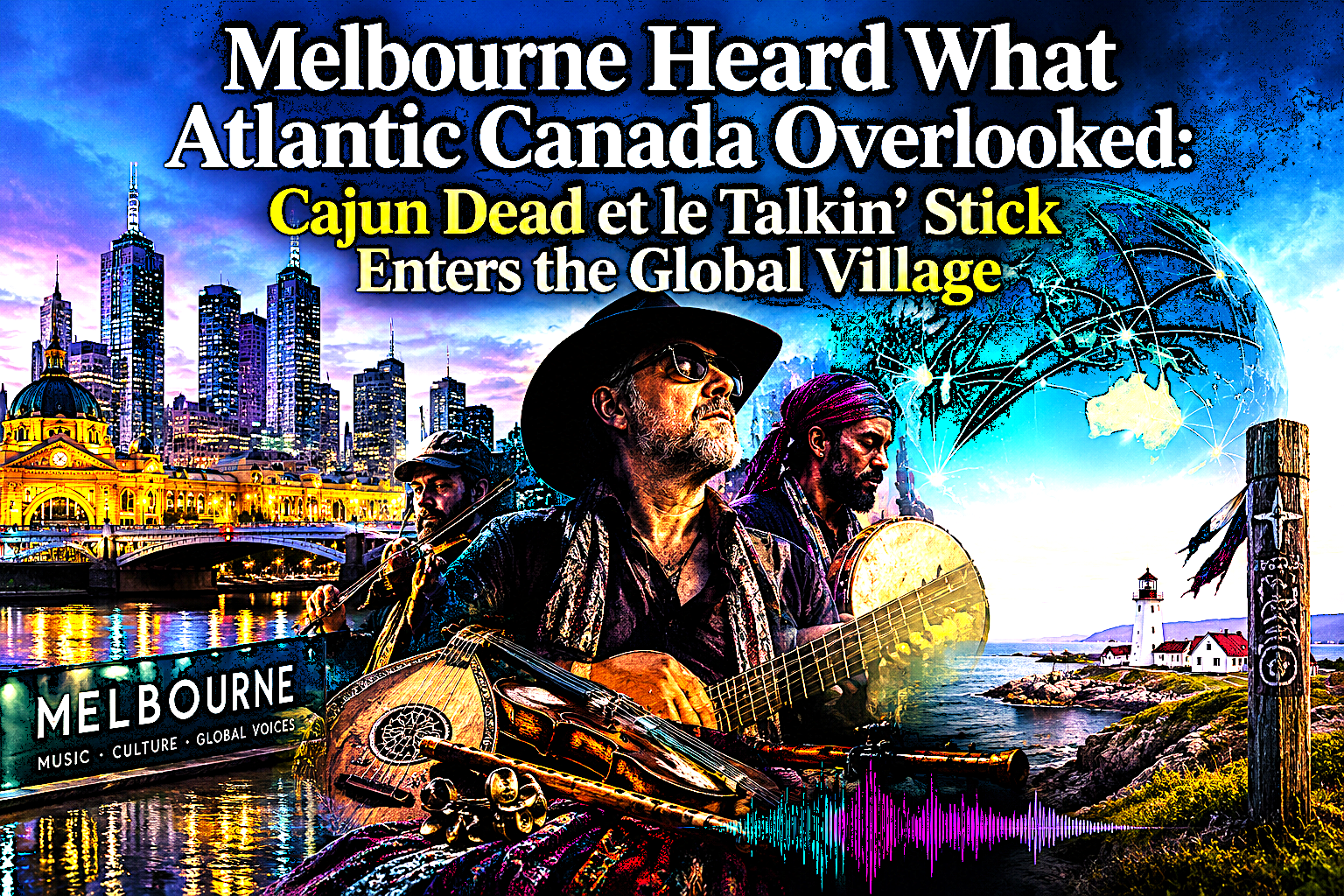
Program #1807. Sunday, September 13, 2026. PBS-FM, 106.7, Naarm/Melbourne. Host Roger Holdsworth has curated this exact two-hour slot since late 1989—before most "tastemaker" playlists you trust today had a founder born. Somewhere inside that program, next to a tribute to the late Tony Gatlif and deep cuts from Hungary and Japan, sits "Road to Perdition: Inheritance That Bankrupts Us (Arabic "Cover)"—Cajun Dead et le Talkin' Stick, self-released, out of Atlantic Canada.
That's not a vanity placement. That's a verdict. And it tells you something tactical about how inclusion actually works in 2026—if you're paying attention instead of waiting for permission.
The Placement: What Landed on Program #1807
Global Village doesn't do filler. Program #1807 built its spine around a tribute to French-Algerian director Tony Gatlif, who died September 4, 2026, at 77, while working on a new film in Arles. Gatlif spent more than two decades putting Roma music and Roma lives on screen with a level of respect the industry rarely bothers with—LatchoLatcho Drom took Un Certain Regard at Cannes; Gadjo Dilo won a Silver Leopard at Locarno and a César for its score; Exils took Best Director at Cannes in 2004. Holdsworth built out selections from those soundtracks alongside extended sets from Hungary (Fonó Records, the Erdőfű ensemble, Balogh Melinda) and Japan (Minyo Crusaders, Remon Nakanishi, Miki Saito).
The Cajun Dead track sits inside that company. An Arabic-language cover of a song about inherited debt and mountain-music roots, pulled from Volume 1: Inheritance and the Talkin' Stick, played on the same bill as RealWorld Records' new Arun Sood/Angeline Morrison record and King Ayisoba on Mais Um Discos. That's the actual news. Not "an artist got played"—an artist from a 200-plus-song, four-language catalogue got selected by a curator whose bar has been calibrated for 37 years and 1,800 episodes.
The Company You're Now Keeping
Here's what most artists miss about a placement like this: the value isn't the airplay. It's the context. Holdsworth didn't reach for Cajun Dead as a diversity checkbox—he placed it inside a program built around Romani musical migration, Hungarian folk preservation, and Japanese roots revival. That's a specific curatorial argument: this Acadian-Arabic hybrid belongs in a conversation about music that crosses borders and survives displacement. Roma. Acadian. Same wound, different accent.
That's the kind of framing you cannot buy, cannot algorithm your way into, and cannot get from a regional panel that's still deciding whether multilingual work "counts" as regional content.
The Tactical Lesson: How This Actually Gets Built
Strip the sentiment out and look at the mechanics, because this is the part worth stealing.
First: catalogue depth beats a single hit. Cajun Dead et le Talkin' Stick runs 200-plus songs across French, English, Italian, and Algerian Arabic. A curator like Holdsworth isn't scanning an algorithmic queue—he's building a themed two-hour program by hand, which means he needs a body of work deep enough to hold a track for whatever thematic needle he's threading that week. One song doesn't get you into that rotation. A catalogue built for exactly this kind of curatorial pull does.
Second: the cover format is a door, not a gimmick. An Arabic cover of an English-rooted track translates intent into a form a global curator can place next to Hanine y Son Cubano or Haifa Kamal without explanation. Cross-lingual material self-selects into world-music programming in a way monolingual regional work never will.
Third—and this is the one nobody in Atlantic Canada wants to hear—you submit directly to the human, not the institution. Community radio curators like Holdsworth still run on taste, not committee approval. No grant panel required. No jury of provincial gatekeepers deciding what "authentic Acadian music" is allowed to sound like. You send the work to the person who actually programs the show, and the work either earns the slot or it doesn't.

The Gatekeeper Problem: Melbourne Community Radio vs. Atlantic Canada's Institutions
Let's be direct. A 106.7 FM community station in Melbourne—listener-funded, run by a volunteer host with four decades of credibility—did in one Sunday broadcast what a lot of Atlantic Canada's cultural gatekeeper institutions have spent years failing to do: it put French Acadian work in direct conversation with the world, on merit, without shrinking it into a folklore display case first.
That's not a coincidence. Global Village functions as a podcast archive and a forward-thinking curatorial platform, filed and streamable for months after air, built by someone whose framework is simply "Does this music cross a border and survive the crossing?" Compare that to the insular, provincial instinct running through too many Atlantic Canadian arts institutions and self-appointed cultural intellectuals: gatekeep first, validate later, and treat multilingual or genre-crossing work as a curiosity rather than the actual future of the culture. Melbourne didn't wait for a permission slip. It listened and put the work on air next to a Cannes winner's legacy.
That's the gap. And it's exactly why owned distribution and direct-to-curator outreach beat waiting on institutional validation every time.
FAQs
What exactly was played, and when? "Road to Perdition: Inheritance That Bankrupts Us (Arabic Cover)" by Cajun Dead et le Talkin' Stick, from Volume 1: Inheritance and the Talkin' Stick, aired on PBS-FM's Global Village, Program #1807, Sunday September 13, 2026, hosted by Roger Holdsworth.
What is Global Village, and why does inclusion on it matter? It's a two-hour world-music program on Melbourne's PBS 106.7 FM, running continuously since late 1989 and past its 1,800th episode as of mid-2026—one of the longest-running, most respected curated world-music programs in community radio, hand-picked rather than algorithm-driven.
Who was Tony Gatlif, and why build a tribute around him? A French-Algerian director (born Michel Dahmani) who died September 4, 2026, at 77. His films—LatchoLatcho Drom, Gadjo Diloand Exils—centredExils — centered Roma music and Roma lives with rare respect, earning Cannes and Locarno honours along the way.
Why does a cover format help independent multilingual work get picked up? It translates intent instantly. A curator programming across a dozen languages in one sitting can place cross-lingual work next to other cross-border material without needing liner notes to explain the fit.
What's the actual takeaway for an independent artist chasing this kind of placement? Build catalogue depth, produce work that crosses languages on purpose, and pitch the human curator directly—skip the regional gatekeeper committee that's still debating whether your work qualifies as legitimate.
Sources
- PBS-FM — Global Village program page
- RadioInfo Australia — 1800 Episodes for Global Village Worldwide Music
- Brit Brief—Tony Gatlif, director of Latcho Drom, dies aged 77
- Newstrail—Cajun Dead Shakes Country Music While Old Guards Stay Deaf
- Newstrail—Cajun Dead et le Talkin' Stick: Reclaiming a Counter Culture
- Modern Contemporary Artwork Trends—Cajun Dead et le Talkin' Stick: Reclaiming the First Spark of Mountain Music