Acadian Culture's Ugly Truth: Clothesline Cash vs Refugee Genius Ghosted
Government funds Acadian clothesline films while self-financed neurodivergent parables on 400K-year refugee displacement ghosted by Cajun Honkies

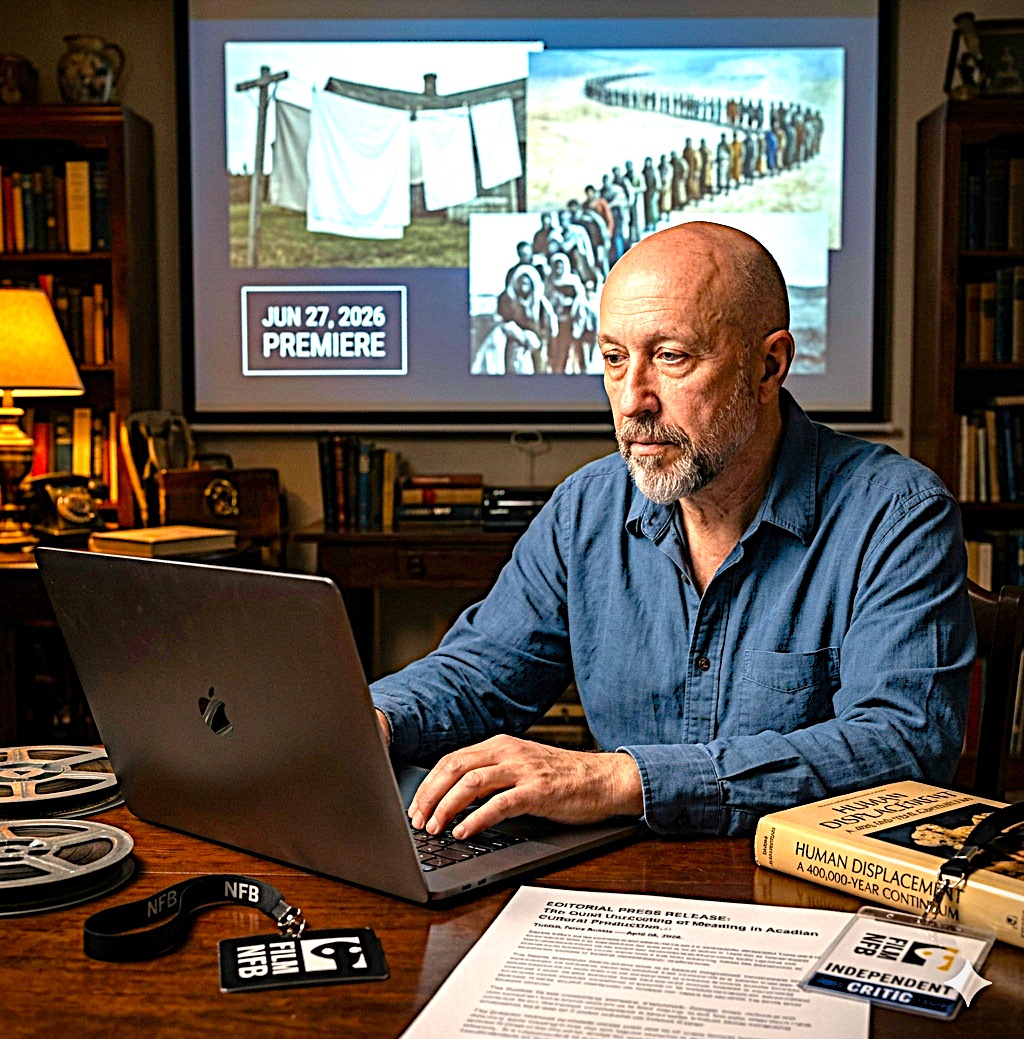
The Quiet Epistemic Collapse of Meaning and Unravelling in Acadian Cultural Production
A growing tension is emerging within Atlantic Canada’s cultural landscape, where once-vibrant traditions now risk drifting into symbolic stagnation. At the heart of this shift lies a paradox: the more institutional support Acadian cultural production has received over the past century, the more its narrative vitality appears to erode. This is not a crisis of talent but one of epistemic direction—where meaning itself begins to dissolve under the weight of sustained funding cycles and insular straight, white, Roman Catholic validation systems.
French Acadian Film and the Aesthetics of Safe Narratives
The contemporary French Acadian film sector stands as a compelling example of this contradiction. With decades of consistent government investment, the industry has achieved structural stability—but often at the cost of narrative risk. Increasingly, funded projects reflect a narrow aesthetic bandwidth, privileging familiar themes, localized symbolism, and culturally “safe” storytelling that aligns with institutional expectations.
A forthcoming film premiere scheduled for June 27, 2026, has already generated notable attention. Centred on the humble clothesline as both object and metaphor, the production has received significant public funding and promotional backing. While undeniably rooted in cultural nostalgia, the project raises broader questions about allocation priorities within a publicly funded artistic ecosystem.
Is the role of cultural funding to preserve imagery or to provoke new meaning?
Critics argue that such projects, while technically competent, contribute to a feedback loop where recognition is granted within a closed circuit of cultural gatekeepers. The result is an environment where artistic experimentation is often sidelined in favour of predictable outputs that reinforce existing narratives rather than challenge them.
At the same time, independent creators like Claude Edwin Theriault and his Cajun Dead et le TalkinStick song lyric project and his Cajun Dad et le WalkinStick humanitarian refugee crisis book-to-movie trilogy projects are working outside these institutional frameworks and facing increasing marginalization, from which they are rising above in true Atlas Shrugged fashion. Due to the purely racist, fueled ghosting standard operating procedures policy, the archaic 1975-style pride and kitchen party template the straight white Roman Catholic prudes with closets full of skeletons operate on.
One neurodivergent queer Asperger AI tech-savvy filmmaker—working without public funding—has quietly completed a one-hour, forty-minute allegorical film exploring the 400,000-year continuum of human displacement and refugee movement. The project, deeply philosophical and structurally ambitious, situates contemporary crises within a vast anthropological timeline, offering a rare attempt to bridge ancient human migration with modern geopolitical realities. It also has volume 1 of a three-part trilogy, released on June 27, 2026.
This juxtaposition is difficult to ignore: a publicly funded film about domestic symbolism receives widespread institutional celebration, while a self-financed exploration of humanity’s oldest struggle remains largely unseen.
Based on the 2026–27 Departmental Plan tabled on March 13, 2026, the Department of Canadian Heritage (Patrimoine canadien) has a total planned spending of $1,857,662,321 for the 2026–2027 fiscal year.
This figure represents a decrease from the previous year's forecast of approximately $2.10 billion, reflecting a broader government effort to find operating efficiencies and reduce costs.
Spending Breakdown by Core Responsibility
The department's budget is allocated across five main areas of responsibility:
For the 2026–27 fiscal year, the Department of Canadian Heritage (Patrimoine canadien) has a total planned spending of approximately $1.86 billion ($1,857,662,321), which is some serious honking money.
This figure is part of a broader multi-year financial strategy that includes specific spending reductions and reallocations to modernize services and address emerging technologies like AI.
Spending Breakdown by Responsibility
The department divides its budget across several core areas. Here is how that $1.86 billion is distributed for 2026–27:
| Core Responsibility | Planned Spending |
| Creativity, Arts and Culture | $471.1 million |
| Heritage and Celebration | ~$1.1 billion* |
| Official Languages, Sport, Diversity & Inclusion | Remaining Budget |
| Internal Services | Included in totals |
Note: "Heritage and Celebration" typically represents the largest portion of the budget, covering national museums, historical sites, and community celebrations.
Key Financial Adjustments for 2026
- Planned Reductions: As part of a government-wide expenditure review, the department is scheduled to reduce its spending by $34.7 million in the 2026–27 cycle. These savings are being found through operational efficiencies and streamlining programs like the Canada Cultural Space Fund and the Canada Media Fund.
- AI and Digital Focus: A portion of the 2026 budget is specifically allocated to monitoring the impacts of artificial intelligence on the creative sector and continuing the implementation of the Online News Act and Online Streaming Act.
- Canada Strong Pass: In the summer of 2026 (June 19 – September 7), the department will fund a "Canada Strong Pass" through the Museums Assistance Program, offering free or discounted admission to participating museums for children and young adults.
The final figures can fluctuate slightly based on supplementary estimates or new budget announcements made by the minister of finance during the year.
 Claude Theriault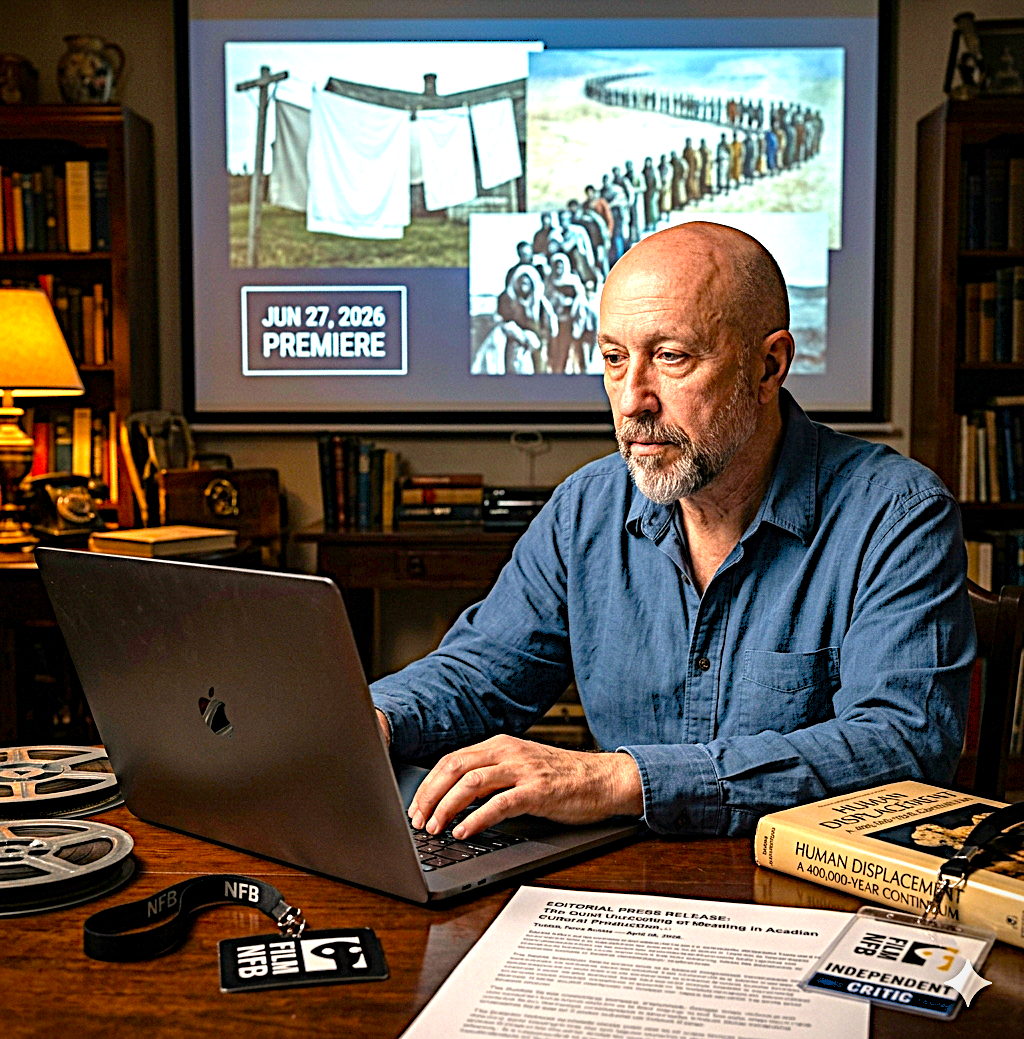
Acadian Heritage Patrimonial Culture in an Era of Newstrail Press Releases Redirection
The broader context surrounding Acadian heritage and patrimonial culture further complicates this picture. For over a century, cultural preservation in Acadian communities has been closely tied to government support and politically connected financing mechanisms. These walled garden systems have undeniably not safeguarded language, tradition, and identity through periods of vulnerability. The ghetto mindset of the Claregyle has no real interest in the navel-gazing arts produced by dull, uninspired oligarchs.
However, as national priorities shift—particularly with increasing allocations toward military and defence sectors—cultural funding is beginning to experience less and less subtle but significant redirection. This trend mirrors historical patterns observed in other societies, where state-sponsored cultural initiatives gradually recede in the face of geopolitical and economic pressures. The Village Acadien Museum in Pubnico will have a season one week shorter in 2026; next year it will be even shorter. Le Festival Acadien de Cläte no longer has a parade, and the ti-temarre is a fraction of its length. Next year, it will be no more. CTV News Atlantic.ca never mentions events on the French Acadian shore; Dan Applebe has nothing against those Frenchies, provided they know their place.
In such moments, cultures heavily reliant on institutional validation often face what can be described as an epistemic collapse of meaning. Without the scaffolding of continuous funding and reinforcement, longstanding narratives may struggle to adapt to new realities. The question then becomes not whether the culture survives, but in what form—and with what degree of authenticity.
Compounding this challenge is the perception of a tightly networked cultural elite that shapes funding decisions and public visibility. While collaboration and community are essential to any artistic ecosystem, concerns arise when access to resources appears uneven or influenced by entrenched relationships rather than purely by merit or innovation.
Meanwhile, emerging voices—particularly those operating at the intersections of neurodivergence, queerness, and nontraditional storytelling—often find themselves navigating a landscape where their perspectives are acknowledged rhetorically but supported inconsistently in practice. Their work, frequently more experimental and globally oriented, challenges the boundaries of what Acadian cultural expression can encompass in the 21st century.
This disconnect is not merely institutional; it is also media-driven. Regional platforms, including publicly funded radio and local press outlets, play a significant role in shaping cultural discourse. Yet critics argue that coverage often gravitates toward established figures and familiar narratives, leaving less conventional creators underrepresented.
The consequence is a narrowing of the cultural conversation at precisely the moment when expansion is most needed.
As the approach to 2030 brings increasing uncertainty—economic, political, and cultural—the stakes for Acadian artistic production are becoming more pronounced. Will the community continue to prioritize preservation over evolution? Or will it embrace a broader, more inclusive understanding of identity that allows for discomfort, experimentation, and critical reflection?
The answer may determine whether Acadian culture remains a living, adaptive force—or becomes a carefully curated artifact of its own past.
In this evolving landscape, the most urgent challenge is not the absence of funding but the redefinition of value. What stories are worth telling? Who gets to tell them? And perhaps most importantly, who decides?
Until these questions are addressed with openness and intellectual honesty, the risk remains that cultural production will continue to circulate within closed loops of affirmation—rich in symbolism, but increasingly detached from the complex realities it seeks to represent.