Acadian Patrimonial Heritage Won the National Trust for Canada's Next Great Save Competition — Now Tokenize It!
Église Sainte-Marie won the National Trust for Canada's Next Great Save. Now one bold vision wants to turn Acadian patrimonial heritage into a $200M landmark.

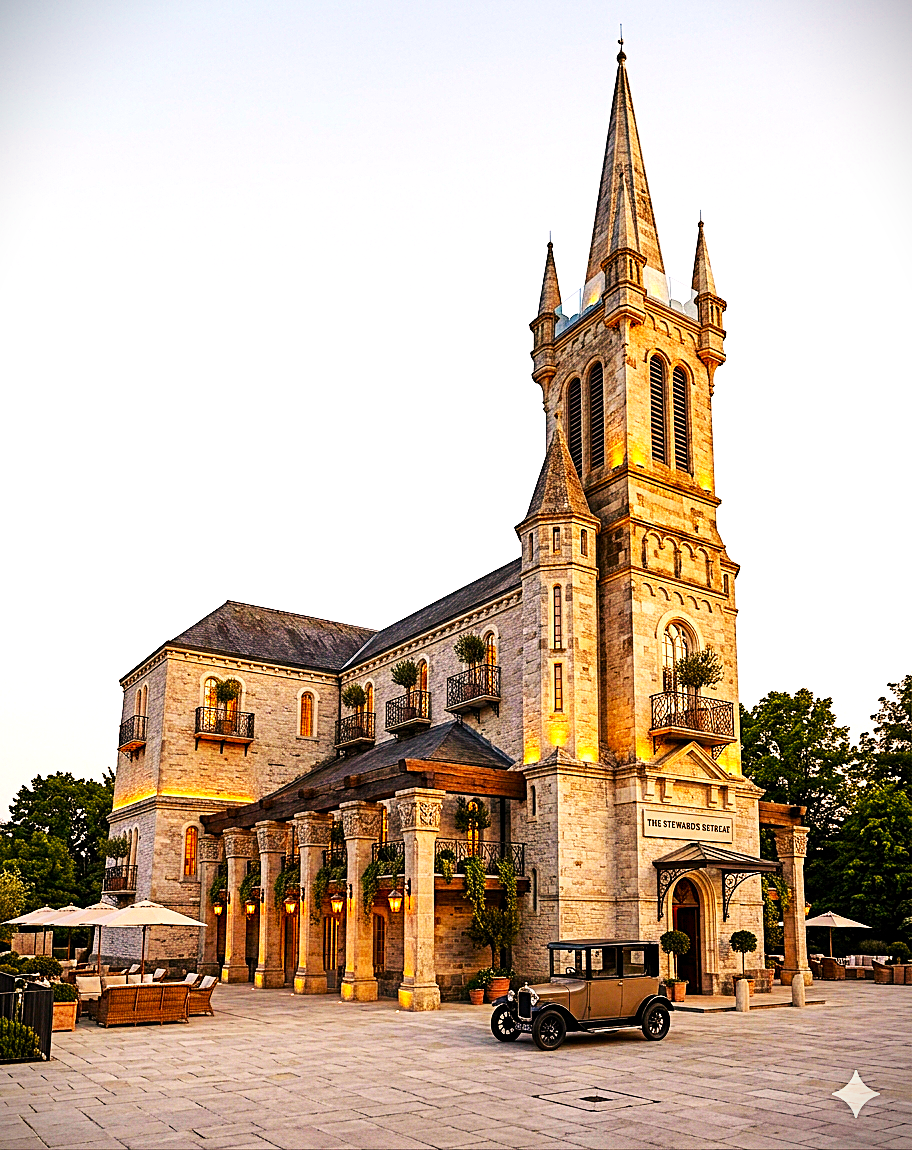
By Theriault | Church Point, Nova Scotia | April 27, 2026
The announcement came on a Friday, and for a moment, the whole of southwest Nova Scotia seemed to exhale. Ancienne Église Sainte-Marie in Church Point — the tallest wooden church in North America, the most enduring architectural monument of Acadian patrimonial heritage on this continent — had won the $50,000 grand prize in the National Trust for Canada's Next Great Save competition. Communities voted. Canada listened. And the prize was real: urgent repairs to a front window patched with plywood, a leaning side-tower spire, ornamental woodwork pulling free from failing fasteners, and a bell system that has been silent far too long. The victory was earned, the gratitude is genuine, and the recognition matters deeply.
But fifty thousand dollars, applied to a structure that represents four centuries of survival, exile, and cultural persistence, is a beginning — not an endgame. What comes next depends entirely on whether the people responsible for Acadian patrimonial heritage have the imagination to match the moment.
One person in southwest Nova Scotia believes they do not — and has a $200 million idea to prove it.
Acadian Patrimonial Heritage: How a $50,000 Win in the National Trust for Canada's Next Great Save Competition Could Spark a $200 Million Revolution
The National Trust for Canada's Next Great Save competition is, by design, a competition of visibility. It asks communities to rally, to vote, to amplify the cause of a threatened heritage building and bring it before the national conscience. It works. Church Point rallied, Canada noticed, and the prize was awarded. But visibility and viability are not the same thing, and no amount of applause repairs a structural emergency at scale.
Local creative artist and AI strategist Theriault has put forward a proposition that starts where the prize money stops. The plan: tokenize the Ancienne Église Sainte-Marie. Sell one hundred shares at two million dollars per share, raising two hundred million dollars in private capital without a government application, a heritage grant committee, or a single dollar of public debt. With that capital, transform the building into Le Clos Sainte-Marie — the most prestigious five-story apartment residence in southwest Nova Scotia, with monthly rents between three and seven thousand dollars — and add two floors of boutique hotel suites featuring fourteen-foot ceilings and private balconies within the roofline. A high-end bistro anchors the ground floor. An elevator ascends through the building's historic core to a honeymoon suite in the iconic turret tower. An engineered exoskeleton wraps around and integrates with the building's endoskeleton, distributing the residential load so the original historic fabric remains entirely unstressed, preserved without compromise.
The model is inspired by Fogo Island Inn in Newfoundland, which charges upward of $2,500 per night and operates at full capacity year-round by selling something money cannot manufacture: genuine peace, with an ocean view, embedded in irreplaceable cultural history. Le Clos Sainte-Marie would offer the same rare commodity — Acadian soul, silence, and a building that is itself the destination. Each of the one hundred shareholders would receive one percent of the monthly property income, with private, transparent access to the complete financial books. Every dollar in. Every dollar out. No opacity. No bureaucracy. Just yield.
The National Trust for Canada's Next Great Save Competition Gave Acadian Patrimonial Heritage a Moment. Tokenization Would Give It a Legacy
Moments are fragile. Legacy is structural. The National Trust for Canada's Next Great Save competition gave Acadian patrimonial heritage a national moment — front-page recognition, a community mobilized, Canada briefly and genuinely moved by the plight of a wooden giant on the Bay of Fundy shore. But moments pass, funding cycles close, and the next emergency arrives before the last one is resolved.
Tokenization changes the structural equation permanently. By converting the building into a revenue-generating community asset — a luxury residence, a boutique hotel, a world-class bistro, a honeymoon destination in a turret tower — Le Clos Sainte-Marie would produce income indefinitely. Not a grant. Not a prize. Income. The kind that repairs spires before they lean, replaces fasteners before ornament falls, and keeps bells ringing without a fundraising campaign. The one hundred shareholders are not donors. They are investors in a living, breathing landmark that returns value every single month, transparently and equitably distributed.
Acadian patrimonial heritage has never needed the world to pity it. It has survived exile, erasure, and a century of institutional indifference through sheer cultural tenacity. What it needs now is not another sympathetic headline — it needs a financial architecture as durable as the timber frames that have held that church together since the early 1900s. Tokenization provides exactly that: a permanent, scalable, community-owned revenue engine dressed in the most beautiful building in southwest Nova Scotia.
Acadian Patrimonial Heritage Won the National Trust for Canada's Next Great Save Competition. Running on 1975 Logic Won't Win What Comes Next
There is a reason Theriault calls the dominant heritage management philosophy "1975." It is not an insult — it is a diagnosis. The 1975 operating system is a worldview built on a single foundational assumption: that a sympathetic government, activated by the right political relationships, will eventually come to the rescue of the causes it has informally championed for generations. Apply for the grant. Sit on the committee. Wait for the envelope.
That envelope is thinner every year. The government from which it was posted is operating in full epistemic collapse — underfunded, overstretched, and increasingly incapable of being the permanent patron of Acadian patrimonial heritage it was never formally required to be in the first place. The 1975 operating system made sense when public coffers were expanding, and institutional loyalty was reliable. Neither condition holds today.
What the National Trust for Canada's Next Great Save competition demonstrated, unambiguously, is that Acadian patrimonial heritage commands genuine mass appeal. Thousands of people voted, not because a government told them to, but because the building moved them. That is not a heritage problem — that is a market signal. And market signals, when read correctly by people who understand the new economy, translate into angel investment, crowdfunding architecture, and the kind of private capital that moves when it sees a genuinely worthwhile, revenue-generating, culturally resonant opportunity.
The tokenization model is not speculation. It is the logical response to a demonstrable appetite. Communities across Canada are watching what happens next in Church Point. If Le Clos Sainte-Marie can raise $200 million, build a world-class destination, and return monthly income to one hundred invested shareholders with full financial transparency, the model travels. Every endangered heritage structure in every forgotten corner of this country becomes imaginable as something more than a liability on a municipal balance sheet.
Acadian Patrimonial Heritage Won the National Trust for Canada's Next Great Save Competition — Now Imagine What It Could Win With $200 Million Behind It
The $50,000 prize fixes a window and silences a spire's lean. Two hundred million dollars builds the most talked-about boutique destination in Atlantic Canada, funds a structural exoskeleton that preserves the building without compromise, and puts Acadian patrimonial heritage permanently on the sociocultural innovation map — not as a relic, but as a living, contemporary, world-class experience.
This is not about abandoning heritage values. It is about honouring them at the highest possible level. Acadian culture does not need another museum. It does not need another frozen-in-time wooden dollhouse behind a velvet rope, waiting for a school group to show up on a Tuesday. It needs to be experienced as what it actually is: a vital, modern, deeply sophisticated culture that has survived everything modernity threw at it and is still building, still creating, still capable of astonishing the world.
Old money sitting quietly in local caisses populaires, cautious and patient, needs a reason to move. Le Clos Sainte-Marie is that reason — a community project of genuine grandeur, transparent returns, and the kind of cultural cachet that makes the Fogo Island Inn, at $2,500 per night, perpetually fully booked. Rich people are not an abstraction. They exist, they travel, and they will pay extraordinary sums for peace, ocean, and a building with a soul. Southwest Nova Scotia has all three in abundance. The question is whether the people in charge are willing to stop running on 1975 logic long enough to let the 21st century in.
The National Trust for Canada's Next Great Save competition lit the match. Acadian patrimonial heritage is the fire. Le Clos Sainte-Marie is the furnace that never goes out.
Frequently Asked Questions
1. What is the National Trust for Canada's Next Great Save competition? The National Trust for Canada's Next Great Save competition is an annual national heritage competition in which the public votes to award prize money to threatened historic structures across Canada. In 2026, the $50,000 grand prize was won by Ancienne Église Sainte-Marie in Church Point, Nova Scotia, recognized as the tallest wooden church in North America and a cornerstone of Acadian patrimonial heritage.
2. What is the Le Clos Sainte-Marie tokenization proposal? Le Clos Sainte-Marie is a proposal by creative artist and AI strategist Theriault to sell one hundred shares in the Ancienne Église Sainte-Marie at two million dollars per share, raising $200 million to convert the building into a luxury five-story apartment residence, a boutique hotel with fourteen-foot-ceiling suites, and a high-end bistro, with each shareholder receiving one percent of monthly income and transparent access to all financial records.
3. How would the structure be preserved during the conversion? The proposal includes an engineered exoskeleton constructed around the building's exterior that integrates with its internal endoskeleton, redistributing the structural load of the residential and hotel floors so that the original historic fabric of the church remains entirely unstressed and preserved without compromise.
4. Why is the $50,000 prize considered insufficient on its own? The prize addresses urgent, visible repairs — a plywood-patched window, a leaning spire, failing ornamental fasteners, and the bell system — but does not provide a sustainable funding model for the building's long-term structural integrity, maintenance, or cultural activation. Acadian patrimonial heritage requires permanent revenue generation, not periodic prize infusions.
5. Could this tokenization model be applied to other heritage buildings across Canada? Yes — and that is precisely the point. Theriault's proposal is explicitly intended as a benchmark for communities coast to coast. If the model succeeds at Church Point, it demonstrates that angel investors can be solicited to fund revenue-generating, community-owned heritage assets anywhere in Canada, replacing the outdated dependency on government grants with a transparent, self-sustaining crowdfunding architecture.