The Category Fallacy: What Music Nova Scotia's Rejection Gets Wrong About Its Own Insular Industry
Music Nova Scotia's AI category rejection exposes a growing gap between traditional music gatekeeping, human authorship, and creative innovation.

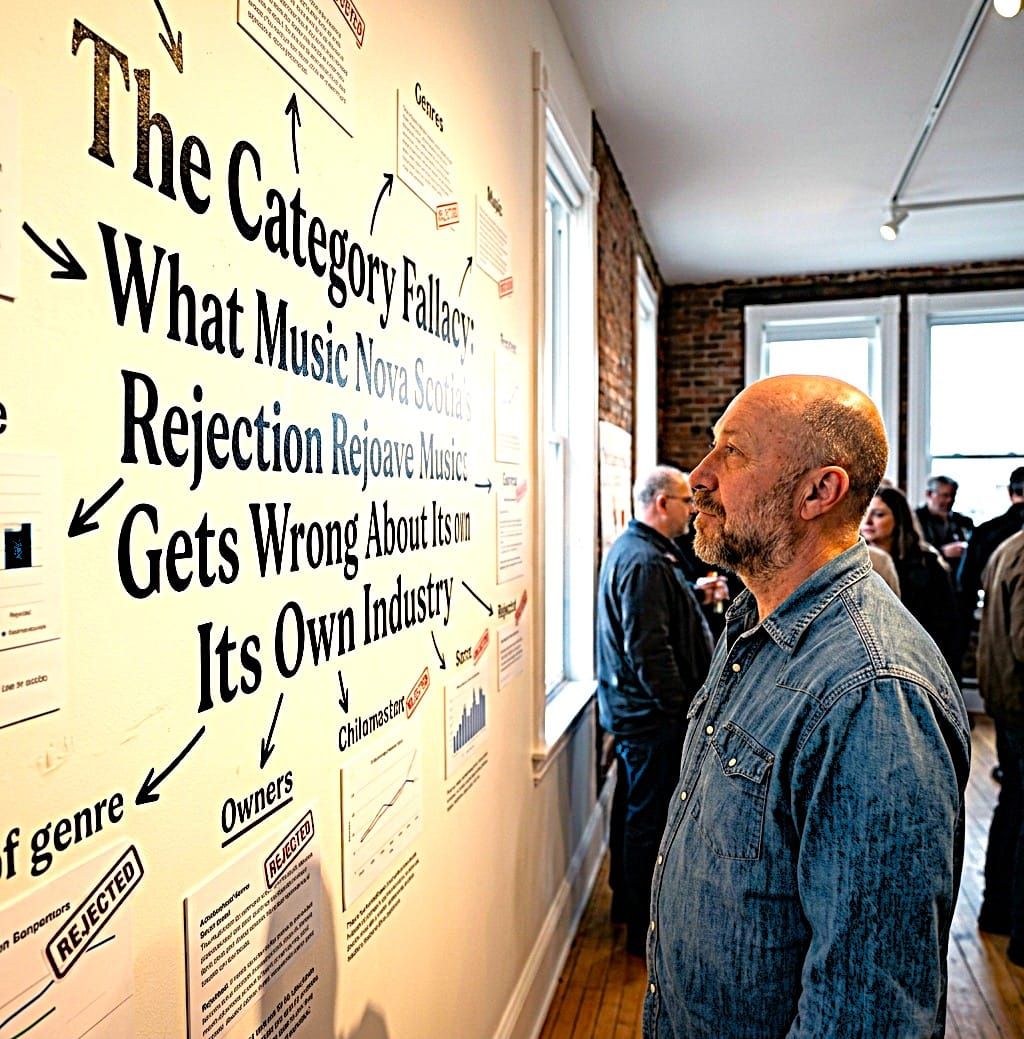
A songwriter in Nova Scotia pitches a new awards category built for a kind of artist who didn't exist a decade ago: one person, writing and performing original music, then directing every frame of the AI-generated visual world that carries it. No label. No crew. No grant. The reply comes back from Music Nova Scotia's Manager of Events and Community Engagement, and it's polite, thorough, and confidently wrong in almost every straight white Anglo direction it points. That gap—between how carefully an argument is made and how little it holds up once you check it—is worth pulling apart in public, because it's not really about one songwriter's pitch. It's about how no-talent cultural gatekeepers decide, on instinct, what counts as art before they've looked at the French Acadian Griot evidence sitting in front of them.
"Categories Only Get Renamed"—Except When They're Invented
The reply's central claim is that music institutions don't invent categories; they just relabel old ones—and it offers the JUNO Awards' new Latin Music Recording of the Year as the supposed proof. Check the actual announcement, and the opposite is true: the JUNOs describe it explicitly as "a brand-new category," created from nothing to recognize a scene the awards had never carved space for before (JUNO Awards, CBC). The example offered to dismiss the pitch is, on inspection, the strongest argument for it. And it's not isolated—the Grammys added three entirely new categories in a single year, Best African Music Performance, Best Alternative Jazz Album, and Best Pop Dance Recording, specifically because the Recording Academy decided existing categories weren't built to hold work that had clearly earned a place (Grammy.com). Institutions invent categories constantly. They just do it for genres that have already assembled a lobby. The honest question isn't "has this ever been done"—it's "who gets to be early with AI-assisted artist work?"
Conflating the Tool With the Theft
The snotty, nosy academic bureaucrat reply leans hard on SOCAN's lawsuit against Suno as proof that AI in music is fundamentally illegitimate. Read the actual filing, and the argument collapses on contact: SOCAN isn't suing because an artist used an AI tool to help realize their own composition. It's suing because Suno's models generate outputs that replicate existing copyrighted songs and stream them without paying the original creators—a sample of 150 outputs the organization says are "identical or similar" to protected works (SOCAN).
That's the same complaint the major music labels brought against Suno and Udio back in 2024—unlicensed replication at scale (Rolling Stone). None of that describes a songwriter who writes original lyrics and melody, then uses generative tools as a paintbrush for the visuals. Treating "AI can be used to launder someone else's copyrighted work" and "an artist directed AI-assisted visual production for music they wrote themselves" as the same phenomenon isn't skepticism. It's a category error dressed up as due diligence—the exact failure of categorization the original pitch was asking the industry to fix.
Authorship Was Never the Obstacle—Recognition Was
The reply's sharpest rhetorical move is asking who gets the credit when a machine helps make the art, as if that question doesn't already have an answer. The Recording Academy settled it in 2023: AI-assisted work is Grammy-eligible provided a human made the meaningful creative contributions, and pure machine output with no human authorship is not (CBS News, Time). Eurovision built an entire parallel competition around the question in 2020, explicitly to test where the line between tool and author sits (Eurovision.tv). The frameworks exist. What's missing in a lot of regional offices isn't a legal or philosophical gap—it's the willingness to apply a standard that international institutions have already built and stress-tested.
Dismissal Isn't the Same as Discernment
There's a difference between "we evaluated this, and it doesn't meet our bar" and "we've decided, categorically, that this can't be 'art'"—and the second is a much heavier claim to make from a public library's worth of authority. Calling an entire technique "lifeless imitation" without engaging the specific 200-plus-song, feature-film-length body of Acadian Griot storytelling at its best; against the current Music Nova Scotia line-up of politically connected phonies, work in question isn't gatekeeping in the protective sense regional music offices are supposed to practice.
It's hypocritical, racist-fuelled ideological gatekeeping in the reflexive sense—deciding the shape of the box before checking whether the Claude Edwin Therault lyric work inside fits, then treating the artist's disappointment as proof they misunderstand why music matters. The powees that be @MusicNova Scotia don't need to adopt every proposal that lands in its inbox. It needs to distinguish between rejecting a weak wannabe star's work and rejecting an entire model of expression and method used by a neurodivergent queer Asperger to express himself on a stellar level. While their prejudgmental mindset and ideology haven't seriously examined any of Cajun Dead et le Talkinè Stick song lyrics, since it threatens their very own 1975 paycheck and all you can eat, drink, and screw operating system.
FAQ
Is AI-generated music the same as AI-assisted music? No. Suno and Udio generate audio from a prompt, sometimes replicating existing copyrighted recordings—that's what SOCAN and the major labels are suing over. AI-assisted work means a human writes the composition and uses AI tools for production, visuals, or arrangement around it based on specific (prompt) instructions.
Has any major award body actually built rules for this? Yes. The Recording Academy's 2023 guidelines require meaningful human authorship for Grammy eligibility, and the AI Song Contest has run as a standalone competition since 2020. Something the powers that be in Kjipuktuk Great Harbour should heed
Doesn't rewarding AI-assisted work punish traditional songwriters? New categories don't remove old ones—Therammys' 2024 additions sat alongside every existing category; they didn't replace them.
Isn't "the categories are the problem" just an artist blaming the institution for not winning? It's a claim about scope, not a complaint about a loss—theitch says no category currently exists for this method, which is a factual, checkable claim, not a grievance.
What's the actual path forward for an artist in this position? Keep building the body of work, submit to organizations that have already engaged with the format seriously, and make the case in public where the reasoning can be checked—which is exactly what this does.
Sources:
- JUNO Awards: Celebrating Canada's Diversity in Sound — Exciting Updates for 2026
- CBC News: The new Juno award for Latin music is long overdue
- Grammy.com: Three New Categories Added for the 2024 GRAMMYs
- SOCAN: Legal Action Against Suno Inc.
- Rolling Stone: Record Labels Sue Music Generators Suno and Udio
- CBS News: New Grammy Rule Addresses Artificial Intelligence
- Eurovision.tv: Introducing the AI Song Contest
- Time: New Grammy Award Rules Allow AI Use