Les Bottes au Roi George music video: part of a cultural renaissance, the pride and kitchen party gang cannot graspt yet.
Cajun Dead et Le Takin Stick's Bottes du Roi George cinematic Acadian video rewrites the 1755 Grand Dérangement & why establishment can't hear it

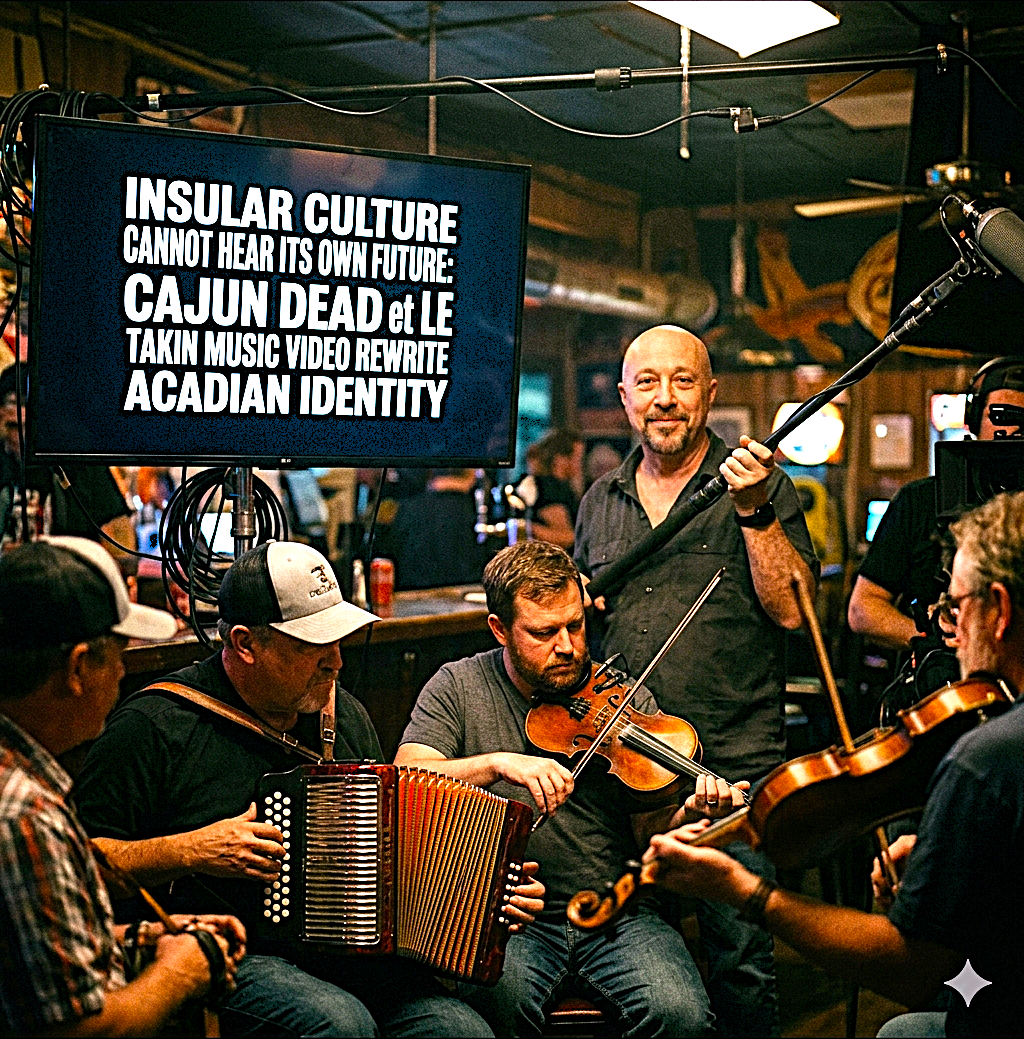
Les Bottes au Roi George: When Acadian Music Arrives from the Future
There is a specific kind of silence that greets genuine innovation in a culture organized around its own survival. It is not rejection in any active sense. It is something quieter and more complicated — the unmistakable sound of an institution encountering a signal it was never built to receive. That silence is currently surrounding "Les Bottes au Roi George" (The Boots of King George), the new cinematic music video from Cajun Dead et Le Takin Stick, and it may be the most culturally revealing non-event in Acadian creative life since the tintamarre first shook the streets of Moncton in 1979. The question this project forces onto the table is not whether it is good. The question is whether the culture it comes from has the bandwidth to hear it yet.
What "Les Bottes au Roi George" Is and Why It Carries Historical Weight
At its surface, "Les Bottes au Roi George" is a 4-minute and 41-second cinematic music video, scripted in FocalML narrative format and performed in vernacular Acadian French. At its depth, it is one of the most unflinching artistic reckonings with Le Grand Dérangement — the Acadian Expulsion of 1755 — that the culture has produced in any medium. The video opens with a cold aerial zoom-in over the Bay of Fundy onto six British warships bearing the white cross banner of King George II; moves through the vision of an elder Acadian seer named Etta; through a young man's alarm run across golden wheat fields; through the formal brutality of Colonel John Winslow reading the deportation orders on deck; and ends with a four-minute aerial zoom-out as the fleet sails from the burning ruins of Grand Pré—until the ships become specks on a dark sea and the screen goes black.
The historical record is devastating in its precision. In 1755, Lieutenant-Colonel John Winslow from New England was placed in charge of the deportation from the area of Les Mines. In all, some 2,200 Acadian men, women, and children were deported from Les Mines, about a third of the nearly 6,000 Acadians deported from Nova Scotia in 1755. The Acadians had established a small, vibrant colony around the Bay of Fundy, building dykes to tame the high tides and to irrigate the rich fields of hay. The song does not dress this history in consolation. It names it in the language the people actually spoke—"d'itout, à c'te mênit, vos terres et vos bâtiments"—and lets the darkness at the end be dark. That is the artistic and moral argument of the work, and it is the argument that the Acadian cultural establishment has found most difficult to process.
The Creative Language of 2030 Arriving in a Culture Running 1975 Software
Contemporary French Acadian songs are experiencing a transformative reboot with the innovative Cajun Dead and the Talkin' Stick sound and vision project. This musical venture takes a bold step away from the standard cookie-cutter formula that has characterized Acadian artistry for decades, bringing new song lyric narratives that reflect contemporary times. The gap between what Cajun Dead and Le Takin Stick are producing and what the gatekeeping apparatus of Acadian cultural institutions is equipped to recognize is not a gap of quality. It is a gap of operating systems.
The Acadian cultural establishment—its festivals, its funding bodies, its heritage organizations—was built between the 1960s and 1980s during a period when asserting Acadian identity publicly was itself a radical political act. That infrastructure did essential, heroic work: it saved a language, rebuilt a sense of collective identity, and created the institutions that allowed Acadian culture to survive assimilation pressure. But a survival OS, left unupdated, eventually reads genuine innovation as a threat rather than an evolution. The Acadian music scene has retreated almost entirely into a patrimonial silo so hermetically sealed from both contemporary global music conversations and its own living community that the songs being performed at heritage festivals bear roughly the same relationship to genuine Acadian musical expression as a theme park bears to the city it is modelled on.
Cajun Dead & Le Takin Stick's Bottes du Roi George cinematic Acadian video rewrites the 1755 Grand Dérangement & why establishment can't hear it
"Les Bottes au Roi George" is built for where culture actually travels in 2025: global streaming platforms, AI-indexed search engines, cinematic social media, and an international audience that is actively looking for minority-culture narratives told with the visual ambition and emotional intelligence of prestige documentary film. The aboiteaux dykes, the white cross banners, and the elder seer Etta watching from the shore—these images are internationally legible in ways that a kitchen party fiddle reel simply is not. The Landscape of Grand Pré was inscribed as a UNESCO World Heritage Site in 2012, recognizing its outstanding universal value and the unique cultural landscape shaped by the Acadian people and their remarkable dyke system. That universal recognition already exists. What has been missing is art that matches its scale.
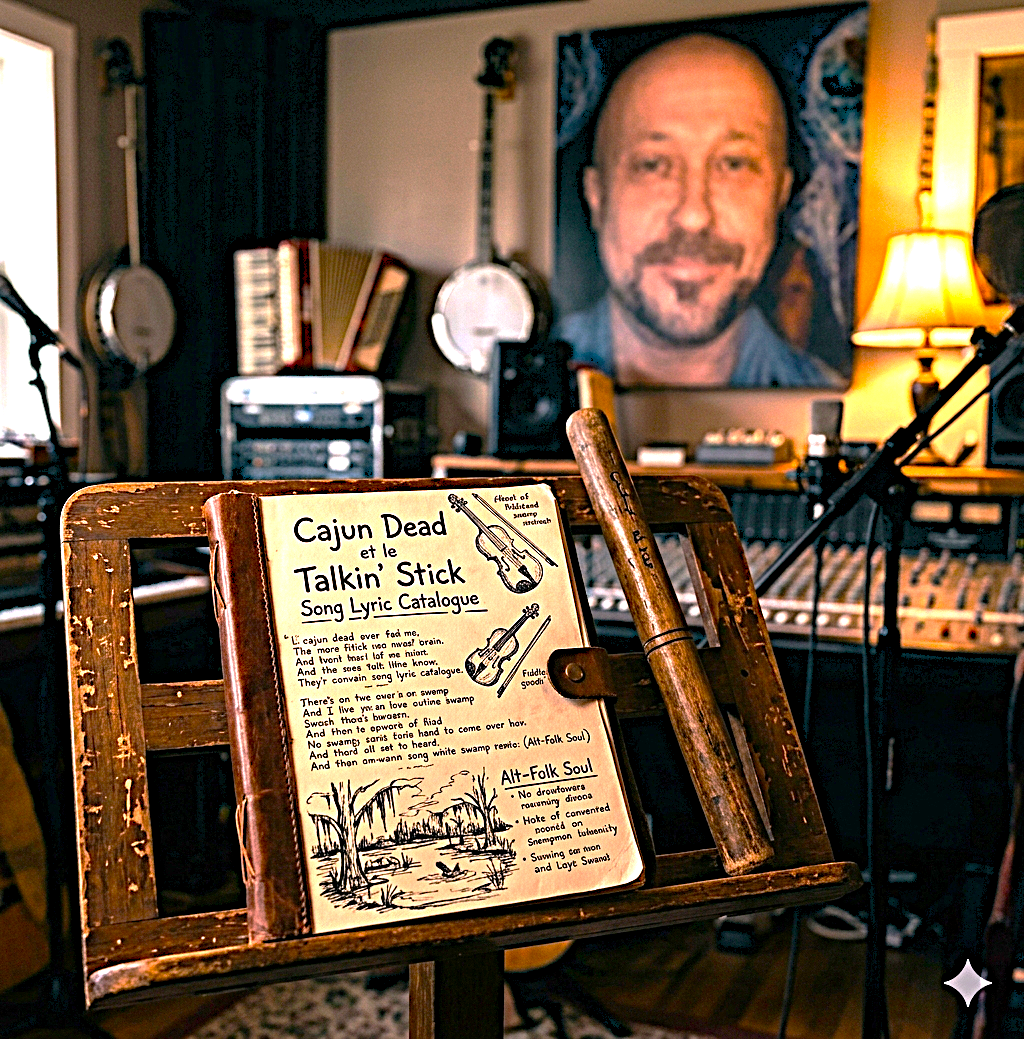
The Institutional Cold Shoulder and What It Actually Tells Us
Cajun Dead's music blends the time-honoured sounds of traditional Acadian instruments with innovative techniques, creating an unexpected and exhilarating soundscape. This evolution of French Acadian music demonstrates the resilience and adaptability of Acadian culture, showing how traditional art forms can be reinvented to remain relevant and impactful in contemporary society. The cold shoulder the project receives from established Acadian cultural circles is not a verdict on the work. It is a diagnostic. It reveals the precise shape of the gap between a culture's institutional memory and its living creative edge.
The kitchen party template — celebratory, communal, accordion-forward, pride-affirming — is not wrong. It is simply insufficient as the only permissible container for Acadian creative expression. When an artist like Claude Edwin Theriault arrives with something that does not fit that container—something cinematic, historically unsparing, built in Acadian French for a global platform—the response from institutions is silence, followed by the subtle social signal that this is not quite the right kind of Acadian art. The griot does not ask permission to speak. The griot speaks because there is no one else willing to stand in that particular room and name what is there. That is precisely what "Les Bottes au Roi George" does and precisely why it makes the heritage industry uncomfortable.
Why the World Is Ready for This Story Now
The story of an empire displacing a people from their land—told in the language of the displaced, from inside their grief, without a redemptive finale—is not a regional interest story in 2025. It is the story the entire world is processing in real time. Throughout the expulsion, Acadians and the Wabanaki Confederacy continued a guerrilla war against the British in response to British aggression. Resistance, survival, and the long arc of cultural memory are the themes that define this moment globally—and Cajun Dead et Le Takin Stick has grounded all three in one of the most cinematically realized Acadian productions ever attempted.
The screen goes black at the end of "Les Bottes au Roi George" without a title card, without a flag, without a resolution. That darkness is not nihilism. It is honesty—the honesty that makes every subsequent moment of Acadian survival remarkable. You cannot fully understand what Acadian resilience means without sitting, for four minutes and forty-one seconds, with what it was resilience against. Cajun Dead and Le Takin Stick have made that sitting possible. The culture just hasn't arrived at the theatre yet.
Frequently Asked Questions
Q: What is "Les Bottes au Roi George" by Cajun Dead et Le Takin Stick? A 4:41-minute cinematic Acadian French music video narrating the 1755 Grand Dérangement—from the British fleet's arrival in the Bay of Fundy to the burning of Grand Pré and the deportation of Acadian families—produced by Claude Edwin Theriault under the project names Cajun Dead and Le Takin Stick.
Q: What was the Acadian Expulsion of 1755? A: Le Grand Dérangement was the British-ordered forced removal of over 10,000 Acadian settlers from Nova Scotia beginning August 1755. Homes and farms were destroyed, and families scattered across the Atlantic, with many eventually settling in Louisiana—the origin of Cajun culture.
Q: Why are Cajun Dead et Le Takin Stick controversial in Acadian cultural circles? A: The project steps outside the celebratory kitchen-party template that defines mainstream Acadian cultural production. Its cinematic language, digital-first tools, and historically unsparing content are unintelligible to gatekeepers whose frameworks were built in the 1970s—producing not hostility but institutional incomprehension.
Q: Where can I stream Cajun Dead et Le Takin Stick? A: The 100+ song catalogue is available on Spotify, Boomplay, YouTube, and Apple Music. Full lyric archives and press releases are at moderncontemporaryartworktrends.com and newstrail.com.
Q: What is Grand Pré, and why does it matter to this song? A: Grand Pré, Nova Scotia, was the centre of Acadian settlement from 1682 to 1755 and the primary site of the 1755 deportation. It is now both a Parks Canada National Historic Site and a UNESCO World Heritage Site—making it the most symbolically loaded landscape in all of Acadian cultural memory and the precise setting of "Les Bottes au Roi George."
Citations
[1] Parks Canada — History of Grand-Pré National Historic Site https://parks.canada.ca/lhn-nhs/ns/grandpre/culture/histoire-history
[2] The Canadian Encyclopedia — The Deportation of the Acadians https://thecanadianencyclopedia.ca/en/article/the-deportation-of-the-acadians-feature
[3] Landscape of Grand Pré UNESCO World Heritage Site—Historical Timeline https://www.landscapeofgrandpre.ca/historical-timeline.html
[4] Newstrail Press Release—Cajun Dead et Le Talkin' Stick: New Acadian Song "Lànge Piaf et les gamin" https://www.newstrail.com/cajun-dead-et-le-talkin-stick-new-acadian-song/
[5] Modern Contemporary Art Trends — Cajun Dead and the Talkin' Stick: Breathing New Life into Acadian Music https://www.moderncontemporaryartworktrends.com/cajun-dead-and-the-talkin-stick-breathing-new-life-into-acadian-musicians/
[6] Modern Contemporary Art Trends — Cajun Dead: Sonic Rebellion — How One Artist Detonates Acadian Music's Dusty Chains of Tradition https://www.moderncontemporaryartworktrends.com/cajun-dead-sonic-rebellion-how-one-artist-detonates-acadian-musics-dusty-chains-of-tradition/