From Blomidon to Bayou Teche: How Cajun Dead et le Walkin' Stick Bridges the 1755 Acadian Diaspora and the 2026 Humanitarian Refugee Crisis
Cajun Dead et le Walkin' Stick links 1755 Acadian expulsion to the global refugee crisis through folk music, film, griot storytelling tradition.


A film within a film, Blomidon to Bayou Teche: How Cajun Dead and le Walkin' Stick Bridge the 1755 Acadian Diaspora and the 2026 Humanitarian Refugee Crisis side by side in the Akashic record flow
There is a road that does not appear on any map. It begins at the red clay headland of Blomidon, rising above the highest tides on earth at the Minas Basin, Nova Scotia. It ends—or rather, it continues without ending—in the bayou country of Louisiana, in the rubble of Gaza, in the dust of Sudan, in every geography where human beings have been marched from the place that was theirs. Cajun Dead and the Walkin' Stick, the 200-song griot archive and forthcoming three-volume book and film trilogy created by Claregyle, Nova Scotia artist Claude Edwin Theriault, walk that road and refuse to pretend it is finished.
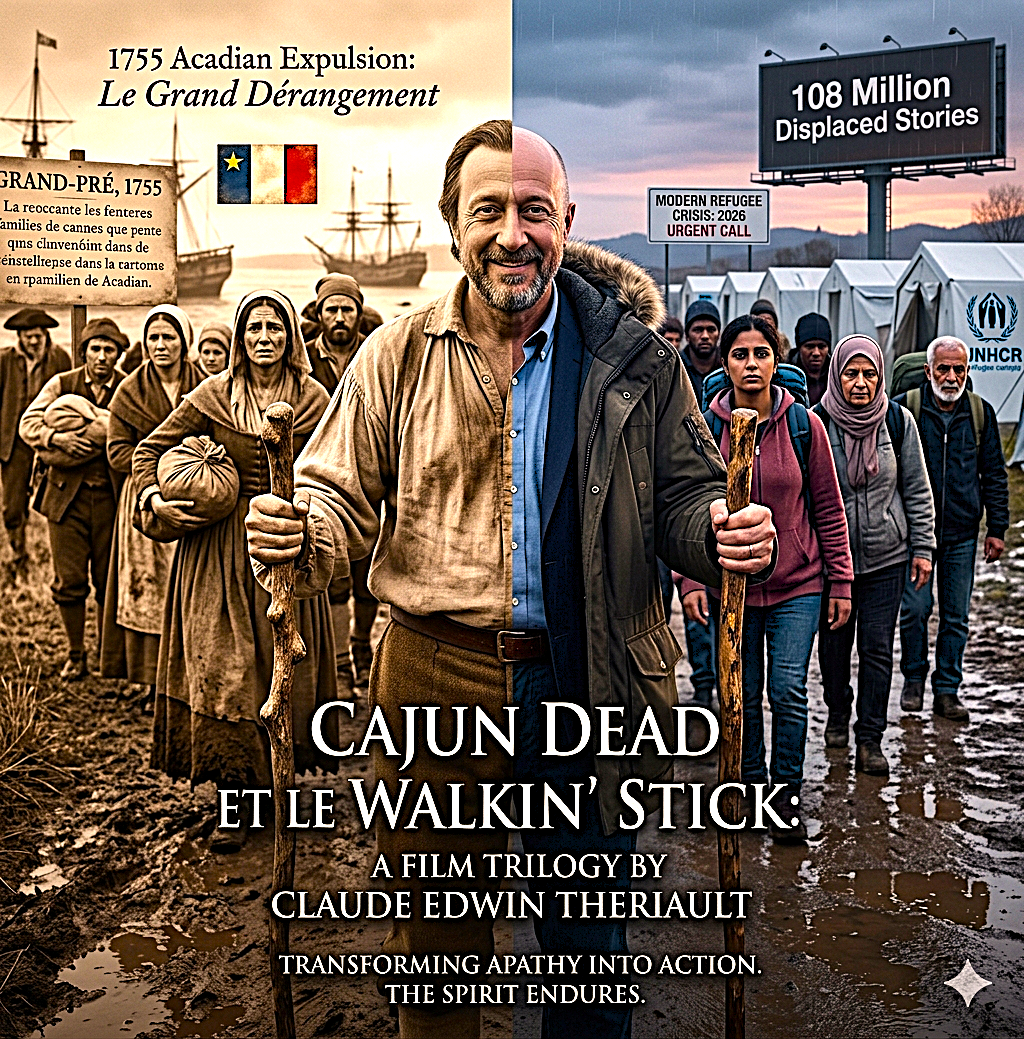
 Claude Theriault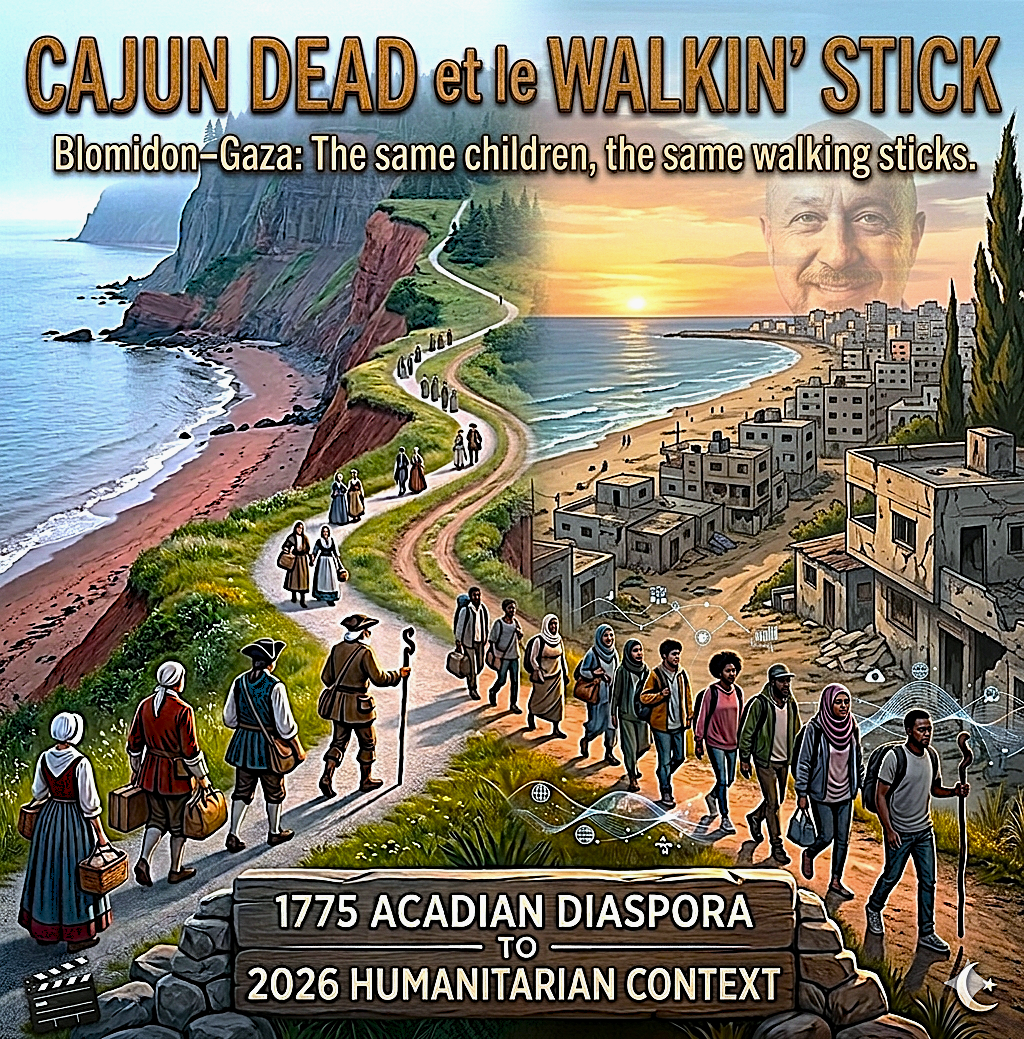
The project connects two timelines most people have been trained to consider separate: a colonial atrocity in 1755 and a humanitarian catastrophe in 2026. Theriault's argument—made in Chiac, in English, in Appalachian modal scales, and in AI-assisted cinematic imagery—is that they are the same event, wearing different clothes, speaking different languages, and happening to different people for the same reason: empire does not stop producing refugees. It outsources the guilt and continues the march.
The 1755 Grand Dérangement: The Expulsion That Started the Walk
In the autumn of 1755, British colonial forces removed the French-speaking Acadian population of what is now Nova Scotia in a forced deportation that scattered approximately 12,000 people across the Atlantic world. The expulsion from the headland of Blomidon—the Bay of Fundy coast that the Acadian community considered the axis mundi of their world—through the Atlantic crossing and into the Louisiana bayou country is the mapped route of a forced migration that the twenty-first century is reproducing, in different languages and different geographies, at a pace no heritage festival aesthetic was built to address. Those deportees who eventually reached Louisiana became the Cajun people. Those who did not reach Louisiana were scattered to the Carolinas, to France, to the Caribbean, and to Saint Pierre et Miquelon. They carried one thing the British could not confiscate: the song. Newstrail
In 1755, British colonial forces expelled the French-speaking Acadian population from what is now Nova Scotia in the event known as the Grand Dérangement—one of the first documented mass deportations in North American history. Those who eventually found their way to Louisiana became the Cajun people, carrying their ballad traditions, their bilingual French-English code-switching, and their modal folk scales into a new geography where those traditions fused with Creole, African, and Caribbean influences to produce Cajun music and Zydeco. This is not distant history. It is the opening chapter of the same story the world is still writing. According to the UNHCR Global Trends Report, the number of forcibly displaced people worldwide exceeded 120 million in 2023—the highest figure ever recorded in human history. Newstrail
The Walking Stick as Symbol: Courage Across Centuries
The walking stick at the centre of Theriault's project is not decorative. In the Acadian oral tradition, as in the Indigenous talking-stick councils of Turtle Island, the stick is the right to speak without interruption. It is passed to the one who carries the testimony the room would prefer not to hear. In the song "Un Vrai But Crée du Courage," the lyric declares, "Pas d'chemin d'avant, pas d'chemin d'arrière dans la misère / Marche en avant, l'attaque s'en vient sur ta vie entière"—no road forward, no road back in the misery; march forward, the attack is coming for your whole life. This is not a metaphor. It is an instruction issued in Chiac from the Bay of Fundy coastline and applicable to anyone who has ever been forced to leave the place that made them who they are.
The worldbeat percussion throughout these songs—the frame drums, the darbukas, and the North African rhythmic architecture—is present because displacement is not exclusively an Acadian story. It is a human story. And the folk tradition this project works inside was built, from its foundation, on the understanding that the local and the universal are not opposites. The UNESCO Intangible Cultural Heritage framework recognizes oral traditions and folk expression as among the most durable forms of cultural resistance, precisely because they cannot be bombed, confiscated, or legislated out of existence. They live in the throat. Newstrail
Griot Storytelling and the Folk Tradition That Refuses to Forget
French Acadian songs are experiencing a transformative reboot with the innovative Cajun Dead and the Talkin' Stick sound and vision project. This musical venture takes a bold step away from the standard cookie-cutter formula that has characterized Acadian heritage music for decades, bringing new song lyric narratives that reflect contemporary times and shed light on real-world challenges from Moncton to Church Point. Modern contemporary artwork trends
The griot tradition Theriault works in is West African in origin and universal in application: the griot is the keeper of collective memory, the one who stands up after the disaster and names what happened so that the community does not have to carry it alone and in silence. These are griot songs built on the modal architecture that the Acadian community shares with Appalachia. The Dorian mode—minor with a raised sixth—produces what musicians describe as simultaneously dark and luminous, minor in feeling but with a lightness that prevents it from collapsing into simple grief. These are the emotional registers of the music that has endured from both traditions precisely because they map most honestly onto the experience of communities that have known displacement, survival, and the specific kind of resilience that does not resolve into triumph. Newstrail
64 Parishes, the authoritative encyclopedia of Louisiana culture, confirms that Cajun music is rooted in the ballads of the French-speaking Acadians of Canada—a direct line of inheritance from the Nova Scotia complainte to the bayou two-step that Theriault's project walks backward and forward simultaneously.
From Blomidon to Gaza: The Argument the Trilogy Is Making
The specific geography of the trilogy—Blomidon, Bayou Teche, Saint Pierre et Miquelon, and Pubnico—is the mapped route of a forced migration that the twenty-first century is reproducing, in different languages and different geographies, at a pace that no heritage festival aesthetic was built to address. Newstrail
The Newstrail press release announcing the trilogy states it plainly: the trilogy carries the lyric, the music, the image, and the civilizational argument into the form that the present moment demands, using AI composition tools and AI video generation to translate the audio into the visual world the symbolist tradition has always seen behind the song. Newstrail
What makes Cajun Dead et le Walkin' Stick distinct from heritage documentation is that it refuses to treat the 1755 deportation as resolved. The nearly 200 songs in the archive, streaming on Spotify, Boomplay, and YouTube, make the argument in real time—song by song—that the Acadian expulsion is not a completed historical event any more than Gaza is a completed news cycle. They are chapters in a story humanity keeps writing because it has not yet been willing to learn the lesson the walking stick has been trying to teach for 270 years: that no colonial administration has ever had the right to decide whose home belongs to whom, and the oral tradition exists precisely to say so when every other institution has agreed to stay quiet.
The full archive is documented at moderncontemporaryartworktrends.com. The Newstrail press release on the trilogy is available at newstrail.com.

Five FAQs
Q1: What is Cajun Dead and the Walkin' Stick? It is a 200-song griot folk archive and three-volume book and film trilogy created by Nova Scotia artist Claude Edwin Theriault. The project connects the 1755 Acadian deportation—Le Grand Dérangement—to the contemporary global humanitarian refugee crisis through bilingual Chiac and English songwriting, Appalachian modal composition, and AI-assisted cinematic production.
Q2: What is the significance of the walking stick in the project? The walking stick is a dual symbol drawn from both the Acadian oral tradition and Indigenous talking-stick council practice. It represents the right to speak testimony without interruption—specifically, testimony about displacement and colonial violence that institutions prefer to leave unspoken. In the song Un Vrai But Crée du Courage, the stick appears as a symbol of forward motion in the face of total loss.
Q3: How does the project connect 1755 to the 2026 refugee crisis? Theriault's argument is structural: the British expulsion of Acadians from Nova Scotia in 1755 was one of the first documented mass deportations in North American history, and the dynamics that produced it—colonial land seizure, ethnic and linguistic persecution, and bureaucratic erasure of civilian populations—are the same dynamics producing refugee crises from Gaza to Sudan today. The music treats these as the same event across time, not separate historical episodes.
Q4: What musical traditions does Cajun Dead draw from? The project draws on the Acadian complainte oral tradition, the Dorian and Mixolydian modal scales shared between Appalachian and Scots-Irish folk music, West African griot storytelling rhythms, and the Chiac bilingual dialect native to coastal Acadian communities. AI-assisted production handles harmonic layering and timbral architecture, while all lyrics are human-written by Theriault.
Q5: Where can I listen to the Cajun Dead catalogue and access the trilogy? The full catalogue streams on Spotify, Boomplay, and YouTube. The books are available on Amazon. Cultural commentary, full lyric archives, and the project's theoretical framework are documented at moderncontemporaryartworktrends.com. Press releases and media coverage are at newstrail.com.