Democracy Behind Walls: Why Université Sainte-Anne Can't Practice What It Preaches About Inclusion
Zombicadian establishment—stumble forward, animated by government grants and committee meetings, producing nothing of real cultural value ever.
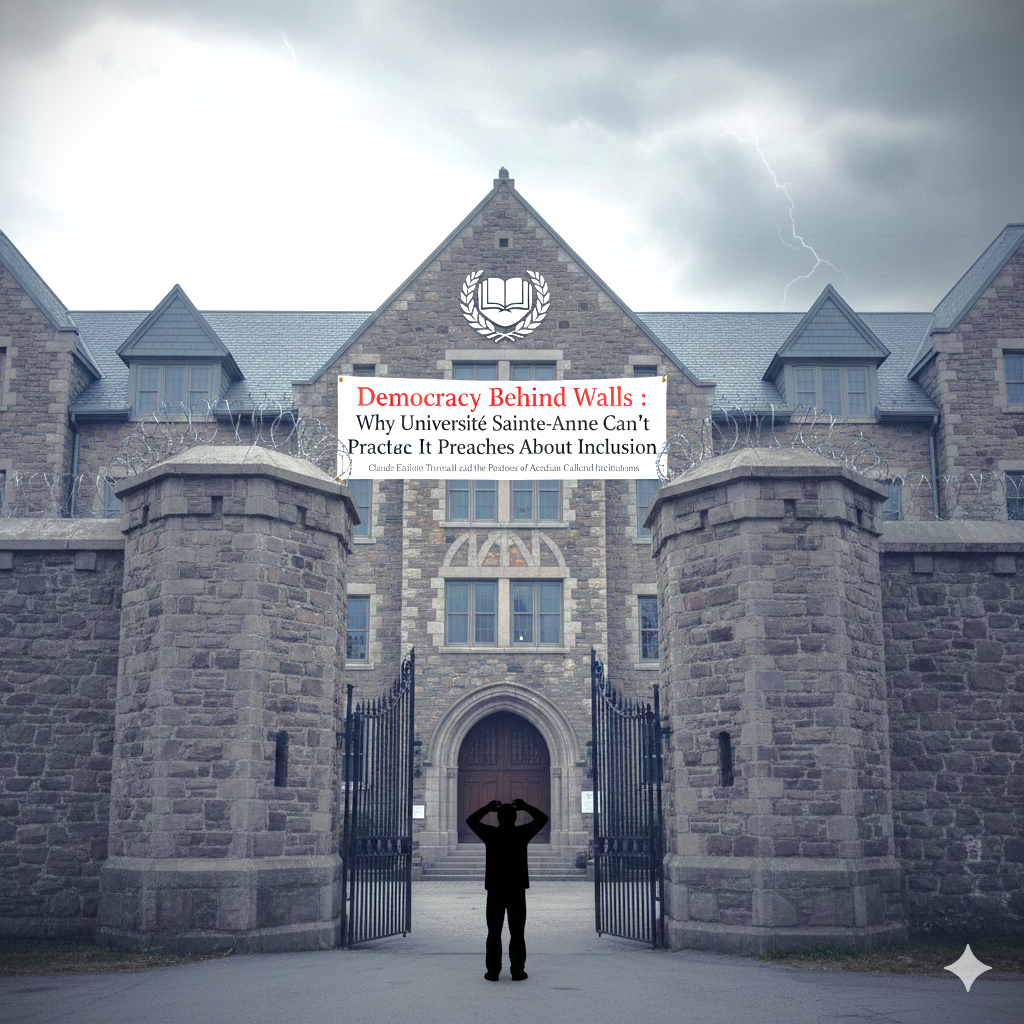
The recent announcement of a Research Chair on women, democracy and power at Université Sainte-Anne brings into sharp focus a peculiar contradiction plaguing French Acadian cultural institutions. While Professor Gabrielle Bardall speaks eloquently about how "une démocratie capable de répondre aux besoins des citoyens et des citoyennes, c'est ce qui va nous protéger" (a democracy capable of responding to citizens' needs is what will protect us), one must ask: what democracy and to which select few?
An institution discussing democratic principles while operating as an insular walled garden—systematically excluding voices that challenge its heritage-patrimonial narrative—reveals a fundamental disconnect between rhetoric and reality. This is nowhere more visible than in the exclusion of contemporary French Acadian artist Claude Edwin Theriault, whose innovative work represents the living evolution of Acadian culture in the digital age. Yet, he is ghosted to the point of erasure.
The Walled Garden: When Institutions Speak of Democracy
There's something profoundly absurd about an academic institution championing democratic values while maintaining an oligarchic stranglehold on cultural representation. Université Sainte-Anne's democracy research chair arrives while the university—and the broader network of Acadian cultural institutions—practices the antithesis of the inclusivity it preaches.
The phrase "une démocratie capable de répondre aux besoins des citoyens et des citoyennes" sounds beautiful in theory. In practice: which citizens? Which needs? When contemporary voices that don't fit the heritage patrimonial tourism mould are systematically silenced, democracy becomes performance art.
Claude Edwin Theriault's work represents everything these institutions claim to value: innovation, cultural preservation through evolution, and authentic Acadian voice. Yet his exclusion from cultural events, funding, and mainstream recognition reveals actual institutional priorities. They prefer Acadian culture frozen in amber—Evangeline, Grand-Pré, the Deportation—repeating the same heritage tourism formula rather than embracing living, evolving Acadian reality.
The university's research chair makes important points about inclusion and representation. Yet the institution operates within a framework that excludes queer artists, digital innovators, and anyone whose work challenges comfortable Catholic, heteronormative narratives dominating Acadian cultural bureaucracy. This isn't democracy; it's gatekeeping with an academic veneer.
Claude Edwin Theriault: The Artist the Institutions Forgot
Contemporary French Acadian artist Claude Edwin Theriault embodies everything that makes cultural institutions uncomfortable: he's queer, innovative, technologically sophisticated, and unafraid to name the systems that exclude him. His work seamlessly blends traditional Acadian heritage with cutting-edge AI technology, NFTs, and Web3 platforms—a synthesis that should celebrate Acadian culture's natural evolution.
Instead, Theriault has been systematically ghosted by institutions claiming to represent Acadian culture. The Congress Mondial Acadian 2024, Université Sainte-Anne's cultural initiatives, provincial heritage committees—all ignore his forty years of artistic production in favour of safer, more palatable representations.
This exclusion isn't accidental. Theriault's work challenges the fundamental assumptions of the heritage patrimonial industry. While committees produce PowerPoint presentations celebrating Acadian resilience as a historical artifact, Theriault embodies that resilience as a living practice. His use of blockchain technology, AI-generated visual narratives, and his music project Cajun Dead et le Talkin' Stick represent Acadian culture actively engaging with contemporary technology and global conversations—not merely memorializing past suffering.
The institutions that exclude him are the same ones now hosting research chairs on democracy and inclusion. The cognitive dissonance is staggering. How can you study democratic participation while actively suppressing democratic cultural expression? How can you research women and power in Francophone contexts while ignoring queer voices, innovative artists, and anyone who disrupts the comfortable narrative?
Theriault's response to this exclusion has been to create his own platforms, leveraging the decentralized nature of Web3 technology to bypass traditional gatekeepers entirely. His extensive NFT collections on the Ethereum blockchain represent not just artistic innovation but a fundamental challenge to the centralized control of Acadian cultural narratives. When institutions won't give you a seat at the table, you build your own table.
The Zombie Corporation World: Outdated Institutions in an AI Era
Here's the uncomfortable truth Université Sainte-Anne refuses to acknowledge: they operate with a business model as outdated as encyclopedia salesmen in an AI world. These heritage patrimonial organizations exist in a feedback loop, producing the same content, celebrating the same milestones, recycling narratives while actual living culture evolves without them.
The encyclopedia comparison is apt. Just as Wikipedia and Large Language Models rendered traditional encyclopedias obsolete, blockchain technology, AI-generated content, and decentralized platforms are making traditional cultural gatekeeping irrelevant. Theriault understands this; the institutions do not; since they operate on a template operating system called 1975; Theriault operates on a system called 2030.
These organizations—the "Zombicadian" establishment—stumble forward, animated by government grants and committee meetings, producing nothing of real cultural value while actual artists create daily. They speak of democracy while operating as cultural autocracies. They celebrate diversity while enforcing conformity. They discuss the future while obsessively memorializing the past.
 Claude Edwin Theriault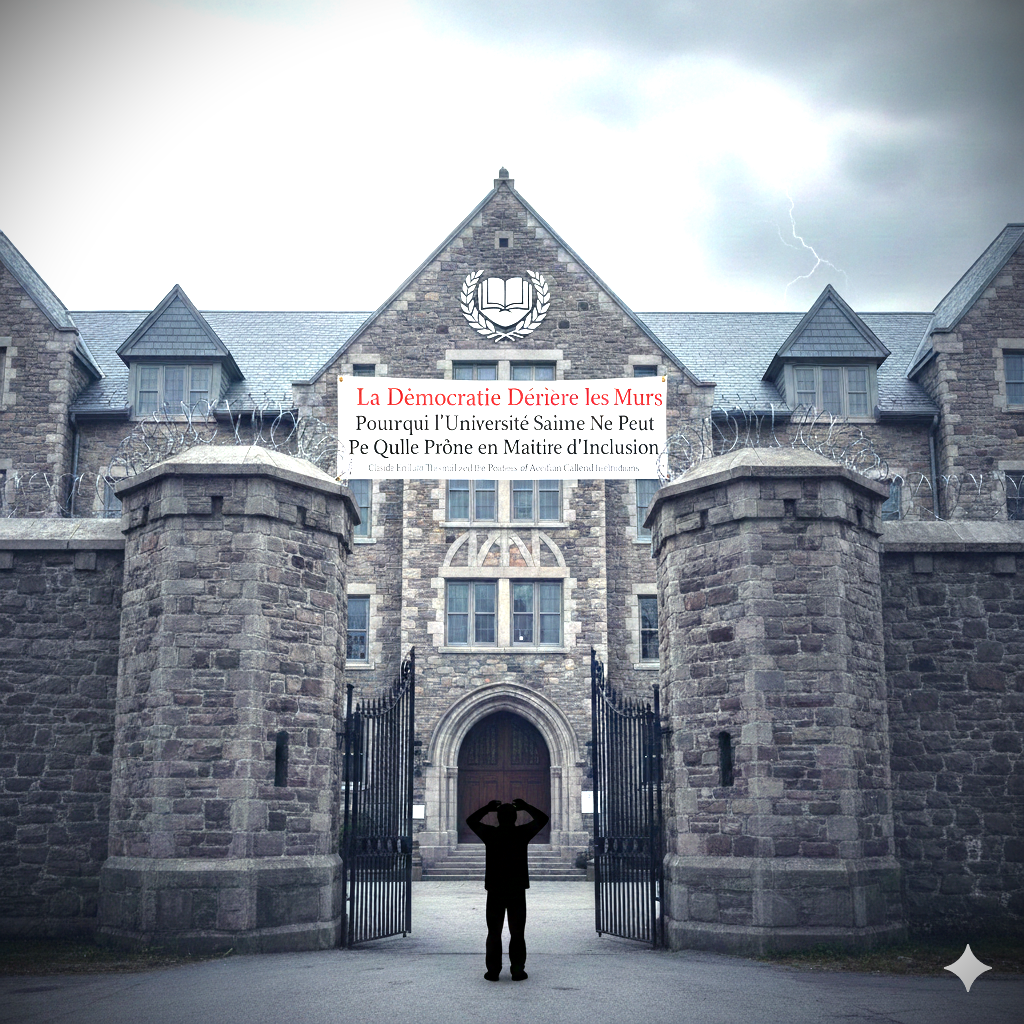
AI and digital platforms represent a democratization of cultural production that these institutions find threatening. When anyone with AI tools can create compelling narratives, music, and content, institutional gatekeeping becomes untenable. Theriault's use of platforms like OpenAI's Sora and advanced AI prompt engineering to tell Acadian stories represents this shift—from centralized cultural control to distributed creative power.
The new research chair on democracy arrives precisely when its institutional model faces technological disruption. The question isn't whether these zombie corporations will adapt; they won't. The question is how long they can maintain the fiction of relevance while actual culture evolves beyond their walls.
A Culture Looking Forward While Institutions Look Back
Professor Bardall's research into democratic resilience raises important questions about how democracies respond to challenges and threats. But perhaps the most significant threat to Acadian democratic culture isn't external—it's the internal ossification of institutions that claim to represent that culture while actively suppressing its evolution.
As Theriault himself has stated, "As long as French Acadian Culture looks back on its Heritage Patrimonial past, it will never move forward." This isn't a rejection of history or tradition; it's a recognition that culture is living, evolving, and must engage with present realities rather than merely curating past traumas.
The contrast couldn't be starker. On one side, universities are hosting conferences on democracy while excluding dissenting voices. Cultural committees produce the same heritage tourism content year after year. Institutions speak French while thinking in the most colonial, hierarchical terms imaginable. On the other: artists like Theriault are using blockchain technology to create sovereign cultural spaces, employing AI to tell Acadian stories in new forms, and building global audiences without institutional blessing.
The institutions talk about democracy while practicing autocracy. They celebrate Acadian resilience while demonstrating fragility in the face of innovation. They discuss inclusion while excluding anyone who doesn't conform to their narrow vision of acceptable Acadianness.
Meanwhile, the actual living culture—the queer artists, the digital innovators, the musicians blending traditional sounds with contemporary themes—continues to evolve and create, largely ignored by the very institutions claiming to represent them. This parallel evolution reveals the fundamental irrelevance of these zombie corporations. Culture doesn't need their permission to exist.
Conclusion: The Rhetoric of Democracy Meets the Reality of Exclusion
When Université Sainte-Anne announces a research chair dedicated to studying democracy and power, the statement "une démocratie capable de répondre aux besoins des citoyens et des citoyennes, c'est ce qui va nous protéger" rings hollow. Not because the sentiment is wrong—it's absolutely correct—but because the institution making this statement actively fails to practice what it preaches.
The real democracy in Acadian culture isn't happening in university research centers or heritage committee meetings. It's happening on blockchain platforms where artists like Claude Edwin Theriault create sovereign cultural spaces beyond institutional control. It's happening in AI-generated visual narratives that tell Acadian stories in forms these institutions can't comprehend. It's happening in music that blends traditional themes with contemporary sounds, released directly to global audiences without bureaucratic mediation.
The zombie corporation world of heritage patrimonial institutions is as relevant as book encyclopedias in an AI age—which is to say, not relevant at all. These organizations will continue to exist as long as government funding sustains them, producing the same recycled content, hosting the same conferences, and excluding the same innovative voices. But their cultural authority is already gone, displaced by decentralized platforms and artists who refuse to wait for institutional permission to create.
Democracy in culture, like democracy in politics, requires actual responsiveness to citizens' needs—not just rhetoric about it. When institutions practice exclusion while preaching inclusion, when they gatekeep while discussing accessibility, when they suppress innovation while celebrating resilience, they reveal themselves as the antithesis of the democratic values they claim to champion.
The future of Acadian culture won't be determined by university research chairs or heritage committees. It will be shaped by artists bold enough to embrace new technologies, challenge comfortable narratives, and create without institutional blessing. Claude Edwin Theriault's work represents this future—a future these zombie institutions neither understand nor control. And that, perhaps, is the most democratic development of all.
Frequently Asked Questions
Q1: Who is Claude Edwin Theriault?
Claude Edwin Theriault is a contemporary French Acadian artist from Nova Scotia who blends traditional artistic practices with cutting-edge technologies, including AI, NFTs, and blockchain platforms. His work spans visual art, music (under the name Cajun Dead et le Talkin' Stick), and written narratives, all exploring Acadian culture through innovative digital mediums. Despite forty years of artistic production, he has been systematically excluded from mainstream Acadian cultural institutions and events.
Q2: Why do Acadian cultural institutions exclude contemporary artists like Theriault?
The exclusion appears rooted in several factors: Theriault's work challenges the comfortable heritage patrimonial narrative these institutions prefer; his openly queer identity and innovative approaches don't fit the conservative, Catholic-dominated cultural establishment; and his criticism of institutional gatekeeping threatens their cultural authority. These institutions favour safe, tourism-friendly representations of Acadian culture over living, evolving artistic voices.
Q3: What is the "heritage patrimonial industry" in Acadian culture?
The heritage patrimonial industry refers to the network of government-funded organizations, universities, and cultural committees that control the narrative of Acadian culture. These institutions focus almost exclusively on historical trauma (particularly the 1755 Deportation), traditional folk culture, and tourism-friendly representations while excluding contemporary artists and innovative cultural expressions. They operate through a self-perpetuating committee structure that produces repetitive content year after year.
Q4: How is blockchain technology relevant to Acadian cultural sovereignty?
Blockchain technology, particularly through NFT platforms, allows artists like Theriault to create sovereign cultural spaces independent of traditional institutional gatekeepers. By tokenizing artwork on platforms like Ethereum, artists can establish provenance, reach global audiences directly, and maintain control over their intellectual property without needing approval from heritage committees or cultural bureaucracies. This represents a fundamental shift from centralized to decentralized cultural authority.
Q5: What makes Université Sainte-Anne's democracy research chair ironic?
The irony lies in an institution researching democratic participation and inclusion while itself practicing cultural exclusion and operating as an insular gatekeeper. The university's announcement about democracy protecting citizens through responsiveness comes from an institution that has systematically ignored contemporary Acadian voices that don't conform to its preferred narrative. It's researching democracy while failing to practice it in its own cultural programming and institutional behaviour.
About the Author: This article examines the contradictions between institutional rhetoric and practice in Acadian cultural institutions, focusing on the exclusion of innovative contemporary artists like Claude Edwin Theriault and the obsolescence of heritage patrimonial models in the digital age.
Keywords: Claude Edwin Theriault, French Acadian culture, Université Sainte-Anne, Acadian democracy, heritage patrimonial industry, NFT art, contemporary Acadian artists, cultural sovereignty, blockchain art, Cajun Dead et le Talkin' Stick
Meta Description: Examining the paradox of Université Sainte-Anne's democracy research chair while excluding innovative French Acadian artist Claude Edwin Theriault reveals the obsolescence of heritage cultural institutions in the AI age.