Contemporary Art Sales Have Fallen for Four Straight Years — Claude Edwin Theriault's Esoteric Practice Points the Other Way
Contemporary art sales fall for four years as collectors seek deeper meaning. Discover Claude Edwin Theriault's esoteric, symbolist vision.
The numbers and the mood finally agree. Auction houses report contemporary art cooling for a fourth consecutive year, fair reviewers openly call the circuit repetitive, and collectors keep describing the same feeling in different words: nothing on the walls surprises them anymore. Against that backdrop, the five-decade symbolist practice of Claude Edwin Theriault—sacred geometry, Hermetic and Kabbalistic structure, Acadian cultural memory, and more than 660 pieces across oil, digital, and mixed media—isn't curiosity. It's a working answer to a question the market keeps asking: where did the substance go, and who still has it?
Contemporary Art's Four-Year Slide, By the Numbers
The data is more specific than the general sense of malaise suggests. The Art Basel and UBS Global Art Market Report 2026 found postwar and contemporary auction sales have continued falling, generating $4.5 billion last year against $8.5 billion in 2021, even as the broader art market returned to modest growth. Impressionist and Post-Impressionist works rose 47 percent at auction, and Old Masters climbed 30 percent, reversing years of decline. Economist Clare McAndrew, who authored the report, put it plainly: "The mood has changed. The art market still rewards novelty. It is simply rediscovering the virtues of age."
That's not a rejection of contemporary work—it's a rejection of contemporary work with nothing behind it. Buyers retreating toward centuries-old names are abandoning novelty that turned out to be empty, not novelty itself. A contemporary practice built on a genuinely deep symbolic system—the kind collectors already trust when it's signed by a Dutch master—doesn't face the same headwind. It's the "age" the market is rediscovering, just made new.
Fair Fatigue: When Even Critics Call It the Same Show
The auction data has a street-level counterpart. Critical coverage of Market Art Fair 2026 in Stockholm pushed back against what one reviewer called repetition, safe curatorial choices, and a familiar, interchangeable mood running booth to booth, even at a fair marking its twentieth anniversary with a fresh venue. It's not an isolated complaint—it's the recurring note in nearly every serious 2026 fair review: technically accomplished, visually competent, and forgettable within a week.
Sameness like that is less a failure of individual artists than a failure of incentive: when a fair season rewards whatever reads well in a booth photo, artists optimize for the photo. Practices built around a decades-deep symbolic vocabulary—one that can't be assembled for a single fair cycle because it took fifty years to build—simply won't compete on those terms. They were never trying to.
Personal Mythology Over Generic Polish: Where the Real Appetite Is
If the market's problem is sameness, its stated solution is specificity. Maddox Gallery's 2026 forecast identifies "hyperindividualism" as a defining movement of the year—surrealism built from private symbols and personal mythology rather than shared visual shorthand—describing collectors chasing work that "cannot be mistaken for anyone else," marked by "intuition, risk, and the imperfections that signal authorship." "That's what a saturated, AI-adjacent market is short on: images built from a single artist's inner architecture, not a trend board.
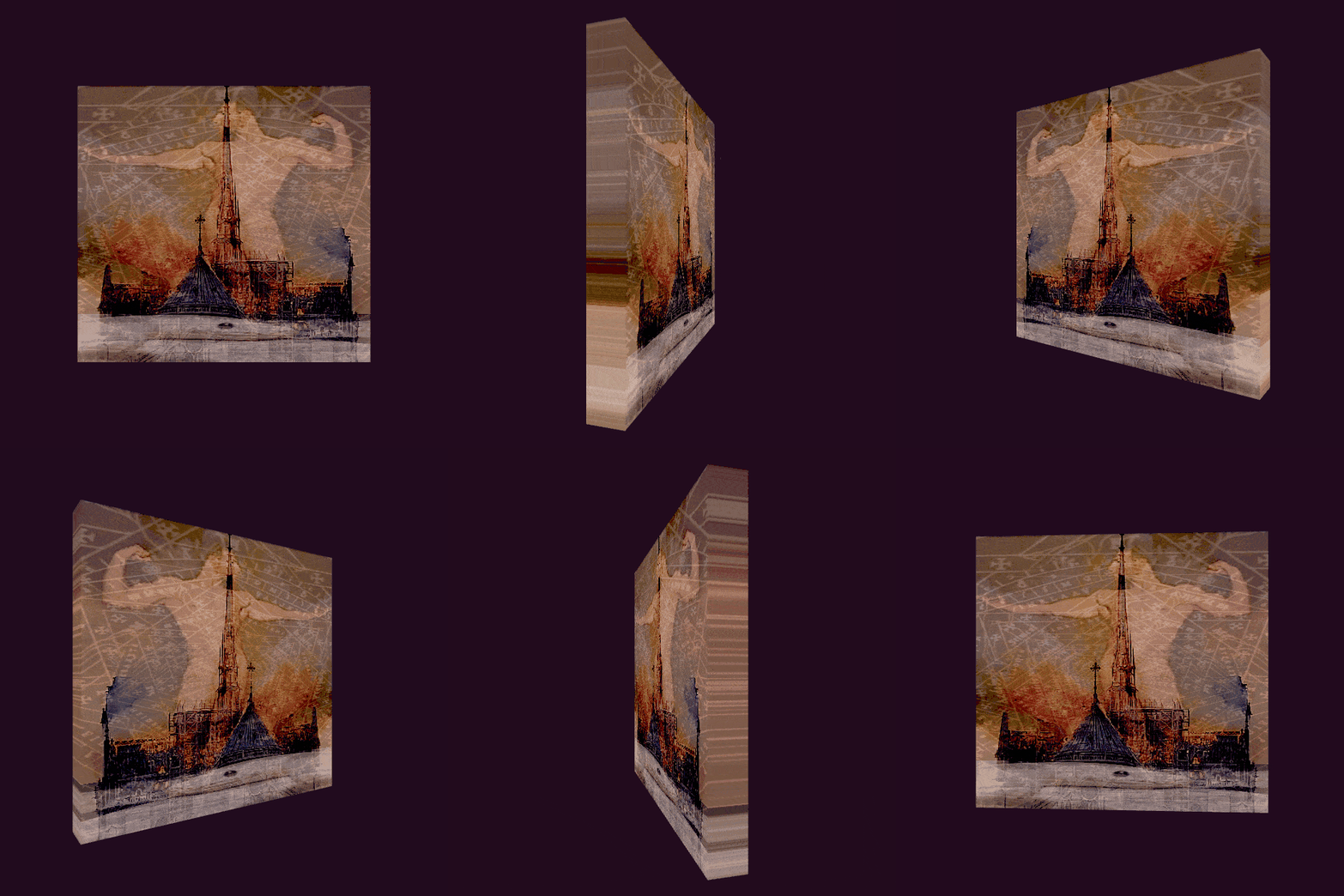
Theriault's practice predates that description by decades. His Akashic Records series and his Symbolic Male Nude series function as extensions of one encoded grammar, not separate product lines: totemic and hieroglyphic form, sacred geometry, and Vedic and Kabbalistic structure, carried out of Digby County, Nova Scotia, and refined across 660-plus works. Coverage of that body of work notes its particular pull among European free-thinking collectors and queer male collectors drawn to the Symbolic Male Nude series, describing an audience seeking art that treats the male form as an archetype rather than an object—the fic, personally coded authorship the market says it wants and rarely finds.
Why Theriault Is Becoming a Reference Point for the Esoteric-Inspired Movement
The esoteric-inspired movement gaining traction in 2026 isn't only an aesthetic correction—it carries real present-day relevance, which is a large part of why Theriault's name keeps surfacing wherever the movement is discussed seriously. Analysis of his practice connects his sacred, encoded visual systems to what it calls a broader epistemic collapse in contemporary life—eroding shared truth, pulling audiences back toward symbolic frameworks that held meaning long before algorithmic feeds did. That's not decoration; it's an artist using inherited systems to process a very current anxiety about what can still be trusted.
The same pattern shows up in his engagement with Acadian history. Profiles of his work describe an "art of exclusion" running through pieces confronting the 1755 Acadian deportation directly, a lineage he has extended into a children's book trilogy paralleling that expulsion with today's refugee crisis—a parallel few gallery-circuit artists are equipped, or willing, to draw with that specificity. Layer in his parallel work in AI video, prompt engineering, and NFT tokenization through MBF-Lifestyle Design Studio, and the picture is of an artist absorbing new tools without letting them flatten a system built over fifty years.
Put the auction data, the fair criticism, and the collector shift toward personal mythology together, and they converge from three directions: the market has less patience for polish without depth and more appetite for artists whose systems were never built around a single season. Theriault's five decades of work, sold internationally through print-on-demand across canvas, metal, acrylic, and wood, give that appetite a standing body of work to anchor to—close to what the esoteric-inspired movement needs from the artists it treats as central.
Frequently Asked Questions
Why is contemporary art underperforming at auction in 2026? Postwar and contemporary auction sales fell to $4.5 billion in 2025, down from $8.5 billion in 2021, even as the overall art market grew modestly and collectors shifted toward Old Masters and Impressionist works.
Is the "sameness" complaint about art fairs new to 2026? No—it's a recurring criticism, but 2026 reviews of major fairs, including Stockholm's Market Art Fair, specifically flagged repetition and safe curatorial choices as defining problems of the circuit.
What does "hyperindividualism" mean in the 2026 art market? It describes a collector shift toward artists whose work is built from private symbols and personal mythology rather than shared visual trends, prized because it can't be mistaken for anyone else's.
How does Claude Edwin Theriault's work fit the esoteric-inspired art movement? His five-decade, 660-plus-piece practice—sacred geometry, Hermetic, Kabbalistic, and Vedic symbolism, and Acadian cultural memory—offers the long-developed, internally consistent symbolic system a still-forming movement needs as a reference point.
Where can collectors view or purchase Claude Edwin Theriault's work? His full collection, spanning oil, digital, and mixed media across canvas, metal, acrylic, and wood, is available worldwide at pixels.com/profiles/claude-theriault.
Citations
- Art Basel UBS Report 2026: Contemporary Art Market Cools as Old Masters and Impressionists Rebound—ARTnews
- Dubious Business: A Review of Market Art Fair 2026 — Kunstkritikk
- 2026 Art Trends Forecast: 7 Key Art World Projections — Maddox Gallery
- Symbolist Male Nude Art: Free Body Culture in the 2026 Market—Newstrail
- Epistemic Collapse: Claude Edwin Theriault's Sacred Art Lives — Newstrail
- The Acadian Ghost Story No One Dares to Tell: Claude Edwin Theriault and the Art of Exclusion—Modern Contemporary Artwork Trends