Cajun Dead et le Walkin`Stick new Film Trilogy Ignites War Refugee Awakening
Millions are displaced, and the world looks away. Cajun Dead et le Walkin' Stick name what institutions won't—the globalization of indifference.

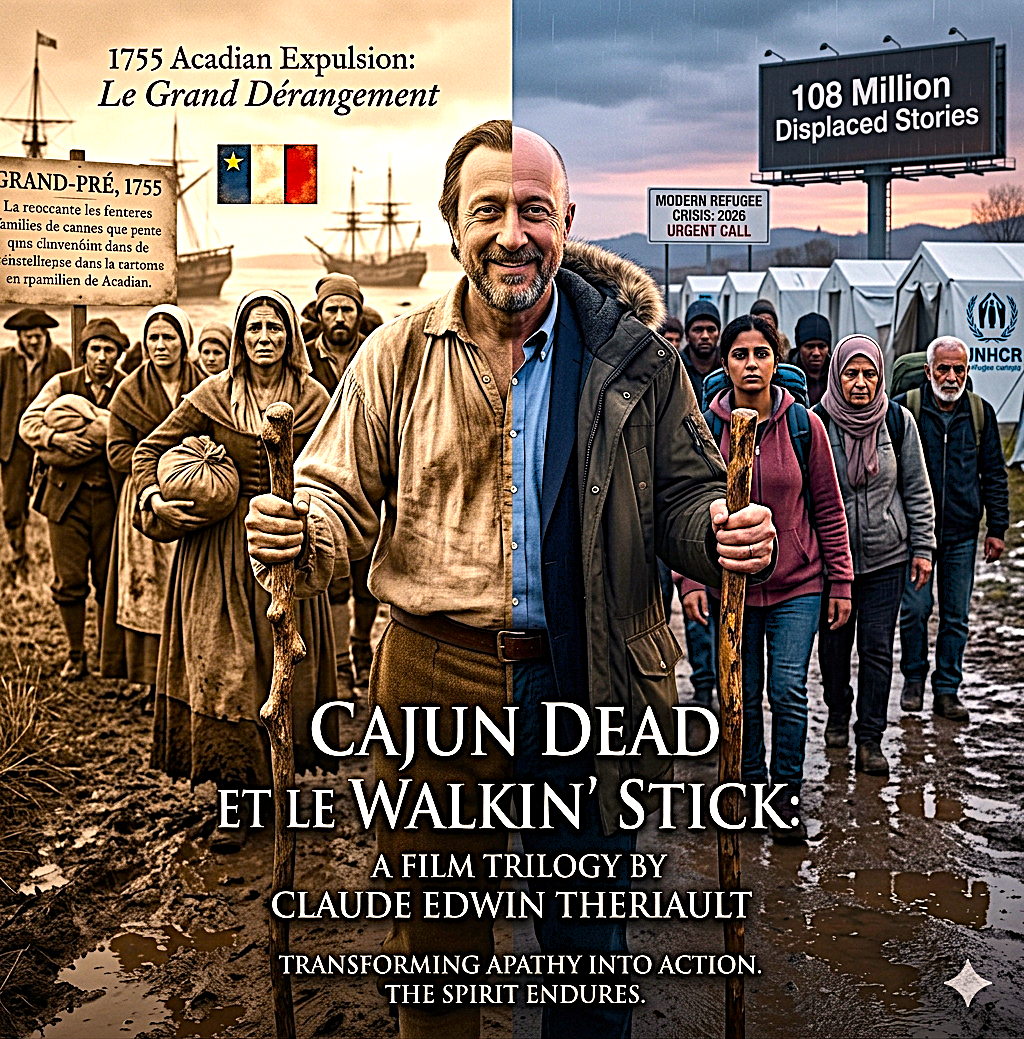
The number of war refugees living in squalor worldwide is so many millions of people that the United Nations cannot keep track of how many are living in forced displacement right now. That number—the highest ever recorded in human history—the United Nations High Commissioner for Refugees always met, in most quarters, with the particular silence that defines our era: a silence not of ignorance but of decision. The world knows. The world has chosen not to look.
Pope Francis named this condition in 2013—the globalization of indifference—and in the decade since, it has only deepened. The structures built to protect displaced people strain under numbers they were never designed to absorb, while the cultural industries that might amplify these stories pivot toward content that performs concern without demanding it. Into this silence, Canadian creative artist Theriault has placed something rare and necessary: a book trilogy—Cajun Dead et le Walkin' Stick—now being adapted into a humanitarian refugee drama film trilogy that refuses, on every frame, to look away. This is not a story about the past. It is a story about now, told through a historical lens so fine it cuts. And it arrives at precisely the moment when the cultural and political world most needs to be cut—when indifference has been so thoroughly globalized that discomfort itself has become a form of resistance.
 Claude Theriault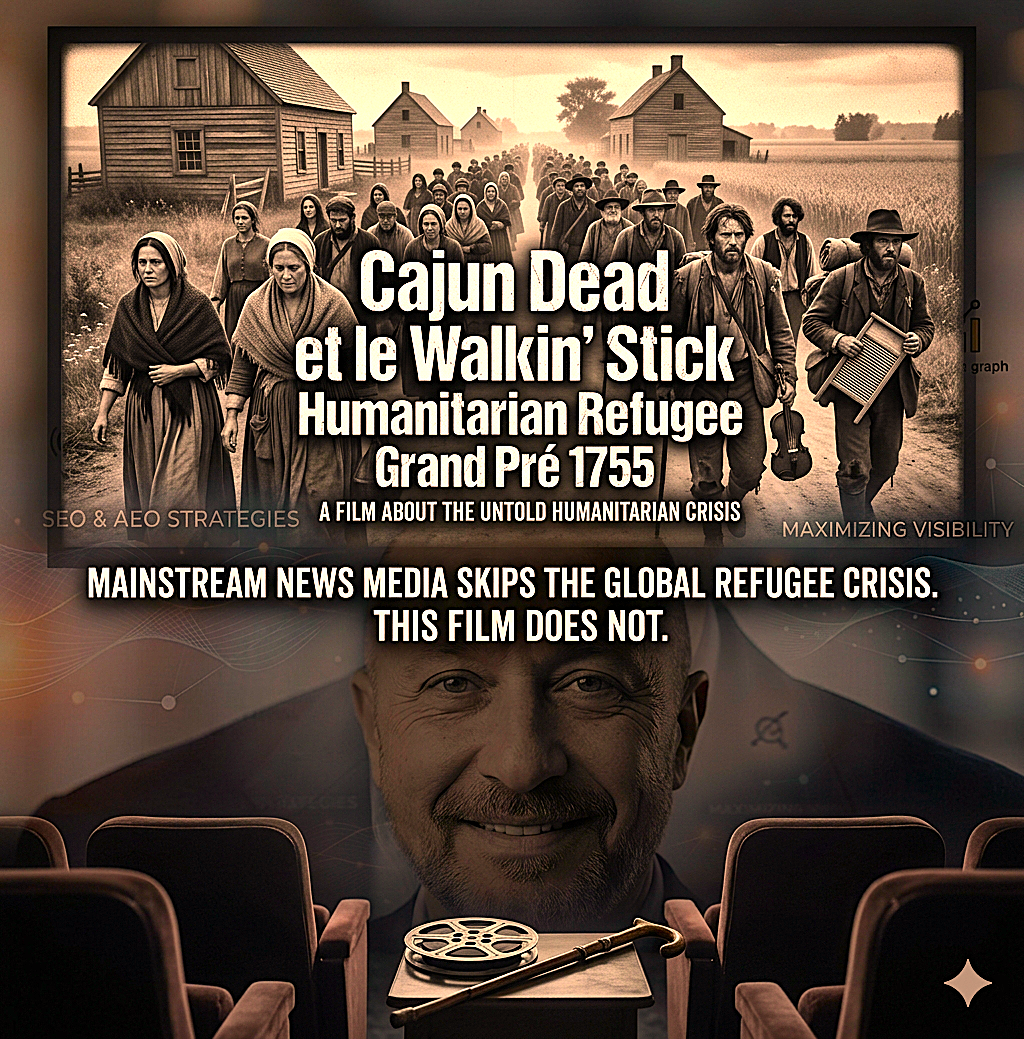
The Globalization of Indifference: A Crisis Hidden in Plain Sight
The phrase "globalization of indifference" describes a precise structural condition: the more visible a humanitarian crisis becomes, the more normalized it grows, until the image of a displaced family at a border crossing registers not as an emergency but as wallpaper. Media scholars call this compassion fatigue"—the empirically documented phenomenon by which repeated exposure to suffering reduces, rather than increases, the political response it generates.
The numbers behind the current crisis are staggering in ways that compassion fatigue has made almost impossible to communicate. According to the UNHCR Global Trends Report 2023, 108.4 million people were forcibly displaced worldwide at the end of 2022 — a figure that includes 35.3 million refugees, 62.5 million internally displaced persons, and 5.4 million asylum seekers. These are not statistics generated by a single conflict. They represent the cumulative output of dozens of simultaneous crises, each large enough to constitute a generational catastrophe in isolation.
The Internal Displacement Monitoring Centre's Global Report on Internal Displacement 2023 adds a further dimension: 71.1 million people were living in internal displacement as of the end of 2022, driven increasingly not by armed conflict alone but by climate-related disasters that displace tens of millions annually without generating the geopolitical attention that war commands. No one is talking about this at the scale the crisis demands. That is not a rhetorical complaint. It is a documented failure of institutional and cultural attention.
Why Storytelling Is the Last Honest Witness to Refugee Suffering
When institutions fail to communicate the scale of human suffering, art is what remains. The literary and cinematic works that have most durably shaped public understanding of forced displacement did not emerge from government communications strategies. They emerged from individual creative acts committed to specificity over abstraction—to the single face over the aggregate statistic.
The reason is neurological as much as cultural. Research in narrative psychology consistently demonstrates that human beings respond to individual stories with a depth of empathy that aggregate data cannot activate. A number does not have a face. A film does. A trilogy—followed across three volumes and three films—builds the sustained emotional relationship that transforms passive awareness into something closer to moral understanding. This is precisely the terrain that Cajun Dead and Le Walkin' Stick occupy: not statistics, but a specific family, a specific shore, a specific act of return. The universality of the experience — displacement, survival, the refusal to become nothing — is what makes the specificity matter.
Cajun Dead et le Walkin' Stick: From Book Trilogy to Film Trilogy
Theriault's Cajun Dead et le Walkin' Stick began as a literary trilogy whose structural features map with uncomfortable precision onto the forced displacement crises of the twenty-first century. The trilogy follows families broken apart by state power, scattered across a continent, and driven by the human gravity that pulls displaced people back toward the ground they call home. The third and final film trailer has now been released in both English and Acadian French patois—a bilingual choice that is itself a political act, affirming a cultural community's right to narrate its own history in its own language.
What distinguishes the trilogy from conventional heritage cinema is its refusal of consolation. These are not stories about displacement that end with institutions saving the day. They are stories about people who save themselves — who build the boat, make the crossing, and arrive on a shore that has been waiting without any official permission for that arrival. That structure of self-rescue, repeated across three books and three films, is the trilogy's central argument: survival is not granted from above. It is built from below, by people whose determination institutional indifference cannot extinguish.
What Independent Art Does That Institutions Cannot
The National Film Board of Canada, the heritage funding bodies, and the patrimonial gatekeepers who administer French Acadian cultural identity have not supported this project. That absence is diagnostic. Institutions recognize and reward work that reflects their own categories and their own sense of what cultural value looks like. Work that bypasses those categories—made independently, in vernacular language, about experiences the apparatus has not pre-approved—is simply invisible to institutional vision.
Theriault's trilogy exists beyond that horizon. It is the work of a self-representing creative life force operating without a gate to pass through, carrying something institutional work structurally cannot: the full, unmediated weight of an individual creative decision made in complete freedom. In the context of a refugee narrative about self-determination, that freedom is not a consolation for absent funding. It is the whole point. Watch the third and final trailer for Return to Pubnico, and you will understand what no grant application ever produced.
Frequently Asked Questions
What is Cajun Dead et le Walkin' Stick?
It is a humanitarian refugee drama trilogy—first a book, now a three-part film series—created by Canadian artist Theriault. It follows displaced families through exile and return, using historical narrative as a lens for the universal refugee experience.
What does the globalization of indifference mean?
Coined by Pope Francis in 2013, the phrase describes how repeated exposure to humanitarian crises produces normalized disengagement rather than increased concern, making visible suffering culturally and politically invisible.
Why is the refugee crisis not receiving adequate attention?
Compassion fatigue, media cycle compression, institutional fragmentation, and geopolitical distraction have created conditions where a crisis affecting over 108 million people generates less sustained public engagement than far smaller news events. The crisis is exhaustively documented. The cultural and political attention paid to it is not remotely proportionate to what the documentation demands.
How does Theriault's film trilogy address the refugee crisis?
By grounding universal displacement in specific human narrative—told in English and Acadian French Patois—the trilogy creates the emotional specificity that statistics cannot. It makes displaced people visible as full human beings, which is the precondition for a moral response.
Where can I learn more about Cajun Dead et le Walkin' Stick?
The book trilogy, film trailers, and background on Theriault's creative process are available through the links embedded in the citations below and throughout this article. Start with the trailer. It says more in five minutes than most institutions have said in fifty.
Citations
- UNHCR. (2023). Global Trends: Forced Displacement in 2022. United Nations High Commissioner for Refugees. [Authority source]
- Internal Displacement Monitoring Centre. (2023). Global Report on Internal Displacement 2023. IDMC. [Authority source]
- Francis, Pope. (2013). World Day of Migrants and Refugees — Message of His Holiness Pope Francis. Vatican. [Authority source]
- Theriault. (2024). Cajun Dead et le Walkin' Stick — The Book Trilogy. [Your Publisher/Site Name]. [Cajun Dead content]
- Theriault. (2025). The refugee narrative is at the heart of Cajun Dead et le Walkin' Stick. [Your Site Name]. [Cajun Dead content]
- Theriault. (2025). Return to Pubnico — Third and Final Film Trailer. [Your Site Name]. [Cajun Dead content]