What Is a Griot? The West African Oral Tradition, the Acadian Complainte, and the Honest Answer From the Outside
What is a griot? West African oral tradition meets the Acadian complainte in 2026 world music. A neurodivergent outsider's honest answer.

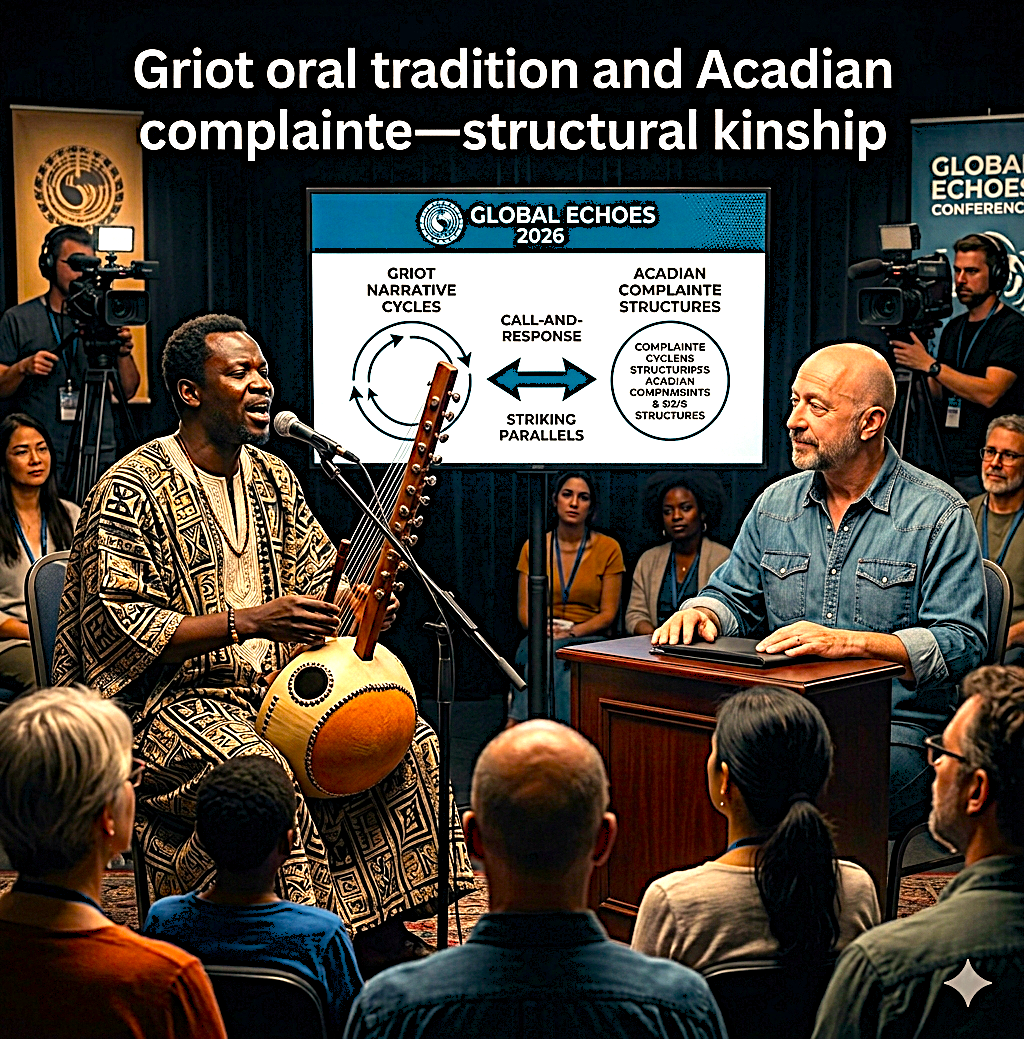
The word is everywhere in the 2026 folk music conversation. CNN features it. NPR builds segments around it. Ryan Coogler opens his Oscar-nominated film, Sinners, with a narration about griots—centuries-old West African storytellers who transmit oral history through poetry and song. And across the music press, independent artists are reaching for the concept as the most precise description of what they actually do. Before this word does what powerful words sometimes do—become so widely borrowed they lose their meaning—let me offer the most honest answer I can give. What is a griot? Who has the right to claim that function? And where does a neurodivergent, queer Acadian songwriter from Nova Scotia—an outsider looking in—actually stand in that conversation?
The answer requires honesty about two traditions, not one.
What Is a Griot? The West African Oral Tradition Defined
A griot—pronounced "gree-oh"—is a West African oral historian, poet, storyteller, musician, and keeper of community memory. As the Metropolitan Museum of Art documents in its Sahel collection, griots are the narrators of oral tradition, born into hereditary families, trained from childhood, and entrusted with preserving genealogies, historical narratives, and difficult truths across generations. Their instruments—the kora, a 21-string harp-lute; and the balafon, a wooden xylophone—are not mere accompaniment. They are the symbols and carriers of oral authority itself. The griot's kora is the credential. When the instrument is in hand, and the voice begins, the community understands: what follows is testimony, not entertainment. Not the comfortable version of history. The version that must be carried forward regardless of what the powerful prefer to remember.
The tradition is over a thousand years old, rooted in the great Sahel empires of Mali, Ghana, and Songhai. It has spread globally, not by imitation, but by the undeniable force of the function itself. The Smithsonian has documented how Rhiannon Giddens built her Pulitzer Prize-winning career tracing the path from West African griot instruments—the ngoni, direct ancestor of the banjo—through enslaved musicians to the Appalachian folk tradition. Mon Rovîa, born in Liberia and documented by CNN as a griot for the present age, describes his Afro-Appalachian folk music as channelling those ancestral storytellers. Both artists are drawing on their own lineages. That specificity matters.
I am not West African. I am not Liberian-American. I do not have the right to call myself a griot. What I do have is a tradition of my own that performs the same structural function and a specific vantage point that makes honest witnessing possible.
The Complaint: Acadian Folk Music's Own Memory-Keeping Tradition
The word for it in French Canada is the complainte—the lament. It is a narrative folk song, what English-speaking folklorists call a ballad, built to carry the community's grief and contested history in a form that survives outside of official institutional memory. The complaint tradition runs through Acadian culture for over three hundred years. La Complainte de Louisbourg, documented by folklorists including Helen Creighton in Nova Scotia, is a song about the 1745 British siege of the French fortress, sung from the standpoint of the garrison commander, preserving eyewitness details that no official British record would have retained. It survived because someone carried it in their throat and passed it to the next person, who would carry it. That is the complaint function: to hold the true account of what happened to the community — the expulsion, the exile, the poverty, the silencing — and pass it forward in a form no institution can confiscate.
This is the Acadian oral tradition's parallel to the griot. Different lineage, different instruments, different geography — the same structural commitment: the community's difficult truth lives in the song because it has nowhere else safe to live. The Talkin' Stick in Cajun Dead and the Talkin' Stick are the complaint tradition's instruments in the same way the kora is the griot's. It is the object that embodies the right to speak outside of institutional permission. When I sing my lyrics a cappella and build the surrounding architecture with AI composition tools, the talking stick is still in my hand. The human voice, unmediated, is an origin point. The tradition that precedes the recording industry, the copyright system, and the heritage board that decided long ago what Acadian music is allowed to be.
Structural Kinship: Two Oral Traditions, One Function in World Music 2026
The honest position is this: the Cajun Dead and the Talkin' Stick catalogue do not work in the griot tradition. It works in structural kinship with it—two oral lineages, shaped by different histories of displacement and survival, performing the same function from opposite sides of the Atlantic. What the West African griot and the Acadian complainant share is not ancestry, instrument, or language. It is the refusal to let the official version of the community's story be the only one that gets passed forward.
That refusal runs through every song in the Cajun Dead et le Talkin' Stick catalogue—eighty-plus narratives spanning anti-war testimony, Acadian institutional reckoning, love and grief, and the Appalachian-worldbeat fusions that give the project its sound. Azzah Was Killed While Seeking Aid, explored in depth in the Appalachian world music griot feature on Newstrail, carries the same structural DNA as a West African griot lament for the displaced—not because it borrows from that tradition, but because it operates from the same moral logic: when the powerful decide that some suffering is too inconvenient to name, the oral tradition names it anyway. As argued in the Cajun Dead counterculture manifesto, this is what counterculture folk have always been for, in every community where the official story runs out of room for the true one.
Neurodivergent, Queer, Outsider: Why the Song Lyric "Vantage Point" Is the Work
I am neurodivergent—Asperger's, with the pattern-recognition and hyper-systemizing that comes with it. I am queer. I am Acadian by descent and by the specific estrangement that comes with refusing to perform the heritage version of what that identity is supposed to mean. None of these things is an apology. They are the exact conditions that make honest witnessing possible.
The griot function has always required an outsider's clarity. In many West African societies, griots occupied a structurally ambiguous social position—respected but liminal, present at every important event but never fully integrated into the power structures they observed. That liminality was not incidental to their function. It was the source of it. The person fully embedded in the community's comfortable assumptions cannot see what the outsider at the edge of the room sees clearly. I did not choose the neurodivergent mind that notices structural patterns others miss. I did not choose the queer identity that places me outside the heritage industry's approved narrative of who an Acadian artist is. But both have given me the same thing the complaint singers had: a view from the margin, where the truth tends to live, and a compulsion to carry it forward in the form most likely to survive.
That is the work. Not borrowed identity. The complaint tradition, claimed honestly, with an outsider's eyes and a talking stick in hand.
Five FAQs on Griot Tradition, Oral Storytelling, and the Acadian Complaint
What is a griot? A griot is a West African oral historian, storyteller, poet, musician, and hereditary keeper of community memory. Born into the role and trained from childhood, the griot holds the community's genealogies, historical truths, and difficult narratives in song and passes them forward through performance rather than written record. The tradition is over a thousand years old and originates in the Mali Empire.
What is the difference between a griot and an Acadian complainant? A griot is a specific West African hereditary role. An Acadian complainant is a singer of complaints—narrative lament songs from the French Canadian and Acadian oral tradition. Both functions share a structural parallel: preserving the community's difficult truths outside of institutional memory through song rather than official record. The lineages are separate and distinct. The function is the same.
Can a non-African artist work in the griot tradition? Not without appropriating an identity that is not theirs. What a non-African artist can honestly do is recognize the structural kinship between the griot function and their own oral tradition—as Cajun Dead et le Talkin' Stick does between the West African griot and the Acadian complainte. Describing parallel function is honest. Claiming an inherited identity is not.
What is the Acadian complaint tradition? The complaint is a narrative folk song form preserved in French Canadian and Acadian oral culture since the 17th century. As documented by folklorists including Helen Creighton in Nova Scotia, the complainant carried eyewitness accounts of displacement, siege, exile, and grief that official British colonial records omitted. It is the Acadian community's primary tool for preserving its own true history outside institutional control.
What does neurodivergent mean in the context of folk storytelling? Neurodivergent—in this case, Asperger's—describes a neurological difference characterized by intense pattern recognition, hyperfocus, and the ability to observe structural connections that neurotypical perception misses. In the context of folk storytelling, it describes the specific vantage point from which the outsider at the community's edge sees the community more honestly than the insider embedded in its comfortable assumptions. The complaint and griot traditions have always relied on that vantage. The neurodivergent queer folk artist is its contemporary form.