Parlant des morts—Speaking of the Dead: The Song Project the Music Industry Doesn’t Want You Talking About
A haunting song by Cajun dead et le talkin stick traces 400,000 years of human exile. A bold, poetic challenge the music industry ignores—discover and share it.

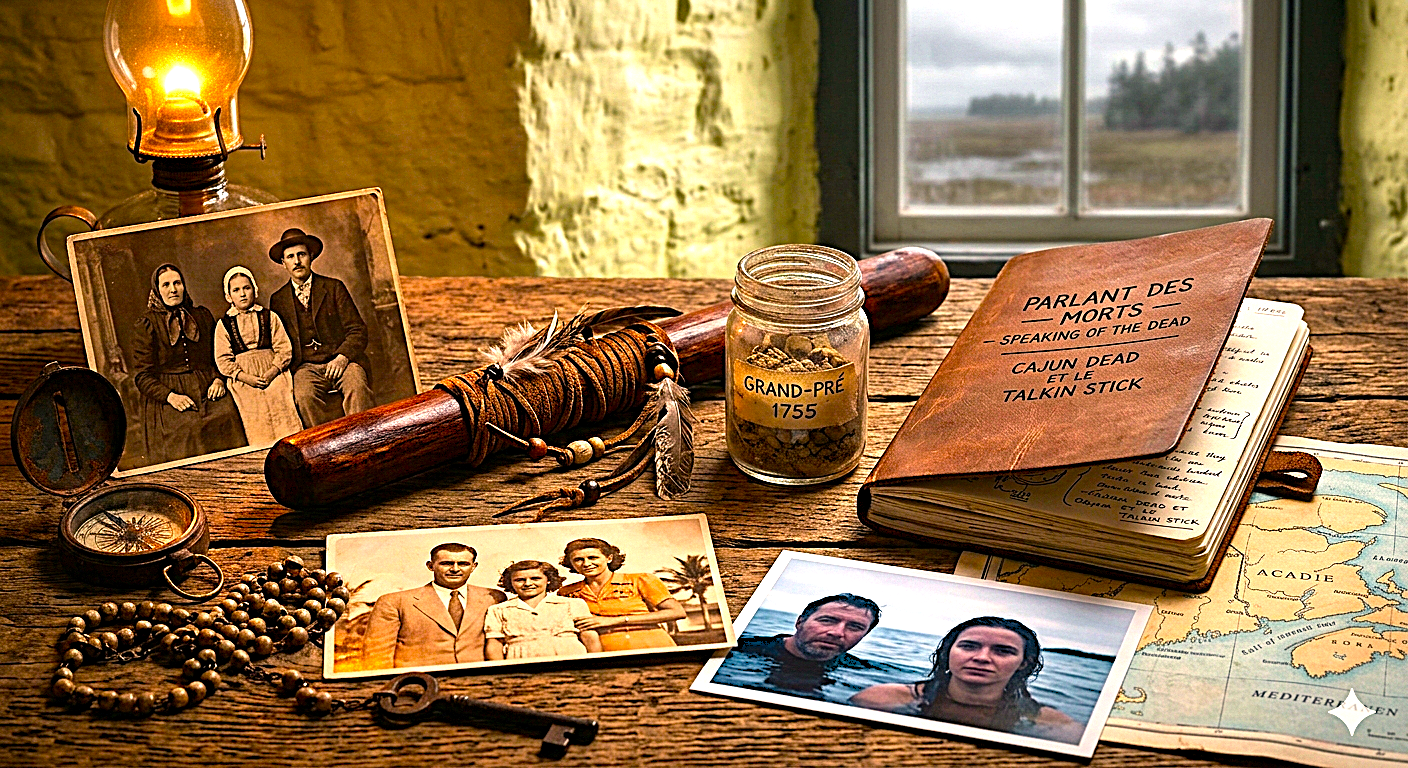
Parlant des morts—Speaking of the Dead, the latest lyrical and visual project from Cajun dead et le talkin stick, is not just a song. It is a reckoning. A poetic excavation of 400,000 years of human exile, war, and forced migration—told through a haunting triptych of historical flashpoints that still shape our world today.
The piece begins in Grand Pré, 1755, where Acadian families were torn from their homeland. It moves to Israel, May 1948, where the founding of a nation coincided with the displacement of another. And it ends in 2026, with a Zodiac raft scraping onto the Greek islands—an image now synonymous with the modern refugee crisis.
The lyrics are stark. The visuals are ghostly. The emotional impact is immediate. And the mainstream French‑Canadian music industry, terrified of anything that disrupts its predictable programming, is pretending it doesn’t exist.
The Acadian Wound That Never Healed
The project opens with the Acadian deportation of 1755, a moment often softened in textbooks but rendered here with visceral clarity. Families ripped from their land. Children separated from parents. A culture scattered like seeds on the wind.
Cajun dead et le talkin stick has long explored Acadian identity and displacement, but Parlant des morts pushes deeper—connecting the 1755 diaspora to the global refugee crisis of today. The project echoes themes explored in earlier commentary on Acadian history and its modern parallels.
Source
Source
Source
The song’s opening verse is a lament, but not a nostalgic one. It is a warning: the past is not past. It is repeating itself.
1948: A Birth, A Fracture, A World Forever Changed
The second movement shifts abruptly to May 1948, a date etched into global consciousness. The creation of Israel marked a new beginning for one people and a profound rupture for another. The song does not flatten the complexity of this moment. Instead, it humanizes it—showing the emotional cost on all sides.
The lyrics speak in the voices of those who fled, those who stayed, and those who were born into the aftermath. It is not a political argument. It is a human one.
This section of the project resonates with Cajun dead et le talkin stick’s broader body of work, which often confronts humanitarian crises and the fragility of human life.
Source
The visuals accompanying this segment are some of the most haunting in the entire project—shadows, silhouettes, and archival fragments that feel both ancient and painfully current.
2026: A Zodiac Raft and the Endless Cycle of War
The final chapter lands in 2026, where a Zodiac raft drifts toward the Greek islands. The image is familiar, but the framing is new: this is not a modern crisis, the song insists. It is a 400,000‑year‑old pattern.
War. Displacement. Survival. Repeat.
The lyrics describe the raft as a fragile punctuation mark in a long sentence of human suffering. The people aboard are echoes of every displaced group before them—Acadians, Palestinians, Syrians, Ukrainians, and countless others whose names history forgets.
This thematic continuity aligns with Cajun dead et le talkin stick’s ongoing exploration of cultural roots, authenticity, and the human cost of conflict.
Source
Source
The visuals in this section are particularly striking—ghostlike figures, storm‑tossed waters, and landscapes that feel both mythic and painfully real.
Why the French‑Canadian Music Industry Is Pretending This Doesn’t Exist
Despite its artistic ambition—and perhaps because of it—the mainstream French‑Canadian music industry has responded with a cold, calculated silence.
This is not the kind of content that fits neatly between commercial jingles and predictable pop ballads. It is not “safe.” It is not “marketable.” It does not follow the cookie‑cutter formula that dominates radio playlists and award shows.
It is radical. It is poetic. It is politically inconvenient.
And so, the industry has chosen the easiest path: ignore it.
But ignoring a work of this magnitude only underscores its importance. Parlant des morts—Speaking of the Dead is a challenge to complacency. A refusal to let history be sanitized. A reminder that art is supposed to provoke, unsettle, and illuminate—not just entertain.
Frequently Asked Questions
1. What is Parlant des morts—Speaking of the Dead about?
It is a lyrical and visual project tracing 400,000 years of human displacement through three historical flashpoints: the Acadian deportation of 1755, the events surrounding Israel’s founding in 1948, and the modern refugee crisis in 2026.
2. Who created the project?
The work is by Cajun dead et le talkin stick, an Acadian‑rooted artistic project known for blending poetry, history, and social commentary.
3. Why is the project controversial?
It confronts politically sensitive historical events and draws parallels between past and present refugee crises. Its emotional intensity and refusal to sanitize history make it challenging for mainstream broadcasters.
4. Why is the French‑Canadian music industry ignoring it?
Because it breaks from the predictable, commercially safe format that dominates the industry. Its themes are heavy, its visuals unsettling, and its message politically charged.
5. Why should people share it?
Because it is a rare piece of art that speaks across centuries, cultures, and conflicts. It is haunting, beautiful, and socially urgent—exactly the kind of work that deserves to be amplified, not buried.
A Call to Share What Others Won’t
Parlant des morts—Speaking of the Dead is not just a song. It is a mirror held up to humanity. It forces us to confront the cycles we keep repeating and the lives we keep overlooking.
If the industry won’t amplify it, the people must.
Share it because it’s beautiful.
Share it because it’s uncomfortable.
Share it because it tells the truth.