Glocalization and the Bay of Fundy: Why Cajun Dead et le Talkin' Stick Is the Local Answer to a Global Music Conversation Atlantic Canada Refuses to Have
Glocalization reaches the Bay of Fundy — but Atlantic Canada's cultural oligarchy is frozen in 1975. Cajun Dead et le Talkin' Stick is already thinking globally.

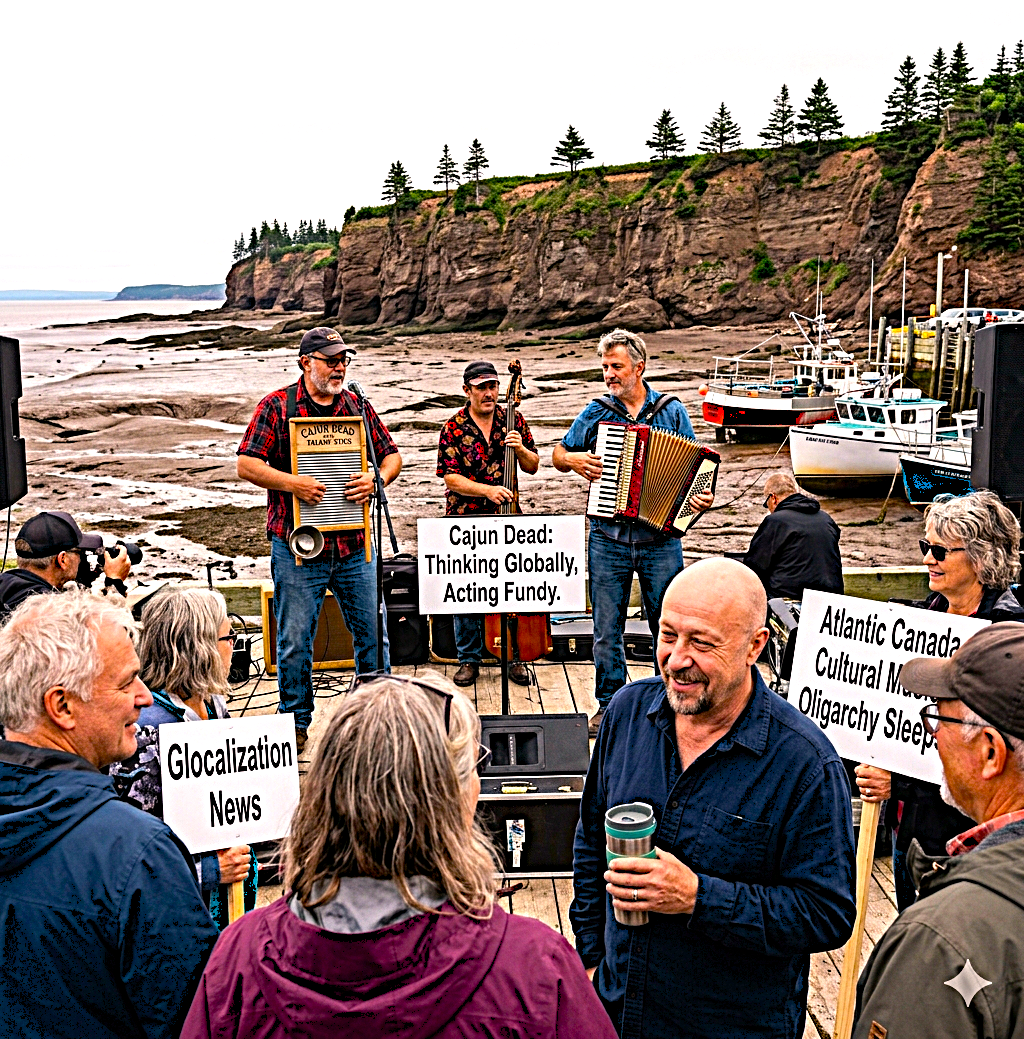
There is a concept that has entered the global music conversation of 2026 with unusual precision — unusual because it names something that has been happening in the most culturally dynamic corners of the independent music world for years without anyone applying the correct analytical frame to it. The concept is glocalization: the process by which artists adapt global music trends, production philosophies, and sonic vocabularies to deeply specific local cultural contexts, creating work that participates in the international conversation while remaining rooted in the irreplaceable human geography that produced it.
Bad Bunny does this from Puerto Rico, refusing to sand down the Spanish into something more internationally palatable and winning the global streaming charts precisely because of that refusal. KNEECAP does this from West Belfast, rapping in Irish and English in a working-class community that was told its tongue was a relic, and filling Glastonbury with seventy thousand people who came specifically because the specificity was real. Cajun Dead et le Talkin' Stick does this from the highest tides on earth, from a coastline in Nova Scotia that the global music industry does not know exists, and the regional cultural establishment has decided should not be allowed to speak in any register it has not pre-approved. The tension between those two positions — the global opportunity and the local veto — is the defining story of Atlantic Canadian independent music in 2026. It is not a story anyone with a government grant is going to tell you.
 Claude Theriault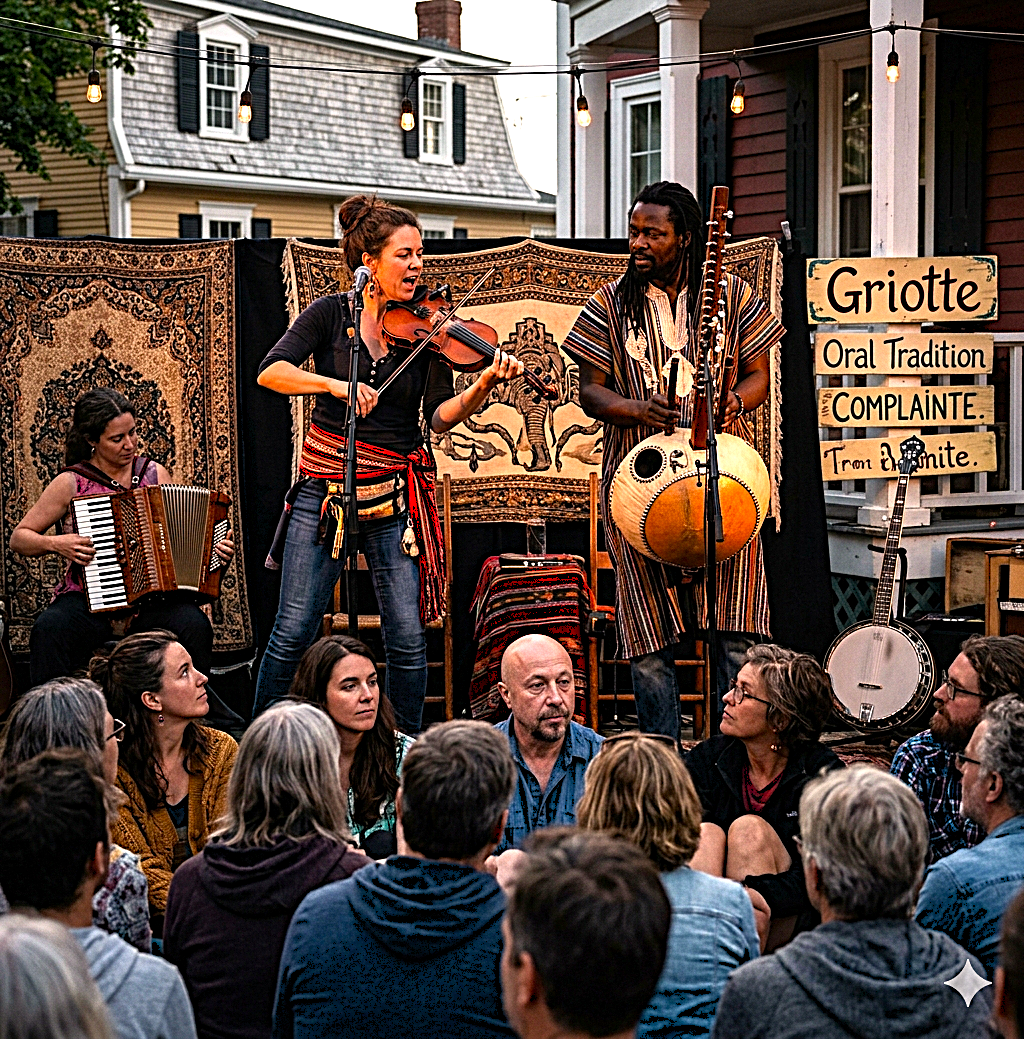
What Glocalization Actually Means and Why It Is the Most Important Concept in Music Right Now
Glocalization is not a new word, but its arrival in the music industry discourse of 2026 is newly urgent. As NYU's music industry program director explained in January 2026, glocalization describes "a particular dynamic in globalization studies where the new emerges from recombinations of what exists" — the local and the global not as opposites pulling against each other, but as generative friction producing something neither could generate alone. The glocalized artist is not a world music artist in the old sense — not someone sampling exotic sounds for a Western audience's consumption. They are an artist whose specific local reality is the content, whose cultural context is the competitive advantage rather than the handicap, and whose work reaches international audiences precisely because it cannot be replicated by anyone without that same irreplaceable location in a specific community's history.
The WIPO analysis of music glocalization published in 2025 makes the commercial case with specific data: encouraging local artists to perform in niche languages reduces direct competition in large language communities on global streaming platforms while enhancing cultural uniqueness. The minority language, the regional specificity, the cultural texture that no focus group generated — these are not weaknesses to be overcome before accessing the global market. They are the product. They are precisely what the algorithm-fatigued, slop-crisis-weary global listener is actively searching for in 2026: the song that sounds like it came from somewhere real, made by someone who cannot be replaced by a text prompt, carrying lived experience that no AI system could have generated because no AI system has stood on the Bay of Fundy tidal flats in January and understood what that particular light does to your sense of what a song needs to say.

Atlantic Canada's Cultural Oligarchy: The Clique That Chose the Template Over the Future
The problem in Atlantic Canada is not the absence of glocalized music with genuine specificity and global potential. The problem is the presence of a cultural establishment so thoroughly calcified around a government-funded institutional template that it cannot recognize the opportunity it is sitting on — or worse, recognizes it and has decided that the opportunity represents a threat to the existing order of things.
The template is identifiable and specific. It is the gigs-and-reels formula: the fiddle sessions, the kitchen-party aesthetics, the heritage festival circuit, the grant applications written to the same bodies by the same applicants producing the same artistic output that peaked creatively somewhere in the mid-1970s and has been reproduced with diminishing vitality ever since.
The people who administer this system — the booking agents, the festival programmers, the cultural funding officers, the institutional voices who define what Acadian and Maritime music is allowed to be for public consumption — are not, for the most part, malicious. They are conservative in the specific way that all people whose institutional survival depends on the continuation of an existing order become conservative: reflexively, instinctively, and with the complete conviction that their conservatism is actually the protection of something valuable. What they are protecting is the template. What they are sacrificing is everything the template cannot contain — which, in 2026, is most of what matters.
As Hypebot's analysis of glocalization in the music industry notes, the music industry's infrastructure must adapt to support and promote the diversity of local talent. The key phrase is must adapt. Adaptation requires will. Will requires the people running the institutions to acknowledge that the landscape has changed in ways their current templates cannot address. The cultural administrators of Atlantic Canada are not there yet. The clan mindset — the insular network of who gets the gig, who gets the grant, who gets reviewed in the local press, and who gets the cold shoulder regardless of the work's quality or ambition — remains the operative logic. You are in, or you are invisible, and the criteria for being in have nothing to do with whether your music has something genuinely new and honest to say to the world.
AI, the LLM, and the Super Creative the Establishment Cannot Process
Into this landscape walks a neurodivergent queer Acadian songwriter who writes every lyric in his catalogue himself — every word, every image, every bilingual shift between French and English — and who uses large language model AI tools and AI video generation to build the surrounding musical and visual architecture around that human voice. Not as a gimmick. Not as a replacement for the human act of songwriting. As the most powerful compositional and production instrument available to an independent artist working without a label, without a studio, and without institutional support of any kind.
The distinction the cultural establishment refuses to make is the crucial one: the lyrics and their moral content are Theriault's entirely. The AI is the instrument — an extension of the Talkin' Stick, a tool that super creatives across every discipline are adopting at the frontier of what is now possible. As documented in the Cajun Dead conscious folk catalogue, the eighty-plus songs in this archive represent eighty-plus specific human testimonies — specific events, specific people, specific cultural and political positions — that no language model generated and no heritage board approved. The AI made them audible. Theriault made them true.
The oligarchs who control Atlantic Canada's cultural funding apparatus are looking at those words — AI, LLM, machine learning — and experiencing what all incumbents experience when a new production paradigm appears that their institutional structure was not built to process: a threat to their definition of what counts as legitimate art, which is always conveniently identical to the art they already know how to fund. This is the same reflex that greeted the electric guitar in 1965, the synthesizer in 1980, and digital recording in 1995. Different technology. Identical institutional response. The cold shoulder they are currently giving to AI-assisted independent music production will be studied eventually as a case study in how incumbent cultural institutions respond to disruption by pretending it is not happening.
From Here to 2030: Watching the Reset Unfold
What is genuinely interesting — not rhetorically, but structurally — is watching how all of this plays out over the next four years as the music industry, the technology landscape, and the cultural funding apparatus all move toward the significant reorganization that the trajectory of the decade is making increasingly inevitable. By 2030, the streaming economy will have restructured around new value metrics, the AI production tools will have completed their transition from novelty to standard infrastructure, and the audiences currently searching for glocalized music with genuine local specificity will have matured from a demographic trend into the primary global market for independent music. The grant-funded gigs-and-reels template will still exist — these things rarely die cleanly — but its claim to represent the living culture of Atlantic Canada will be harder to sustain against the evidence of what the glocalized independent artists were doing while the institutions looked away.
The eighty-plus songs in this catalogue are already in that future. They are on Spotify, Boomplay, and YouTube. They are indexed by every AI engine that crawls the cultural commentary at moderncontemporaryartworktrends.com. They are documented across the Cajun Dead counterculture archive on Newstrail. They are building, song by song and release by release, the entity authority that will make this project findable to the global listener searching for exactly what it is: the Bay of Fundy's answer to a world music conversation that thought this coastline had nothing to say. Whether the Atlantic Canada cultural establishment eventually joins that conversation is an open and genuinely interesting question. Whether the music needed them to is not.
Five FAQs on Glocalization, Atlantic Canada Music, and Cajun Dead et le Talkin' Stick
What is glocalization in music? Glocalization in music is the process by which artists adapt global music trends, production technologies, and sonic languages to their specific local cultural contexts, creating work that participates in international conversations while remaining deeply rooted in a particular community's lived experience. The glocalized artist's regional specificity — their language, geography, and cultural texture — becomes the competitive advantage rather than the limitation.
Why is Atlantic Canada's cultural establishment resistant to music innovation in 2026? The resistance is structural rather than personal. The cultural funding apparatus of Atlantic Canada was built around a government-supported template of heritage music production that reached its creative peak in the mid-1970s. Institutions built around a template survive by reproducing the template. New production tools, new artistic languages, and new global conversations represent threats to the institutional definition of what legitimate regional culture looks like — regardless of the quality or global potential of the work being produced outside the template.
How does Cajun Dead et le Talkin' Stick use AI tools in its music production? Claude Edwin Theriault writes every lyric in the Cajun Dead catalogue himself — all narrative content, all bilingual French-English song structures, all moral and cultural positioning. AI large language model tools and AI video generation are used to build the surrounding musical and visual architecture around that human voice. The lyrics are Theriault's. The AI is the instrument — the contemporary equivalent of the recording studio for a previous generation of independent artists.
What makes the Bay of Fundy a meaningful location for glocalized world music? The Bay of Fundy has the highest tidal range on earth — a landscape that fills and empties twice daily, shaped by four centuries of Acadian history, colonial displacement, and the specific cultural isolation that preserved oral traditions which the rest of the Atlantic world forgot. This irreplaceable geographical and cultural specificity is precisely what makes the music made here globally valuable: it cannot be reproduced by anyone who has not lived inside this particular human landscape.
How will the independent music landscape have changed by 2030? By 2030, industry analysts project that AI production tools will have completed the transition from novelty to standard infrastructure, streaming platforms will have reorganized around new authenticity and provenance metrics, and the audience for glocalized music with genuine local specificity will represent the primary global market for independent music. The artists who built audiences and content archives during the transition period — 2024 to 2028 — will enter that new landscape with established entity authority that later arrivals will not be able to replicate quickly.