Folk Music as Moral Witness: Cajun Dead and the Reawakening of the Griot Voice
Cajun Dead et le Talkin’ Stick revives folk as moral witness—Claude Edwin Theriault’s Acadian griot songs confront today’s humanitarian crises.

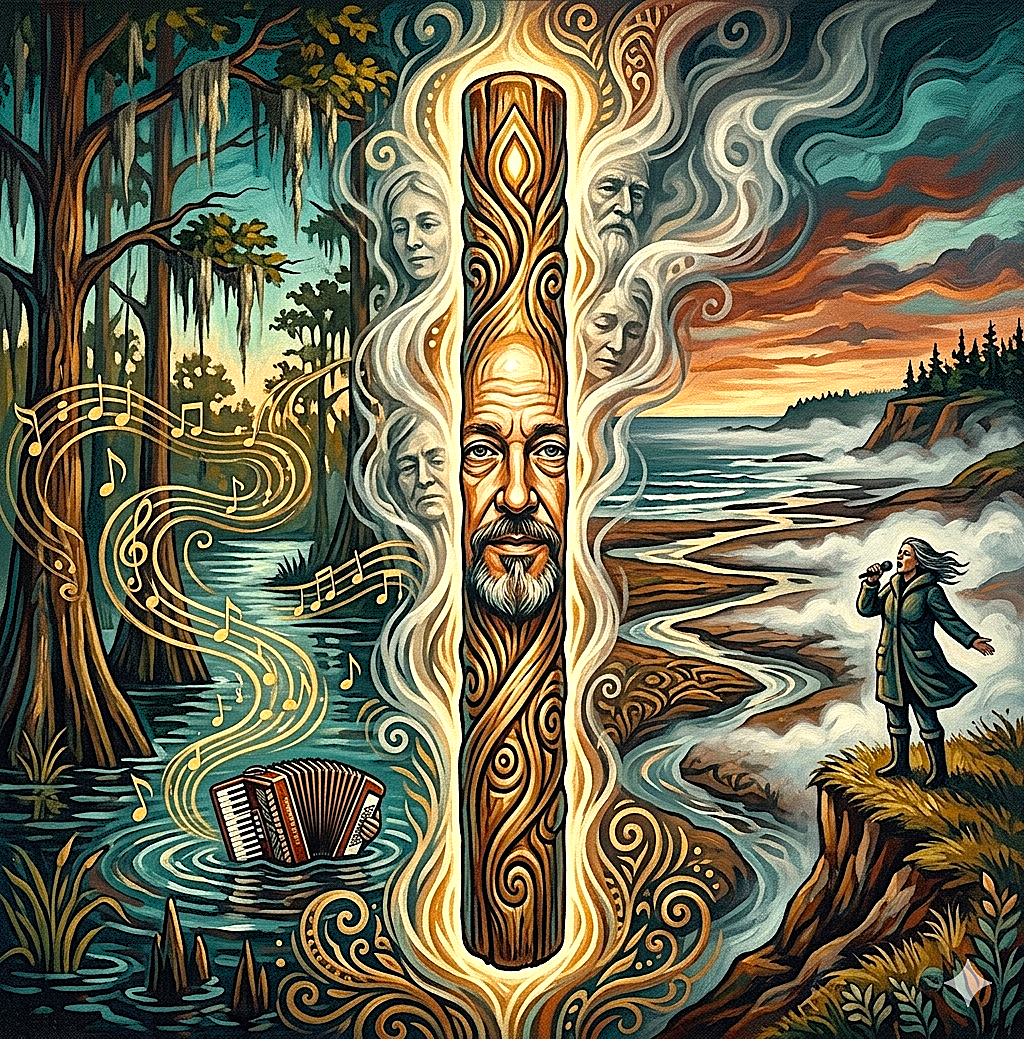
They told Woody Guthrie to leave politics to the politicians and Pete Seeger to keep his songs away from the picket line. History smiled and ignored that advice. Because every time an institution tried to silence the folk singer, the folk singer replied with melody. What humanity has learned, and keeps relearning, is that you can ban a concert—but not the echo.
From my window in Claregyle, Nova Scotia, with the Bay of Fundy breathing its ancient rhythm beyond my studio, that echo feels endless. Eighty songs deep into a catalog that local gatekeepers still don’t quite know how to file, I’ve come to understand something crucial: folk music is not nostalgia. It’s not a honky-ass, government-funded museum piece in Pubnico. It’s a living witness, an open wound that sings.
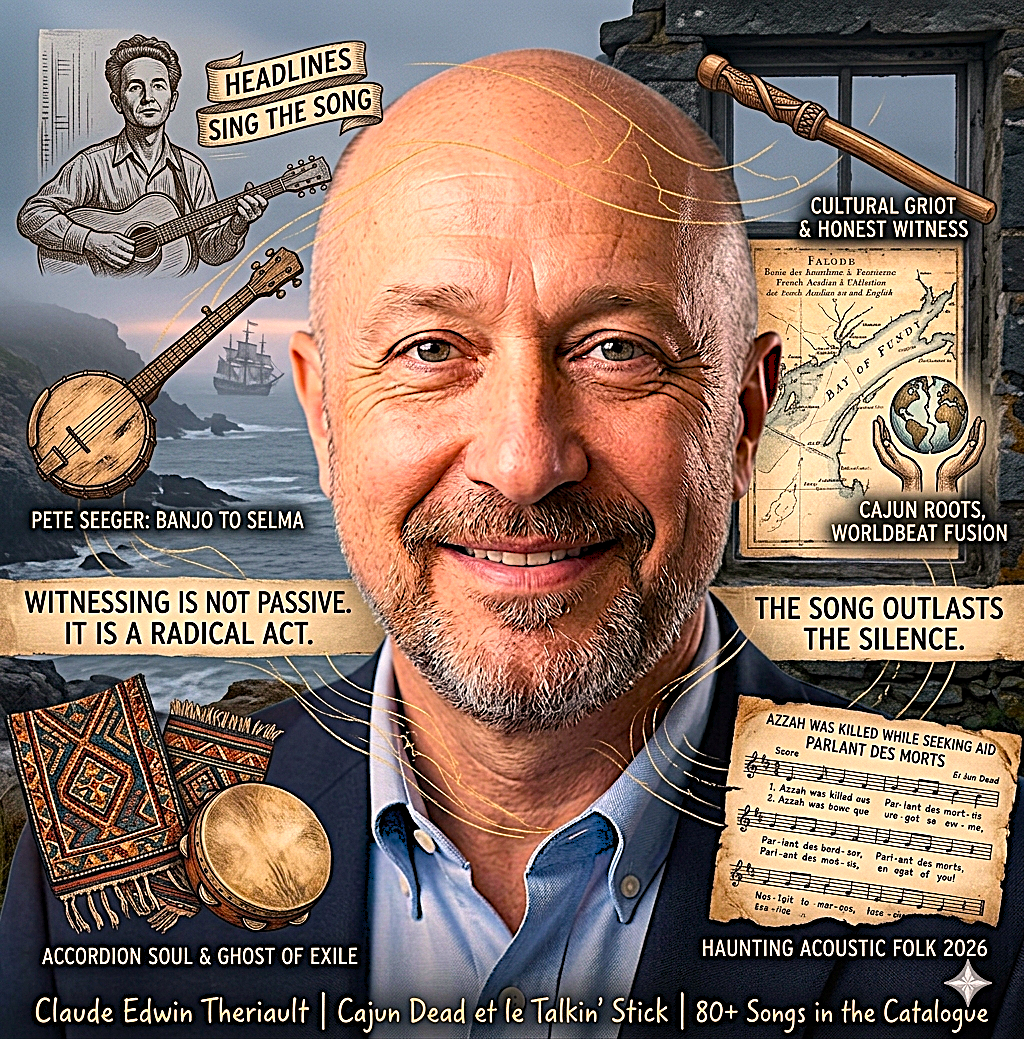
The Song as a Witness: Griot in Exile
When I composed Azzah Was Killed While Seeking Aid, I wasn’t chasing politics; I was chasing truth. The griot tradition doesn’t ask for permission to speak—its job is to hold memory when institutions fail. From the West African oral storytellers to Appalachian mountainside ballads, the griot’s purpose remains unchanged: take what the world wants to forget and sing it back to life.
That’s what Azzah attempts. It speaks in English and French—woven together the way the Acadian tongue once was—and carries a rhythm that pulls equally from Appalachia and North Africa. It’s not a song for radio rotation. It’s a song for the moral archive, a continuation of what the Library of Congress has been documenting since the 1930s: folk music as the democratic art form that sings truth to indifference.
Guthrie once said, “All you can write is what you see.” What I see from Claregyle is a global blind spot—a humanitarian fog where civilians die seeking food or shelter and the headlines move on before the candles go out. Folk music, honestly made, refuses that amnesia. It steps into silence and names what the institutions won’t.
The griot refuses the comfort of distance. Witnessing, in its truest form, is an act of rebellion. Every lament, every verse that names a tragedy rather than glossing over it, becomes a form of protest art—because to sing truth aloud in 2026, unfiltered and without corporate branding, is already radical.
Cajun Roots, Worldbeat Pulse: Folk as Human Story
People often ask what Cajun Dead et le Talkin’ Stick sounds like. I tell them it’s not a genre—it’s a geography of conscience. It’s the Acadian soul in exile, the Appalachian string meeting the frame drum, the Atlantic wind written in 3/4 time. The fusion of Cajun roots and worldbeat percussion isn’t a stylistic experiment; it’s a moral necessity.
Acadians were among the first displaced peoples of North America—torn from their homes in 1755 and exiled to Louisiana, scattering across the merciless geography of empire. In those echoes live countless other stories: Sudan, Gaza, and Haiti. Different languages, same human fracture. That’s why I call this music humanitarian folk: because it gathers the broken fragments of history and insists they still fit together.
When you listen to Parlant des Morts—Speaking of the Dead—you're hearing 400,000 years of exile condensed into one human cry. That’s the griot’s function, ancient and unflinching—to remind us that displacement isn’t new, just rebranded for each generation. The Smithsonian Folkways archive still holds decades of evidence that whenever folk speak truth, power resists it. Pete Seeger faced blacklists, Woody Guthrie was sidelined, and every form of censorship only proved how necessary the songs were.
Music becomes antifragile under pressure—it strengthens when the world cracks. That’s why this body of work will survive any algorithm that ignores it. It lives off-server, in the breath of whoever sings the words next. Folk isn’t a product. It’s a pulse passed hand to hand.

The Griot’s Dispatch: Atlantic Witness in the Machine Age
Cajun Dead and le Talkin' Stick aren't waiting for bureaucratic heritage validation. The self-appointed arbiters of “official Nova Scotia culture” haven’t known what to do with cross-temporal, trilingual griot work set to darbuka and Appalachian banjo. That’s fine. The future of folk doesn’t need permission slips; it needs courage and witness.
The complete archive of this project is detailed in the Cajun Dead et le Talkin' Stick song catalog, a living document where forty griot narratives converge: anti-war elegies, Acadian reparative anthems, ballads of migration, and love songs for the displaced.
My intent isn’t to fit within an Atlantic Canada category—it’s to rewire the conversation. The griot cannot exist within the heritage board’s taxonomy because the griot reports from outside the walls those boards were built to defend.
Humanitarian folk isn’t entertainment; it’s literature you can hum. It’s the instrument of conscience that doesn’t need the approval of industry tastemakers to know its mission. As the recent Newstrail feature on Azzah Killed While Seeking Aid From the Air Raid illustrates, this isn’t music that flatters the listener. It challenges them. It asks, “Where are you when others fall?”
That is, and has always been, the griot’s job—to be the last voice still singing truth after the official story signs off.
FAQs
1. What does “folk as moral witness” mean?
It means using song to expose what society prefers to remain hidden. Folk music has always been the art form that refuses silence when witnessing harm.
2. What inspired Cajun Dead et le Talkin’ Stick?
The project emerges from Acadian cultural memory and personal moral urgency—a blend of Louisiana Cajun roots, Nova Scotia exile history, and worldbeat groove that reclaims the griot tradition for modern humanitarian expression.
3. Why connect Cajun history to global crises today?
Because displacement and erasure are cyclical. From the 18th-century Acadian expulsion to modern refugee crises, it’s the same moral story told with new costumes.
4. What separates Cajun Dead’s music from modern “folk revival” projects?
It doesn’t imitate 1960s protest nostalgia. It updates the griot legacy for the 21st century—trilingual, percussive, hybrid—and uses storytelling as a humanitarian instrument, not just an aesthetic.
5. Where can people hear or study the project’s music?
All releases are available on Spotify, Boomplay, and YouTube. Critical essays and song notes live on moderncontemporaryartworktrends.com.
Claude Edwin Theriault is the founder of Cajun Dead et le Talkin’ Stick, a global griot-driven alt-folk project based in Claregyle, Nova Scotia. The catalogue now spans over eighty original compositions, interlacing Acadian memory, protest heritage, and worldbeat solidarity.